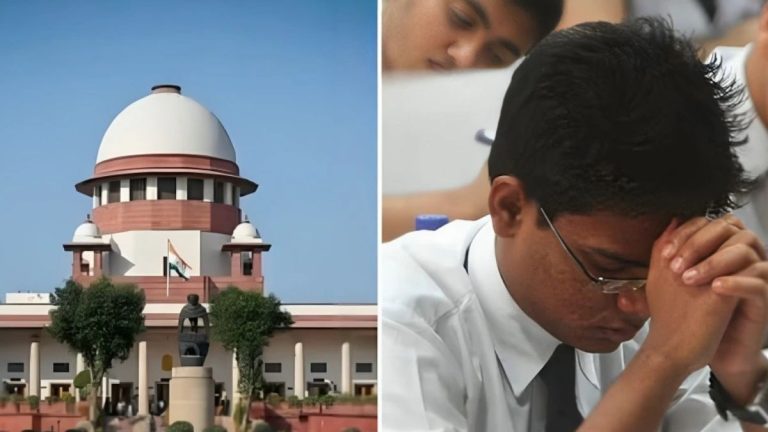
The Supreme Court has sought responses from the Centre, CBSE and NCERT over concerns regarding infrastructure, teachers
May 27, 2026: The Supreme Court of India on Wednesday questioned the Union government, Central Board of Secondary Education (CBSE), and National Council of Educational Research and Training (NCERT) over the practical feasibility of implementing the new three-language policy from the coming academic session. A bench led by Chief Justice of India Surya Kant issued notices seeking replies on petitions challenging the CBSE circular issued on May 15, 2026.
During the hearing, the bench repeatedly asked whether schools had adequate teachers, textbooks and logistical infrastructure to support the policy. The court observed that there appeared to be “issues of hardship, inconvenience and logistical support” linked to implementation. Senior advocates Mukul Rohatgi and Kapil Sibal, appearing for the petitioners, argued that schools and students were unprepared for the abrupt rollout and that the policy raised concerns related to federalism, educational continuity and freedom of language choice.
The petitions challenge the CBSE directive requiring Class IX students from July 1, 2026, to study three languages, with at least two being Indian languages. Petitioners argued that the move contradicted earlier assurances by CBSE that the rule would not apply before the 2029-30 academic session. The court has scheduled the next hearing for the second week of July and directed the Centre, CBSE and NCERT to file their responses within four weeks.