
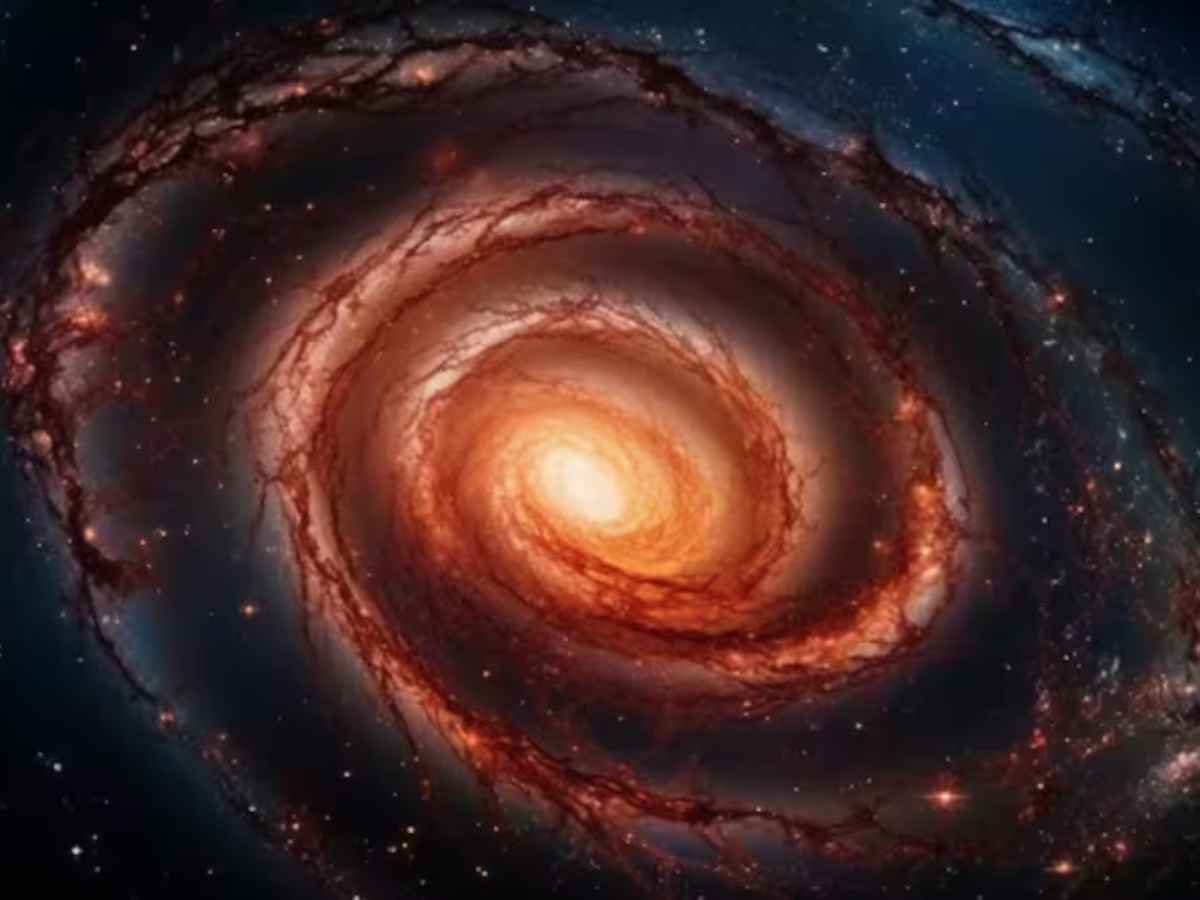


June 18, 2025: Giant Black Hole- Recent observations by NASA’s James Webb Space Telescope (JWST) have unveiled a perplexing cosmic anomaly: approximately 60% of early galaxies exhibit a consistent clockwise rotation. This discovery challenges the long-standing assumption that galaxy rotations are evenly distributed between clockwise and counterclockwise directions. Such a significant imbalance suggests the possibility of an underlying cosmic influence.
This phenomenon has led some scientists to propose the “Black Hole Cosmology” theory, which posits that our entire universe might reside within a massive, rotating black hole. According to this hypothesis, the rotation of the black hole could impart a uniform spin to all matter within it, including galaxies. This theory aligns with the observations made by JWST and offers a potential explanation for the observed galactic rotation patterns.
The implications of this theory are profound. If our universe is indeed inside a black hole, it could mean that black holes are not just destructive forces but also potential gateways to the birth of new universes. This concept aligns with the idea of a multiverse, where each black hole could lead to the formation of a new, isolated universe.
While this theory is still speculative and requires further investigation, it opens up exciting new avenues for understanding the fundamental nature of our universe. The JWST’s findings have provided a fresh perspective on cosmic evolution and have the potential to reshape our understanding of the cosmos.
As research continues, scientists hope to gather more data to confirm or refute the Black Hole Cosmology theory. Regardless of the outcome, these discoveries highlight the JWST’s pivotal role in advancing our knowledge of the universe and its origins.