
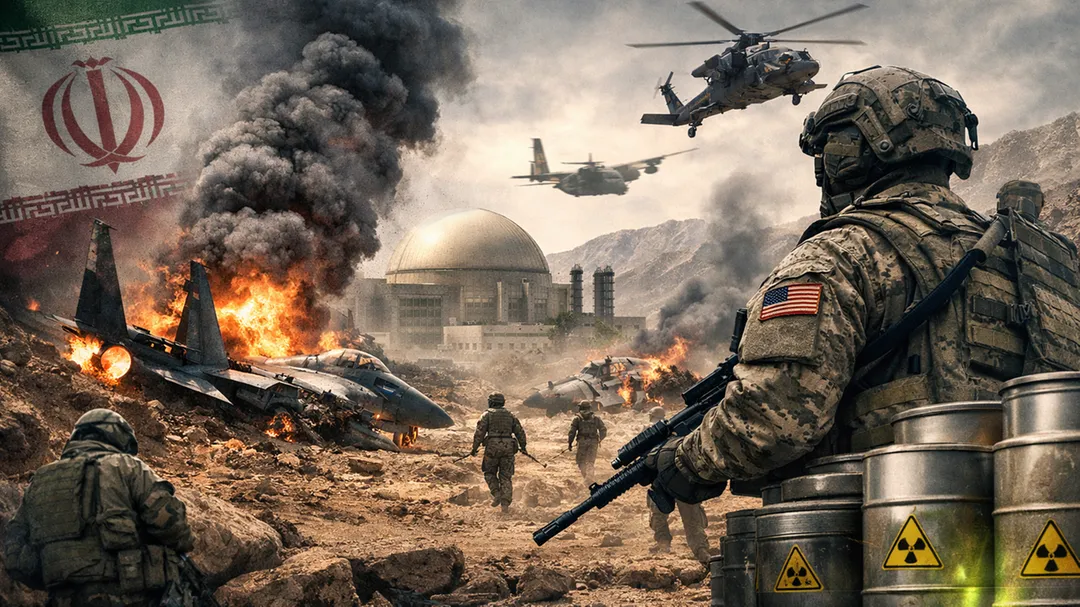


Iran has raised fresh questions about a high-risk American rescue mission conducted earlier this month, suggesting that the operation may not have been solely aimed at recovering a downed airman but could have been an attempt to seize enriched uranium.
The rescue mission followed the downing of a F-15E Strike Eagle operated by the United States Military in southwestern Iran. What initially appeared to be a dramatic search-and-rescue operation has since become the subject of competing claims between Washington and Tehran.
Iran Alters Position, Raises Doubts Over US Motives
On April 5, US forces carried out what American officials described as one of the most daring search-and-rescue missions in modern military history to recover an airman who went missing after the fighter jet was shot down.
However, Iran’s narrative evolved over time. Initially, Iranian officials claimed the rescue operation had been “foiled.” By Monday, the position shifted further, with Tehran suggesting the mission might not have been a rescue at all.
Iranian Foreign Ministry spokesperson Esmaeil Baqaei questioned the intent behind the operation.
“The possibility that this was a deception operation to steal enriched uranium should not be ignored at all,” Baqaei said, adding that numerous uncertainties remained regarding the mission.
He also pointed out that the location where the American pilot was reportedly hiding in Kohgiluyeh and Boyer-Ahmad Province was far from where US forces reportedly attempted to land in central Iran.
Baqaei described the mission as “a disaster” for the United States.
Why Iran’s Enriched Uranium Is a Global Concern
Iran is believed to possess between 400 and 450 kilograms of enriched uranium, an amount that experts say could contribute significantly to the production of nuclear weapons if further refined.
Reports published last week indicated that Donald Trump had considered the possibility of launching a ground operation in Iran to extract enriched uranium directly.
According to sources cited in those reports, Trump has encouraged advisers to push Tehran to surrender its nuclear material as part of any agreement to end the ongoing conflict.
He has also reportedly indicated to political allies that Iran should not be allowed to retain such material and has discussed the possibility of seizing it by force if negotiations fail.
Status of Iran’s Nuclear Material After Airstrikes
Before airstrikes launched by the United States and Israel in June 2025, Iran was believed to possess more than 400 kilograms of 60% highly enriched uranium and nearly 200 kilograms of 20% enriched fissile material, both of which could be further processed into weapons-grade uranium.
Much of this material is now believed to be buried under rubble following US strikes on mountainous nuclear facilities. Trump previously claimed that the bombings had “obliterated” Tehran’s nuclear programme.
However, Rafael Grossi, head of the International Atomic Energy Agency (IAEA), has indicated that significant nuclear material remains stored at key sites.
These locations reportedly include:
- An underground tunnel system at the nuclear complex in Isfahan
- A storage facility at Natanz
These findings suggest that Iran’s nuclear capabilities may not have been fully neutralised.
How the US Carried Out the High-Risk Rescue Operation
The rescue mission began on April 3, after the F-15E Strike Eagle was downed over southwestern Iran.
While the pilot was recovered shortly after the aircraft was hit, the search for the second crew member—a weapons systems officer—continued for nearly two days.
The rescue operation reportedly took place in southern parts of Isfahan province and is estimated to have cost the United States nearly $500 million.
The mission involved a large-scale deployment of military assets, including:
- A-10 Thunderbolt II jets
- MC-130J Commando II planes
- Black Hawk helicopters
- MQ-9 Reaper drones
- C-130 Hercules aircraft
- H-60 helicopters
Several of these assets were reportedly destroyed during the operation.
Elite US troops were inserted into Iranian territory under the cover of darkness, supported by aerial bombardment and suppressive fire designed to keep Iranian forces away from the rescue site.
Trump Says Injured Airman Is Recovering
President Donald Trump confirmed that the rescued airman had sustained injuries during the incident but reassured the public that the service member was expected to recover.
Trump described the operation as a major success for American forces, though the incident has further intensified tensions between Washington and Tehran.