
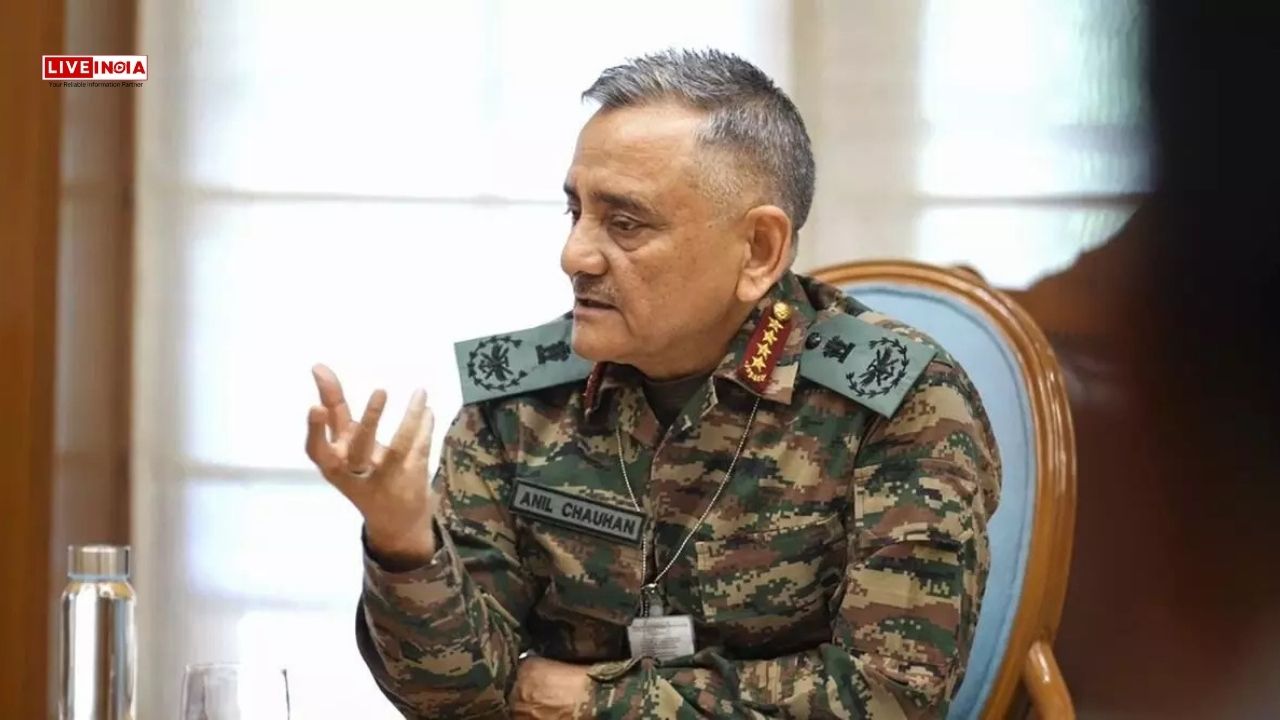


Chief of Defence Staff Gen Anil Chauhan says India swiftly rectified initial mistakes during the May 7-10 standoff and carried out precision strikes deep inside Pakistan.
June-1, 2025: India lost some of its fighter jets during the initial hours of the May 7-10 military standoff with Pakistan, Chief of Defence Staff (CDS) General Anil Chauhan revealed during media interactions in Singapore on Saturday. Speaking at the 22nd Shangri-La Dialogue and in interviews with Bloomberg TV and Reuters, Gen Chauhan stressed that while India faced early setbacks, it quickly identified and rectified the tactical mistakes, enabling the Indian Air Force (IAF) to mount a robust counterattack deep inside Pakistan.
Also Read: Law Student and Influencer Sharmistha Panoli Arrested Over Controversial Instagram Video
“What is important is not the jet being downed, but why it was downed,” said Gen Chauhan. “We understood the tactical mistake, remedied it, and then re-engaged Pakistan’s defences in large numbers with precision strikes at long range.”
Pakistan’s Claims of Six Indian Jets Downed ‘Absolutely Incorrect’
When asked about Pakistan’s assertion that it shot down six Indian jets during the intense aerial exchanges, Gen Chauhan dismissed the claims as “absolutely incorrect.” He confirmed that India did suffer losses but emphasized that it was part of combat operations. He did not specify how many jets were lost.
A spokesperson for the IAF declined to comment on Gen Chauhan’s remarks or the specific tactical errors.
Pinpoint Strikes, Rationality Amid Tensions
Gen Chauhan detailed how, after early losses, Indian forces regrouped and executed a series of precision strikes targeting Pakistan’s airbases and terror camps on May 7, 8, and 10. “We flew all types of aircraft with all types of ordnance, delivering strikes with pinpoint accuracy — in some cases to within a metre of the intended target,” he said.
He also highlighted the “rationality” displayed by both Indian and Pakistani military leadership during the intense exchanges. “There is a lot of room for conventional operations below the nuclear threshold, and I saw rationality in the thoughts and actions of both sides,” he noted, dispelling fears of escalation into a nuclear conflict.
Also Read: Pak Actress Hina Khawaja Bayat Slams Karachi Airport Says No Water In Washrooms
Operation Sindoor: A Decisive Counterstrike
The operation, launched in response to the April 22 Pahalgam terror attack that killed 26 people, saw India bomb nine terror camps in Pakistan and Pakistan-occupied Kashmir (PoK), while also striking 13 Pakistani military airbases and installations. Key airstrikes included hits on terror hubs at Markaz Subhanallah in Bahawalpur and Markaz Taiba near Muridke.
Also Read: Kerala Group Faces Heat for Hosting Shahid Afridi at Dubai Event Amid India-Pak Tensions
The Indian Army simultaneously launched artillery strikes at targets in Sialkot, Muzaffarabad, Kotli, Bhimber, and other areas. The IAF also targeted Pakistani military bases in places like Rafiqui, Chaklala, Rahim Yar Khan, Skardu, and Karachi’s Malir Cantt.
Air Force Prepares for Future Warfare
Reflecting on the changing nature of warfare, Air Chief Marshal AP Singh, in comments on May 29, said Operation Sindoor had underlined the evolving nature of modern conflict. “Every day we see new technologies coming in… Operation Sindoor has given us a clear idea of what we need for the future,” he stated, adding that the IAF is already working on realigning strategies and operational doctrines.
Operation Sindoor, though short-lived, marked a significant chapter in India’s resolve to respond to cross-border terror attacks with calibrated, conventional military force while maintaining restraint in the nuclear domain.
Tags:
Operation Sindoor, India-Pakistan clash, Gen Anil Chauhan, Indian Air Force, airstrikes, Pahalgam attack, cross-border tensions