
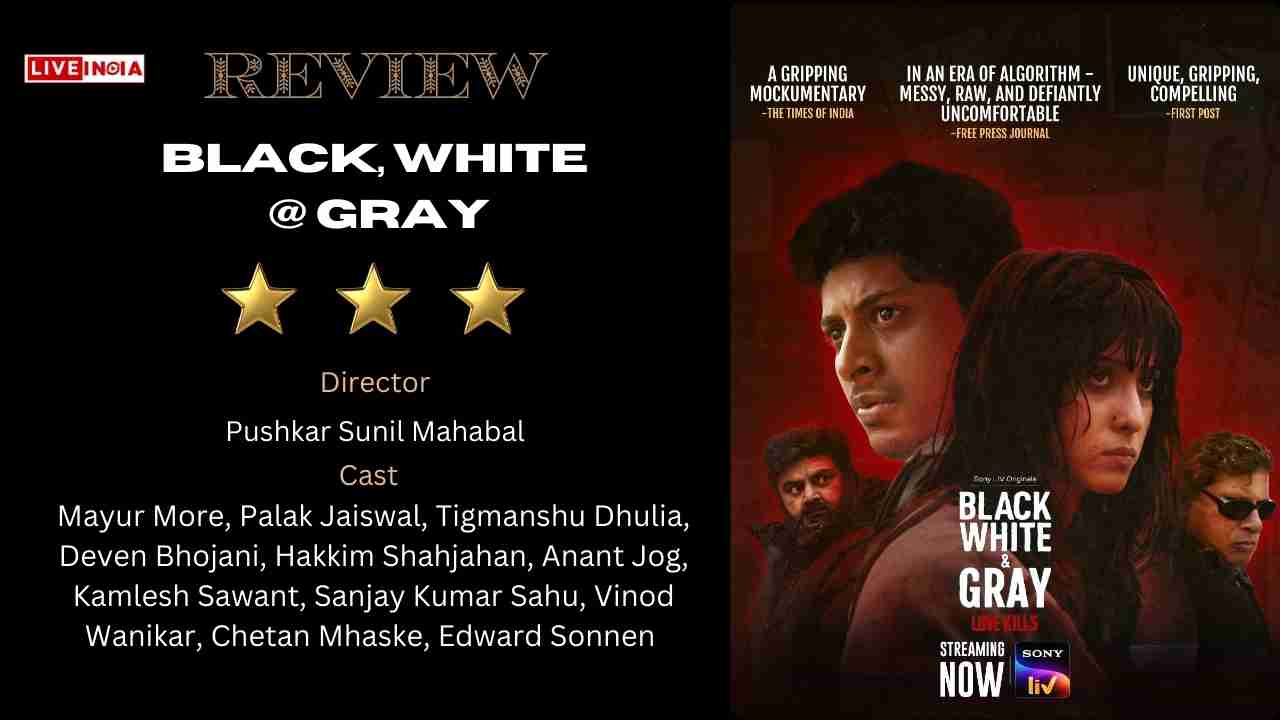


Pushkar Sunil Mahabal’s crime drama blends forbidden love, social critique, and documentary-style storytelling into a hauntingly effective narrative.
In Black, White and Gray: Love Kills, director Pushkar Sunil Mahabal offers a gripping tale of doomed love, framed by the harsh realities of caste, class, and patriarchy in India. Though it bears thematic echoes of earlier works on lovers-on-the-run, this six-episode series carves out a distinct space through its sharp character studies and smart, layered storytelling.
Cast: Mayur More, Palak Jaiswal, Tigmanshu Dhulia, Deven Bhojani, Hakkim Shahjahan, Anant Jog, Kamlesh Sawant, Sanjay Kumar Sahu, Vinod Wanikar, Chetan Mhaske, Edward Sonnen
Director: Pushkar Sunil Mahabal
Rating: ★★★☆
The Premise:
The story unfolds through a parallel narrative structure—one track follows a documentary filmmaker capturing the voices of people involved in a tragic love story, while the other dramatizes these events through fictionalized characters. At the heart of it all is a young couple—never named—who find themselves on the run, caught in a whirlwind of societal taboos and personal betrayals.
What Works:
Despite the occasionally clunky setup of documentary-meets-drama, Black, White and Gray is compelling because it stays emotionally grounded. The show doesn’t spoon-feed you moral lessons, but instead subtly hints at caste, class and systemic divides.
Mayur More and Palak Jaiswal bring freshness and conviction to their roles, portraying an unnamed young couple bound by intense affection but divided by everything else around them. Their chemistry is raw and believable, which adds an edge to the narrative. Meanwhile, Sanjay Kumar Sahu, playing the ‘real boy,’ delivers one of the most nuanced performances—his quiet, expressive face tells a story far deeper than words.
Veteran actor Tigmanshu Dhulia is a delight in a meaty role, reminding us why he should be doing more work in front of the camera. The supporting cast, including Deven Bhojani and Hakkim Shahjahan, round out the ensemble with grounded performances that help elevate the realism of the show.
What Doesn’t:
The show stumbles in its portrayal of media and journalism—attempts to recreate newsrooms feel theatrical and exaggerated. Some dialogues are overly on-the-nose, and the moral allegories can become a bit too loud. However, these flaws don’t dilute the power of the core story, which remains engaging and thought-provoking.
Final Verdict:
Black, White and Gray doesn’t revolutionize the genre, but it delivers a deeply affecting story with style and substance. It’s a rare love story that feels both modern and grounded in India’s complex social realities. Watch it for its honest performances, thoughtful direction, and a love story that refuses to be confined by societal lines.