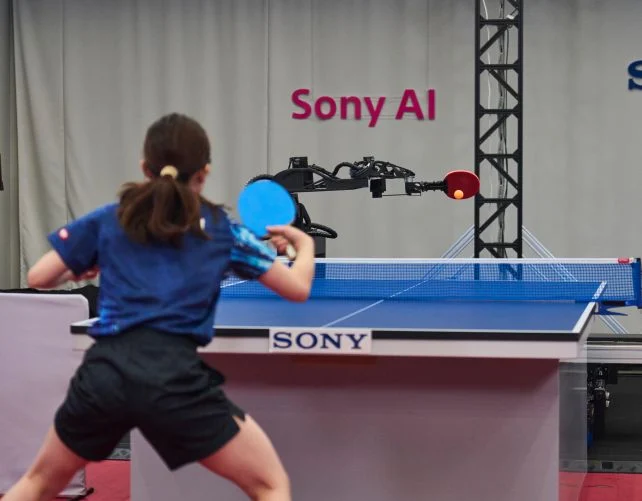
Engineers at Sony AI have developed a table tennis robot capable of defeating some of the world’s top amateur players, marking what researchers describe as one of the most significant advances in physical artificial intelligence to date.
The robot, named Ace, won three out of five matches against elite amateur players who had more than a decade of playing experience and typically trained around 20 hours each week. Across the series, Ace secured seven wins in 13 games against this group.
However, when tested against professional competitors from the Japanese league, the robot faced tougher resistance. Ace managed to win just one game out of seven and ultimately lost both matches against the professionals, highlighting that while the technology is advanced, it still has room for improvement at the highest competitive levels.
Researchers Call Achievement A Landmark In Physical AI
Peter Durr, director of Sony AI in Zurich and project lead for Ace, described the achievement as a milestone in robotics and artificial intelligence.
According to Durr, the research demonstrates that an autonomous robot can compete in a real-world sport, matching or even surpassing human reaction times and decision-making abilities in fast-paced physical environments.
Experts note that table tennis presents a unique challenge for robots compared to digital games such as chess or Go. Unlike virtual environments, physical gameplay requires the robot to track a rapidly moving ball, read its spin, decide the best response, and execute an accurate shot—all within fractions of a second.
Three Core Technologies Power The Ace Robot
The success of Ace is driven by three major technological systems working together seamlessly.
1. Advanced Perception System
Ace features a high-speed perception system designed to track the ball’s motion and accurately detect its spin. Spin detection has long been a major obstacle for table tennis robots because spin dramatically changes how the ball travels through the air and bounces off surfaces.
2. AI Decision-Making Through Reinforcement Learning
The robot’s tactical intelligence comes from deep reinforcement learning, a method where the AI trained itself by playing thousands of simulated matches. Instead of following fixed instructions, Ace learns patterns and strategies, allowing it to adapt to real-time gameplay situations.
3. Highly Agile Robotic Arm
Ace is equipped with an eight-jointed robotic arm capable of executing precise movements at high speeds. This mechanical agility allows the robot to deliver accurate returns and maintain consistent control during rallies.
Spin Detection Emerges As Key To Success
Detailed analysis of Ace’s matches revealed that its ability to detect spin was central to its performance. The robot successfully returned around 75 percent of spinning balls, handling a wide range of spin types with consistent accuracy.
Rather than relying on aggressive power shots, Ace often won points through controlled placement and steady rally management, surprising both players and observers.
During one match demonstration, former Olympian and table tennis expert Kinjiro Nakamura expressed astonishment at one of the robot’s unexpected shots, noting that such a move would be extremely rare even among skilled human players.
Implications Extend Far Beyond Sports
According to Peter Stone, the breakthrough has broader implications beyond competitive sports.
He explained that the research shows, for the first time, how an AI system can effectively perceive, reason, and act in complex and rapidly changing real-world environments that require precision and speed. This capability opens the door to applications in industries where human-level physical intelligence is required.
Potential future applications include:
- Advanced manufacturing systems
- Robotic surgery
- Warehouse automation
- Disaster-response robotics
- Precision industrial operations
Researchers believe such technologies could dramatically improve efficiency and safety in fields where human error or slow reaction times can be costly.
Study Published In Leading Scientific Journal
The full research findings on Ace have been published in the prestigious scientific journal Nature, further highlighting the significance of the achievement within the global research community.
Scientists say this breakthrough represents a crucial step toward creating robots capable of functioning autonomously in real-world environments, not just controlled laboratory settings.
Why Table Tennis Is A True Test For AI
Unlike static tasks, table tennis requires real-time adjustments based on unpredictable movement and physical forces. The robot must simultaneously:
- Track the ball’s speed and direction
- Identify spin type and intensity
- Predict bounce trajectory
- Select an optimal shot
- Execute the movement instantly
These combined requirements make table tennis one of the most demanding environments for robotics and AI development.
The Road Ahead: From Sports To Real-World Applications
While Ace has proven its capability against strong amateur players, researchers acknowledge that outperforming professional athletes consistently remains a long-term goal.
Still, the current progress signals a shift toward AI systems capable of functioning in dynamic environments—an area long considered one of the most difficult challenges in artificial intelligence.
As physical AI continues to evolve, innovations like Ace could redefine how robots interact with the real world, potentially transforming industries far beyond sports arenas.