
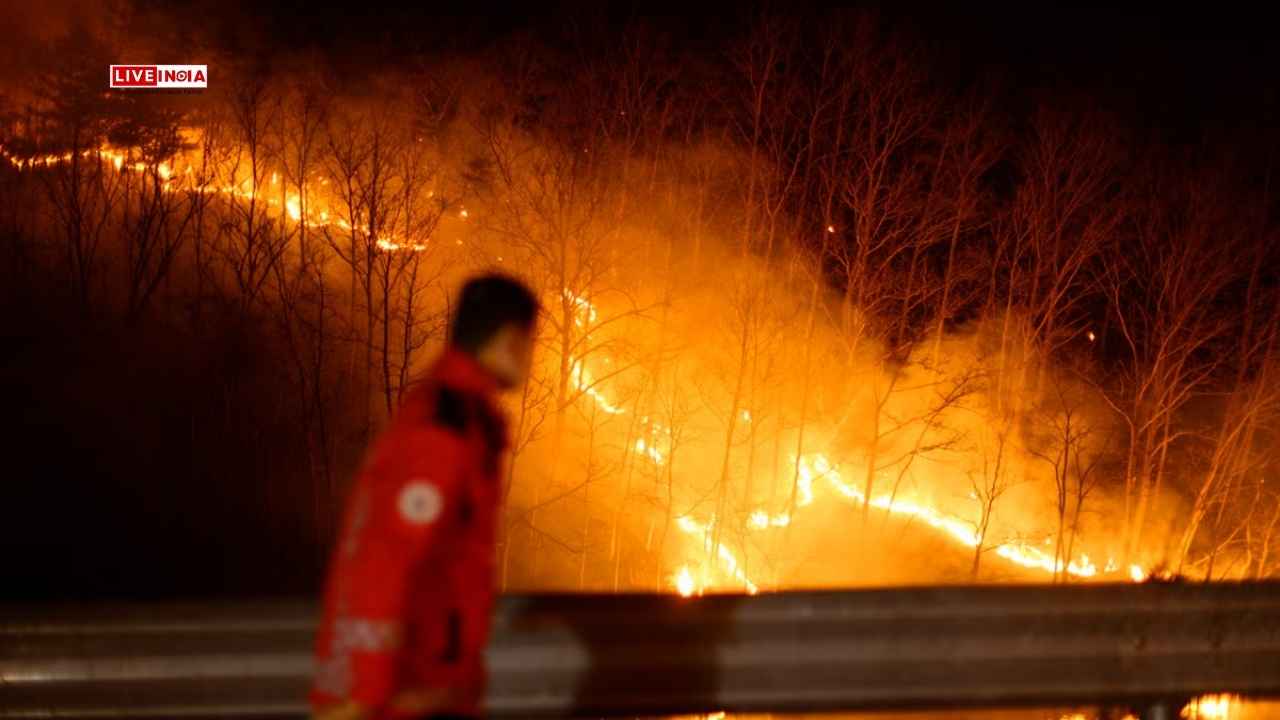


Unprecedented wildfires in South Korea’s southeast have claimed 27 lives and displaced over 37,000 people, as officials cite climate crisis and forest mismanagement.
Seoul | March 27, 2025 –
South Korea is grappling with the deadliest and most destructive wildfire in its recorded history, as officials confirm 27 fatalities and over 35,000 hectares of forest land scorched across the southeastern region.
Also Read: LA Wild Fires Rage On: Leave 24 Dead, Trigger Fire Tornadoes Amid Catastrophic Blaze
The fires began over the weekend, spreading rapidly due to unseasonably dry weather and strong winds, forcing more than 37,000 people to evacuate. Several major roads were cut off and communication lines went down as the fires raged.
BREAKING : Deadly wildfires spread further across SouthKorea on Monday as authorities designated 3 more counties 'special disaster zones'
— MOHAMMAD AHSAN (@MOHAMMAD_AARSH) March 26, 2025
At least 18 people have been killed & hundreds forced to flee their homes since blazes broke out in several areas, stoked by strong winds &… pic.twitter.com/PuR81b1R2c
According to the Ministry of Interior and Safety, the death toll includes elderly residents, three firefighters, and a helicopter pilot who died when his aircraft crashed during firefighting operations.
Also Read: US Woman Goes on Naked Rampage at Texas Airport, Bites and Stabs Staff With Pencil
South Korea’s WORST WILDFIRES IN DECADES: 18 dead, 19 injured
— Sputnik (@SputnikInt) March 26, 2025
Five days of fires in the country’s southeast have caused “unprecedented damage,” Han Duck-soo, South Korea’s prime minister and acting president, admitted. pic.twitter.com/llSmdgqJOw
“This is the largest wildfire event since 1987, surpassing even the devastating April 2000 fire that burned over 23,000 hectares,” said Lee Han-kyung, Chief of the Disaster and Safety Division.
Also Read: Sensex, Nifty Rise Despite Global Weakness: 10 Highlights From Thursday’s Market Rally
Deadly #wildfires continue to rage in southeastern #SouthKorea. The death toll has risen to 22, including four firefighters. Over 14,000 hectares have burned. #fire pic.twitter.com/72JSgWHeFA
— Shanghai Daily (@shanghaidaily) March 26, 2025
🔥 ‘Climate Crisis Unlike Anything Before’
Authorities warn that this tragedy reflects the escalating impact of climate change. While winter temperatures were close to the 30-year average, the affected regions received less than half their usual rainfall, creating a perfect storm for wildfires.
“This wildfire has once again exposed the harsh reality of a climate crisis unlike anything we’ve experienced before,” Lee added.
Experts agree that while climate change is a major factor, forest management policies have also contributed. South Korea’s forests, dominated by resin-rich pine trees, act like “oil-soaked paper,” said Professor Hong Suk-hwan of Pusan National University, explaining how flames spread rapidly in such conditions.
Had the government promoted natural mixed forests with more deciduous trees, the damage might have been mitigated, he added.
🏛️ Cultural Heritage at Risk
The blaze has also endangered cultural and historical landmarks.
- A 200-year-old pine tree at Bongjeongsa Temple, a UNESCO-listed site, had to be cut down to stop the fire from reaching the temple buildings.
- Firefighters are working tirelessly at Byeongsan Seowon, another UNESCO site, spraying tons of water and retardants daily.
- “If the wind turns, it could carry flames from afar,” said firefighter Choi Young-ho at the scene.
Officials hope that rain forecast for Thursday evening will offer a critical opportunity to contain the blaze.
🏷️ Tags:
South Korea wildfire 2025, climate crisis, South Korea forest fire deaths, Andong fire, UNESCO sites wildfire, wildfire death toll, Korean weather, climate change, Rajiv Gandhi International Stadium, global warming impact, Asia wildfires