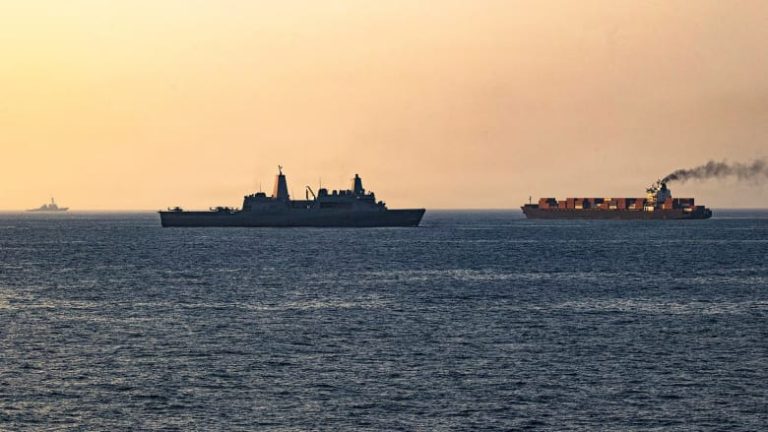
New Delhi: In a sharp escalation of tensions in the Persian Gulf, Donald Trump on Thursday announced that he has ordered the United States Navy to “shoot and kill” any small Iranian boats found laying mines in the strategically vital Strait of Hormuz.
The directive was shared through a social media post shortly after US forces seized another tanker suspected of involvement in the smuggling of Iranian crude oil. The move has further intensified the ongoing standoff between Washington and Tehran, as the waterway handles nearly 20% of the world’s crude oil and liquefied natural gas trade.
Trump Orders Immediate Military Response To Mine-Laying Boats
In his statement, Trump made it clear that US naval forces have been instructed to act decisively against perceived threats in the strait.
“I have ordered the United States Navy to shoot and kill any boat, small boats though they may be, that is putting mines in the waters of the Strait of Hormuz,” Trump posted.
“There is to be no hesitation. Additionally, our mine ‘sweepers’ are clearing the Strait right now.”
He further said that mine-clearing operations in the region are being intensified, with activity levels tripled to ensure maritime safety.
The announcement follows a recent incident in which Iranian paramilitary forces reportedly attacked three cargo vessels in the strait, capturing two of them. These developments have significantly heightened fears of prolonged instability in the region.
US Seizes Tanker Linked To Iranian Oil Smuggling
The United States Department of Defense released video footage showing American personnel boarding the Guinea-flagged oil tanker Majestic X, which was seized in the Indian Ocean.
According to ship-tracking data, the tanker was located between Sri Lanka and Indonesia, roughly in the same region where another vessel, Tifani, had earlier been intercepted by US forces.
The vessel had previously operated under the name Phonix and was sanctioned in 2024 by the United States Department of the Treasury for transporting Iranian oil in violation of US sanctions.
Officials said the tanker had been headed toward Zhoushan, a key destination for energy shipments.
Iran has not issued any immediate official response to the seizure.
Ceasefire Remains Fragile Amid Continued Military Activity
Just days earlier, Trump had extended a ceasefire arrangement while maintaining an American blockade of Iranian ports. However, there is still uncertainty about whether diplomatic negotiations will resume.
Peace talks had previously been discussed in Islamabad, but officials have not confirmed any new meeting schedule.
Since the outbreak of hostilities on February 28 involving Iran, Israel, and the United States, more than 30 vessels have reportedly been attacked across the Persian Gulf, the Strait of Hormuz, and the Gulf of Oman.
These attacks, combined with rising insurance costs and security risks, have significantly disrupted shipping through the region.
Exiled Iranian Crown Prince Targeted In Berlin Incident
Amid the escalating tensions, Reza Pahlavi was attacked during a public appearance in Berlin.
The 65-year-old royal was splashed with red liquid as he exited a building after addressing reporters. Police detained the suspected attacker immediately.
During the event, Pahlavi criticised the ceasefire between the United States and Iran, warning that it assumes the Iranian government will change its behaviour.
“You’re going to deal with people who all of a sudden have become pragmatists,” he said, expressing doubts over the effectiveness of the agreement.
Pahlavi has lived in exile for nearly five decades since the Iranian Revolution, which forced his father, the Shah of Iran, from power.
Global Trade Disruptions Continue To Mount
The ongoing confrontation has effectively choked off much of the commercial shipping traffic through the Strait of Hormuz — one of the world’s most critical maritime routes.
Iran’s ability to disrupt passage through the narrow waterway remains a powerful strategic tool in the conflict. The disruption has already caused:
- Sharp increases in global energy prices
- Rising insurance premiums for cargo vessels
- Delays in international supply chains
- Increased food and fuel costs across multiple regions
Officials worldwide have warned that the economic impact of the crisis could be long-lasting, affecting businesses, consumers, and national economies alike.