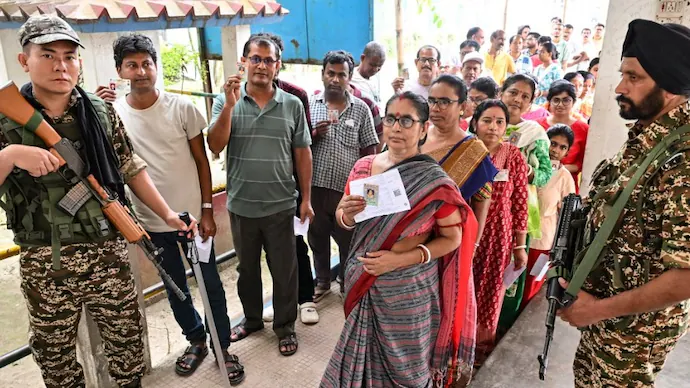
Polling for Phase 1 of the 2026 West Bengal Assembly elections concluded on Thursday across 152 constituencies, marking a significant milestone in what is shaping up to be a closely contested election. The first phase covered politically crucial regions of the state and has set the tone for the second and final phase of voting scheduled for April 29.
Chief Election Commissioner Gyanesh Kumar announced that Phase 1 witnessed a record voter turnout of 91.4%, the highest ever recorded in the region since Independence.
High-Stakes Contest Between TMC, BJP And Congress-Left Alliance
The election battle is being closely watched as Chief Minister Mamata Banerjee seeks another term for the ruling All India Trinamool Congress (TMC).
Meanwhile, the Bharatiya Janata Party (BJP) is aiming to expand its influence after emerging as the principal opposition in the 2021 elections. The Congress-Left alliance is also attempting to regain lost ground by highlighting issues such as price rise, unemployment and rural distress.
Official counting of votes for all 294 Assembly seats will take place on May 4, when the final results will determine the next government in the state.
Key Battleground Regions Covered in Phase 1
The opening phase included several politically sensitive and diverse regions, such as:
- North Bengal
- Jangalmahal region
- Parts of South Bengal
- Several border districts
These areas have historically delivered mixed mandates and often play a decisive role in shaping the overall electoral outcome.
The constituencies in Phase 1 represent a mix of urban, semi-urban, rural, tribal and minority-dominated seats, making them strategically important for all major parties.
According to data from the Election Commission of India (ECI), 1,478 candidates contested in this phase.
- The TMC fielded sitting legislators and local strong candidates, banking on governance and welfare schemes.
- The BJP focused its campaign on law and order, corruption and employment issues.
- The Congress-Left alliance targeted rising prices, joblessness and rural hardships.
- Several smaller regional parties and independent candidates also contested in multiple constituencies.
Massive Security Deployment Across Polling Stations
To ensure peaceful voting, the Election Commission rolled out extensive security arrangements across the polling regions.
Key security measures included:
- Identification of over 8,000 polling booths as “super sensitive”
- Categorisation of 55 constituencies as expenditure-sensitive
- Deployment of central armed forces and state police personnel
- Installation of webcasting systems and appointment of micro-observers
Authorities also conducted intensive monitoring during the campaign period. Enforcement agencies reported seizures of cash, liquor, drugs and freebies, indicating efforts to curb inducements and illegal campaign practices.
Despite isolated complaints about EVM malfunctions, long queues and minor clashes between rival groups, officials said polling remained largely peaceful overall.
When Will Exit Poll Results Be Released?
Under Section 126A of the Representation of the People Act, the publication or broadcast of exit polls is prohibited until voting in all phases of an election is completed.
Since West Bengal is voting in two phases, exit polls will be released only after the final phase concludes on April 29.
Voting for Phase 2 is expected to end around 6 p.m., after which broadcasters are likely to begin releasing exit poll results from 7 p.m. onwards.
What Is an Exit Poll And How Does It Work?
An exit poll is a post-voting survey conducted by polling agencies immediately after voters leave polling booths.
In this process:
- Voters are asked which candidate or party they voted for
- Responses are collected from a representative sample of voters
- Data is adjusted using demographic factors such as:
- Region
- Gender
- Caste
- Age
- Rural-urban distribution
- Previous voting patterns
Based on this analysis, polling agencies estimate vote share percentages and seat projections.
However, exit polls are predictions, not official results, and final outcomes may differ from the forecasts declared after counting.