


In a landmark escalation, U.S. President Donald Trump declares Fordow “gone” following a successful airstrike on key Iranian nuclear facilities; spotlight turns to Iran’s widespread uranium enrichment network.
Vienna, June 22: U.S. President Donald Trump on Saturday confirmed that American military forces conducted a “very successful attack” on Iranian nuclear sites, including the fortified underground facility at Fordow, marking a dramatic escalation in the ongoing Israel-Iran conflict. Trump’s statement came just days after Israel launched its own attacks on Iran’s Natanz and Khondab nuclear installations. As the world reacts to this seismic military action, attention has now shifted to the strategic depth and resilience of Iran’s nuclear infrastructure, which spans multiple locations across the country.
Iran’s Nuclear Infrastructure Under Attack: A Breakdown
📍Where Are Iran’s Nuclear Sites?
Iran’s nuclear program is scattered across the country, with several facilities built underground to survive aerial assaults. The U.S. strike targeted Fordow, Natanz, and Esfahan — central to uranium enrichment and fuel fabrication activities.
❗ Does Iran Have a Nuclear Weapons Program?
Despite Tehran’s denials, both the United States and the IAEA believe Iran halted a coordinated nuclear weapons program in 2003. Under the 2015 nuclear deal, Iran agreed to restrict nuclear activities in return for sanctions relief. But Trump’s 2018 withdrawal from the deal led to Iran ramping up enrichment, edging closer to weapons-grade uranium levels.
⚛️ Iran’s Enrichment Surge
- Iran is now enriching uranium up to 60% purity at two sites — perilously close to the 90% required for weapons-grade material.
- The IAEA estimates Iran has enough enriched material for six bombs if further refined.
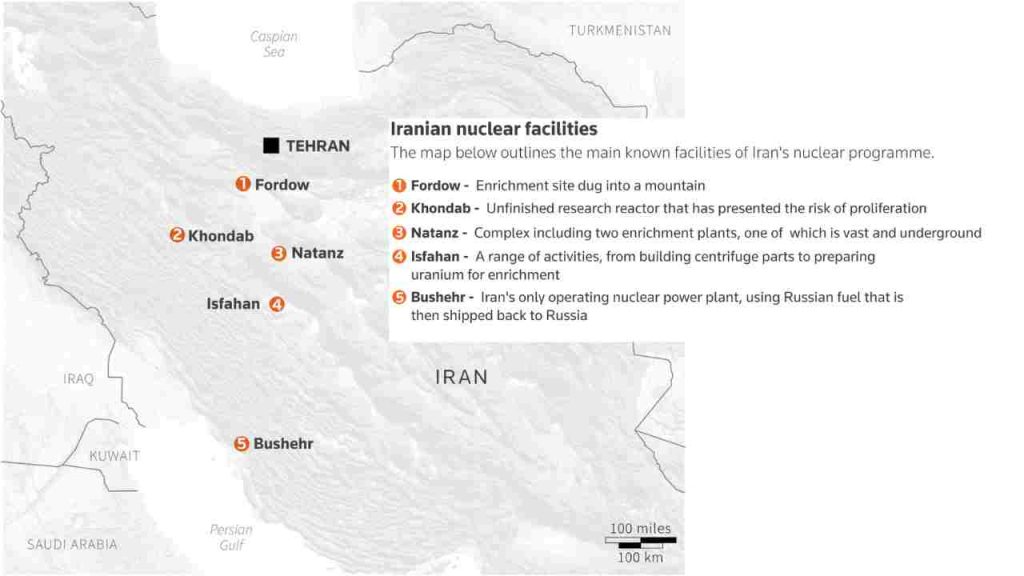
🏗️ Targeted Sites and Their Strategic Importance
➡️ Natanz
- Iran’s largest enrichment hub near Qom.
- Houses both the underground Fuel Enrichment Plant (FEP) and above-ground Pilot Plant.
- Before the strikes, ~16,000 centrifuges operated here.
- Previously damaged by sabotage in 2021, allegedly by Israel.
➡️ Fordow
- Deep inside a mountain near Qom; fortified against strikes.
- About 2,000 centrifuges operated here, including advanced IR-6s.
- Trump claimed in his post-strike statement: “Fordow is gone.”
- Previously prohibited from enrichment under the 2015 deal.
➡️ Isfahan
- A major nuclear industrial zone.
- Includes uranium conversion and storage facilities.
- Houses tools for uranium metal production and centrifuge part fabrication — both crucial for potential weapons development.
➡️ Khondab (Formerly Arak)
- A heavy-water research reactor, halted under the 2015 pact.
- Could produce plutonium, another path to nuclear weapons.
- Iran aims to restart operations by 2026.
➡️ Tehran Research Centre & Bushehr
- The capital hosts a nuclear research reactor.
- Bushehr, Iran’s only operational nuclear power plant, is considered low-risk due to Russian fuel management.
📉 Global and Market Implications
Trump’s bold military move sent tremors through diplomatic and financial circles. While some analysts predict oil price spikes and market volatility, others suggest Iran may be forced into a peace agreement amid its weakened nuclear posture.