
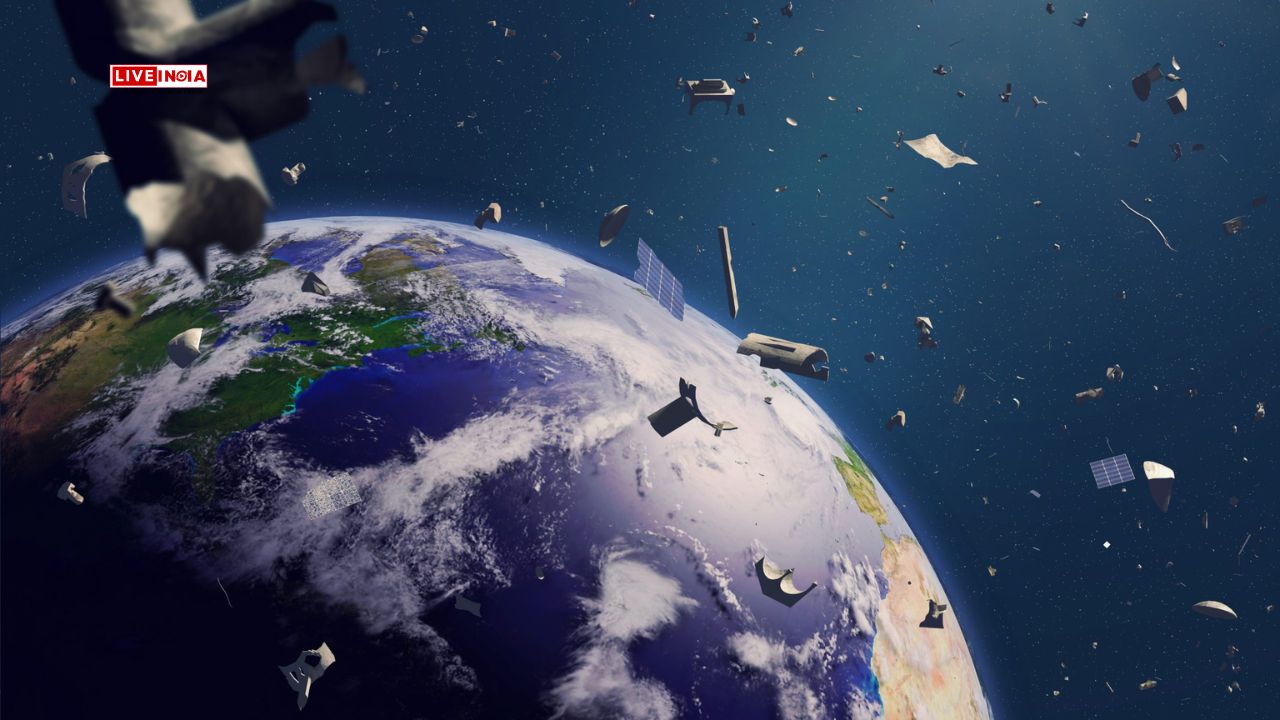


A new ESA report warns of escalating space debris, with over 1,200 re-entries in 2024 alone, risking a catastrophic chain reaction that could end safe space operations.
April 5, 2025: The European Space Agency (ESA) has raised alarm bells after confirming that more than 1,200 objects re-entered Earth’s atmosphere in 2024, fueling concerns over the increasingly dangerous accumulation of space debris and the growing likelihood of a catastrophic phenomenon known as the Kessler Syndrome.
Also Read: Puffy Head, Chicken Legs: Sunita Williams’ Road to Recovery After 9 Months in Space
According to the ESA’s latest space safety report, the number of objects crashing back to Earth is growing rapidly due to increased launch activity, rising solar activity, and a crowded Low Earth Orbit (LEO), where thousands of satellites now operate.
Also Read: Russia Launches Mysterious Satellites Into Earth’s Orbit, Sparks Spy Mission Speculation
“Intact satellites or rocket bodies are now re-entering Earth’s atmosphere on average more than three times a day,” the ESA stated.
💥 Kessler Syndrome – A Real Risk?
Originally proposed in 1978 by NASA scientist Donald J. Kessler, the Kessler Syndrome predicts a domino effect of orbital collisions. Once a critical density of objects is reached, collisions could generate more debris, leading to more collisions, and ultimately rendering certain orbits unusable for generations.
Also Read: Why Myanmar’s Earthquake Was So Catastrophic: Scientists Explain the Seismic Forces
This scenario, once theoretical, is now becoming alarmingly plausible.
“Even if spaceflight operations stopped today, debris objects in LEO would continue to rise due to fragmentation events,” warned the report.
🚨 Space: The New Junkyard
There are currently over 1.2 million debris objects larger than 1 cm floating in orbit—each capable of crippling satellites or endangering the International Space Station (ISS).
According to NASA, about 6,000 tons of materials are floating in Earth’s orbit. With the rise of private satellite networks like Starlink, that number is expected to grow sharply in the coming years.
🧹 A Need for Cleanup
ESA stressed the urgent requirement for active debris removal to prevent runaway collisions and keep LEO operational.
“To prevent this runaway chain reaction, active debris removal is required,” the report emphasized.
☄️ Space Junk Re-entries on the Rise
The report also documented notable debris crashes:
- In December 2024, Kenya’s Mukuku village saw a 500 kg rocket fragment crash down, confirmed by the Kenya Space Agency (KSA).
- In March 2025, a piece of SpaceX’s Falcon 9 rocket crash-landed in Poland, after an uncontrolled atmospheric re-entry.
Both incidents underline the growing frequency—and unpredictability—of space debris descending to Earth.
🧠 What’s Next?
With the space industry booming, and commercial spaceflight on the rise, experts are now calling for:
- International cooperation on debris mitigation,
- Stricter regulations on orbital traffic,
- And investment in clean-up technologies.
As humanity’s orbit gets more crowded, the race is on—not just to explore the stars, but to protect our pathway to them.
🏷️ Tags:
Kessler Syndrome, space debris, ESA report, Low Earth Orbit, space collisions, space junk, satellite safety, ISS, uncontrolled re-entry, SpaceX debris, space crash, space pollution, orbital crowding, active debris removal, Starlink