


June 22, 2025: Iran Nuclear Sites Map– In a dramatic escalation of the ongoing Iran-Israel conflict, U.S. President Donald Trump confirmed that the United States has launched targeted airstrikes on three of Iran’s most critical nuclear facilities: Fordow, Natanz, and Isfahan.
In a post on Truth Social late Saturday, Trump called the operation a “complete and total obliteration” of Iran’s nuclear infrastructure and issued a stern warning: “Any Iranian retaliation will be met with far greater force.”
However, Iranian officials have downplayed the damage, describing the strikes as “superficial” and claiming minimal impact, particularly at the highly fortified Fordow facility.
What We Know About the Targeted Sites:
Natanz Nuclear Complex
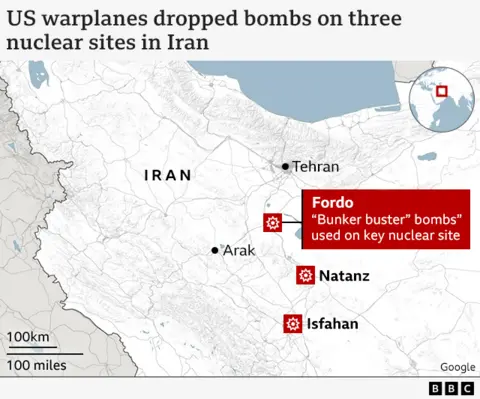
Located about 250 kilometers south of Tehran, Natanz is widely regarded as Iran’s largest uranium enrichment facility. It houses six above-ground buildings and three fortified underground structures, capable of holding up to 50,000 centrifuges.
Recent International Atomic Energy Agency (IAEA) reports confirmed that Iran was enriching uranium up to 60% purity here—just shy of the 90% required for weapons-grade material.
The U.S. strikes reportedly destroyed above-ground portions of the Pilot Fuel Enrichment Plant and disabled power supply to lower underground levels, targeting equipment necessary for uranium enrichment.
Fordow Fuel Enrichment Plant
Built deep within a mountain near the holy city of Qom, Fordow is Iran’s most heavily protected nuclear facility. Intelligence reports indicate the site lies up to 90 meters underground, making it impervious to most conventional missiles.
The facility currently holds 2,700 advanced centrifuges, and experts from the Institute for Science and International Security (ISIS) warn that Iran could use it to produce enough weapons-grade uranium for nine nuclear bombs within three weeks.
While Iranian lawmakers claim Fordow sustained only minor damage, analysts emphasize that only a U.S. bunker-buster bomb like the GBU-57 could reach the site’s underground halls.
Isfahan Nuclear Research Center
Home to Iran’s largest nuclear research infrastructure, Isfahan plays a central role in nuclear fuel development. Originally built with Chinese assistance in the 1980s, the site includes:
- Three Chinese-supplied research reactors
- A fuel production plant
- A zirconium cladding facility
- A uranium conversion plant
With an estimated 3,000 scientists working on site, Isfahan is suspected to be the intellectual and technical heart of Iran’s nuclear ambitions.
Iran Vows Consequences
Iran’s Foreign Minister Seyed Abbas Araghchi condemned the strikes as a “grave violation of international law” and the UN Charter. In a statement on X (formerly Twitter), he warned the U.S. that its actions would have “everlasting consequences.”
Despite the attacks, Iranian officials reassured citizens that residents face no immediate danger, and its atomic agency vowed to continue its nuclear program.
Global Implications
The attacks have further escalated the already volatile situation in the Middle East. As diplomatic efforts flounder, fears are growing that the conflict may spiral into a broader regional war involving multiple nations.
The Strait of Hormuz, a key oil shipping route, remains under close watch as Iranian officials hint at possible retaliatory action—including potential naval blockades and missile strikes against U.S. military installations in the region.