
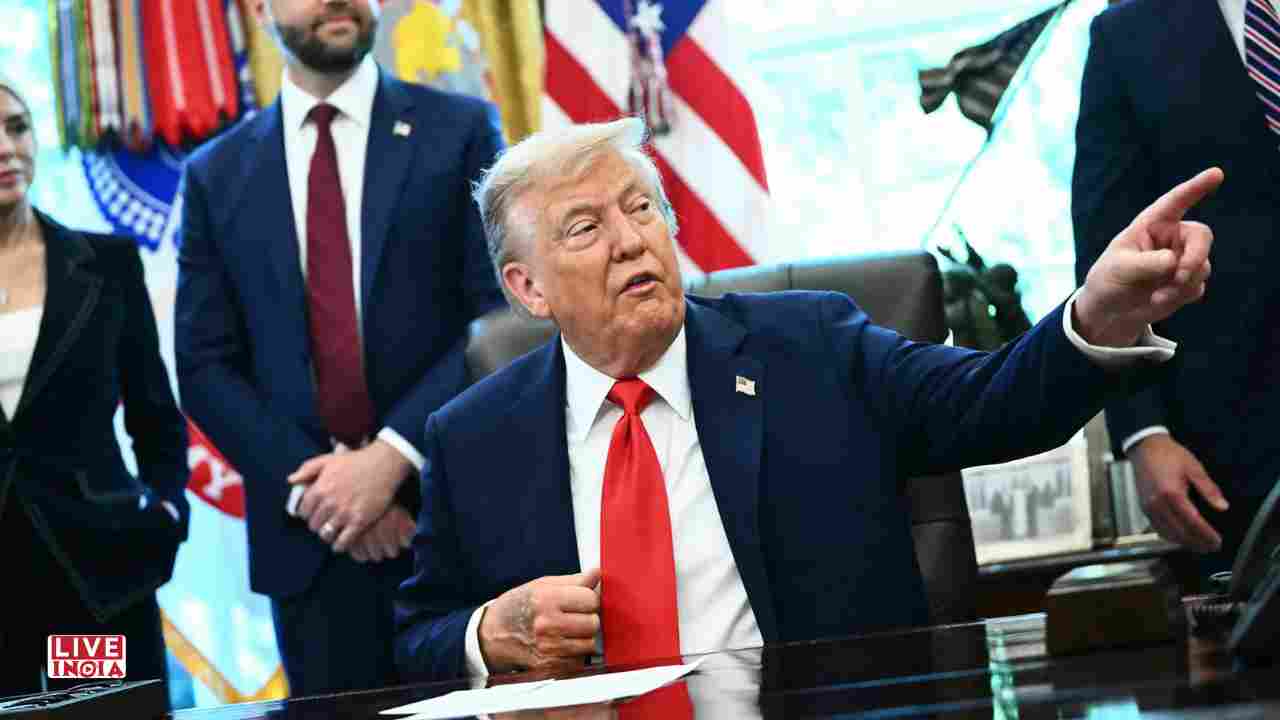


U.S. President highlights role of tariffs, diplomacy, and “economic leverage” in stopping global wars
Washington D.C., August 26 — U.S. President Donald Trump has once again emphasized his self-proclaimed success in preventing wars during his presidency, including what he described as a near-nuclear conflict between India and Pakistan.
Speaking during a bilateral meeting with the President of South Korea, Trump claimed that his administration stopped seven wars, including one that nearly pushed South Asia to the brink of catastrophe.
“I stopped 7 wars that were raging… including India and Pakistan that was probably two weeks away from being a nuclear war. They were shooting down airplanes all over the place. I am very proud of that,” Trump said.
Tariffs as a tool for diplomacy
Linking his conflict-prevention strategy to economic pressure, Trump argued that tariffs and trade restrictions became his administration’s most powerful weapon to deter war.
“Of the 7 wars I stopped, 4 were because I had tariffs and trade. I was able to say, ‘If you go fight and want to kill everybody, that is okay, but I am going to charge you each a 100% tariff when you trade with us.’ They all gave up,” Trump added.
He claimed that tariffs not only brought in “trillions of dollars” in revenue but also created a deterrence strong enough to keep several conflicts from escalating.
JD Vance defends sanctions on India
Trump’s remarks came as U.S. Vice President JD Vance defended Washington’s decision to impose secondary sanctions and tariffs on India. The measures are part of the administration’s wider push to apply “aggressive economic leverage” against Russia amid its ongoing war in Ukraine.
In an interview with NBC’s Meet the Press, Vance said the tariffs were aimed at cutting off Russia’s oil-driven economy:
“The President has applied aggressive economic leverage, for example, the secondary tariffs on India, to try to make it harder for the Russians to get rich from their oil economy. He has tried to make it clear that Russia can be reintegrated into the world economy if it stops the killing, but they are going to continue to be isolated if it doesn’t.”
Sanctions as leverage against Moscow
Vance acknowledged that sanctions alone may not force Russian President Vladimir Putin into a ceasefire, but he insisted they remain a critical negotiating tool.
“Sanctions are not off the table, but we are going to make these determinations on a case-by-case basis. What we do think is actually going to exert the right kind of leverage to bring the Russians to the table? … If we look at the way Russians have conducted themselves, they don’t want a ceasefire. They don’t want to cease for complicated reasons,” Vance said.
The Vice President stressed that the Trump administration has applied more economic pressure on Moscow than any previous U.S. government, suggesting that further escalation remains possible.
Pressure on China
When asked why Washington has not enforced similar sanctions on China, the world’s largest buyer of Russian oil, Vance pointed out that the U.S. already has a 54% tariff on Chinese goods.
“We have already applied pretty hefty sanctions on the Chinese and we have had a number of conversations at all levels of government to try to encourage the Chinese to be better partners in bringing this war to a close,” he explained.
He added that tariffs could be adjusted depending on diplomatic progress, signaling flexibility: “Maybe we will apply additional pressure, or maybe we feel like we are making progress, and we will dial that pressure back.”
Washington’s push for a diplomatic solution
Vance also reaffirmed Washington’s commitment to long-term security guarantees for Ukraine, ensuring it will not be left vulnerable to future invasions.
“It is providing the Ukrainians the kind of security guarantees that ensure the country is not going to be invaded again. This is why I think we have made a lot of progress, even though we are not there yet.”
Highlighting the White House’s broader strategy, Vance said: “We are trying to negotiate as much as we can with both the Russians and the Ukrainians to find a middle ground to stop the killing. This war is not in anyone’s interest — not Europe’s, not the United States’, and not even Russia’s or Ukraine’s. We are going to keep pushing for a diplomatic solution.”