
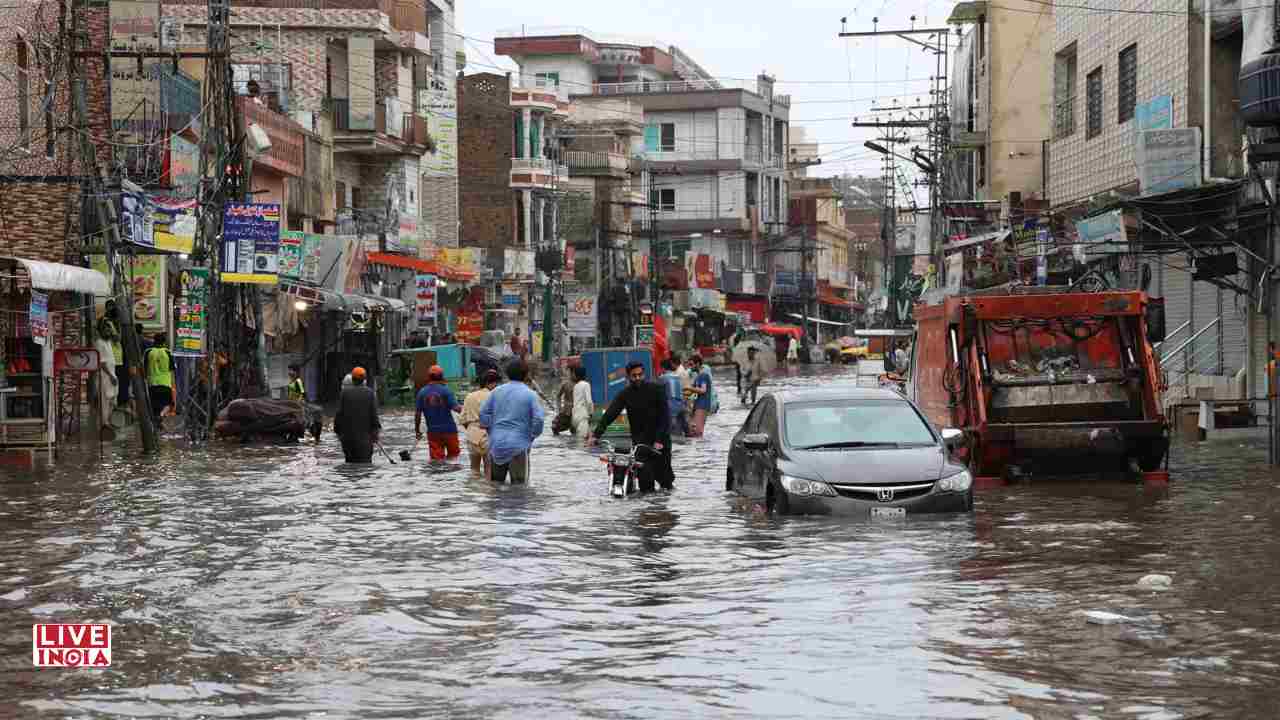


Federal Minister Musadik Malik urges citizens, NGOs, and authorities to step up relief efforts as climate-driven floods devastate rural and urban regions, leaving the poorest most vulnerable.
Islamabad, September 1: Pakistan is reeling under one of its worst flooding crises in recent years, with nearly two million people displaced across the country. Federal Minister for Climate Change Musadik Malik has called on the nation to unite in the face of disaster, stressing that the poorest families are bearing the brunt of this climate-driven tragedy, according to The Express Tribune.
Speaking to reporters on Sunday, Malik said the government’s top priority is to provide urgent relief to the most vulnerable populations. He urged citizens, volunteers, and NGOs to step forward with compassion and extend all possible support to families who have lost their homes and livelihoods.
The flooding has wreaked havoc on rural communities along riverbanks, while several urban centers—including parts of Lahore—have also been submerged. At relief camps, overcrowding has sparked concerns of disease outbreaks, further complicating rescue and rehabilitation efforts.
Standing alongside Malik was National Disaster Management Authority (NDMA) Chairman Inam Haider Malik, who highlighted the immediate need for essential supplies such as food, medicines, mosquito nets, clean water, temporary water tanks, and electricity. “We must move fast to prevent a health emergency in relief camps,” he cautioned.
Despite being abroad, Prime Minister Shehbaz Sharif is closely monitoring the situation with daily briefings, while Army Chief General Asim Munir has personally taken charge of relief operations on the ground. Malik assured that the federal government, armed forces, Rangers, NDMA, and Rescue 1122 are working together to support provinces in crisis.
At key flood control points like Head Trimmu, Head Panjnad, and Kot Mithan, authorities are attempting to regulate water flow to prevent catastrophic flooding in populated areas. Controlled breaches are being executed to divert water safely, though Malik warned that the Panjnad river system could swell to three million cusecs if rainfall intensifies.
Holding climate change responsible, Malik described the flooding as “a direct result of extreme weather events.” He praised the tireless efforts of provincial governments and security forces in Narowal, Sialkot, and Khyber Pakhtunkhwa, who have rescued countless stranded families.
Meanwhile, NDMA continues to deliver aid in collaboration with provincial authorities. Relief trucks carrying 46kg ration bags filled with 22 essential items have already reached Wazirabad and Hafizabad, with additional consignments dispatched to Narowal and Sialkot. Preparations are also underway to supply assistance to Chiniot and Jhang.
As the water levels continue to rise, the human cost of Pakistan’s vulnerability to climate change is once again on full display. For millions left homeless and hungry, the nation’s collective solidarity may be their only lifeline.