

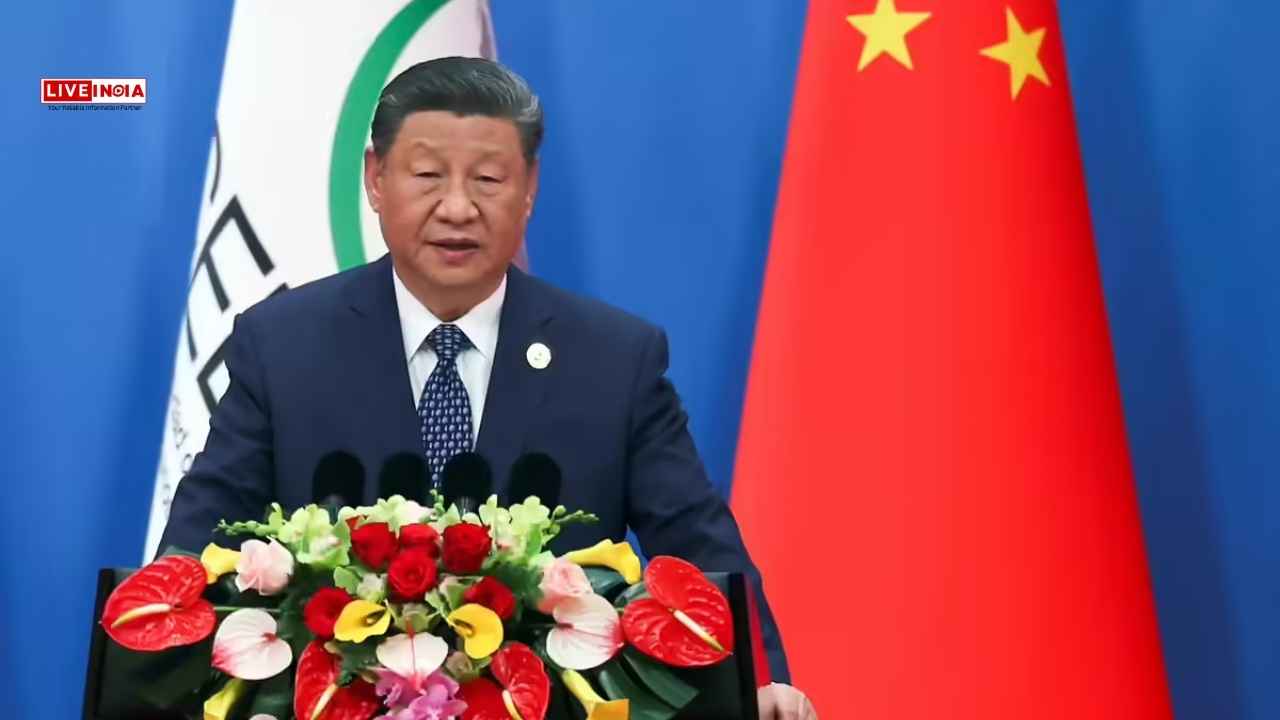


As BRICS convenes in Brazil amid global trade tensions and rising Western influence, Chinese President Xi Jinping’s absence raises questions — even as Beijing doubles down on its vision for a multipolar world.
Rio de Janeiro / Hong Kong, July 6, 2025
For the first time in over a decade, Chinese President Xi Jinping — the architect of China’s aggressive Global South strategy — will not attend the annual BRICS summit, now underway in Brazil.
Also Read: IND vs ENG 2nd Test Day 4: England 3 Down for 72 Runs at Stumps While Chasing 608
The absence of BRICS’ most powerful member’s top leader comes at a pivotal time for the expanded 11-nation bloc, which recently added Egypt, UAE, Ethiopia, Indonesia, and Iran to its original lineup of Brazil, Russia, India, China, and South Africa.
🔍 What Xi’s Absence Signals — and What It Doesn’t
Xi’s decision to skip the Rio de Janeiro summit and instead send Premier Li Qiang has surprised observers, given that BRICS has been central to China’s ambition to reshape global power away from the West. The group has been key to Beijing’s effort to position itself as a leader of the Global South — especially as the U.S. under Donald Trump doubles down on isolationism and tariffs.
Still, analysts caution this is not a downgrade in China’s BRICS commitment.
“This isn’t a snub,” says one Beijing-based analyst. “It’s a recalibration, perhaps driven by domestic priorities or a desire to let new BRICS members establish themselves on the global stage.”
🌍 BRICS at a Crossroads
The timing of Xi’s absence is delicate:
- A looming July 9 deadline on U.S. tariffs threatens key economies, including BRICS members
- The U.S.-Israel strike on Iranian nuclear sites has rattled geopolitical alliances
- Trump’s ‘America First’ stance has disrupted global trade norms, forcing emerging powers to seek greater unity
At such a moment, Xi’s physical absence may be seen as a missed chance to cement China’s image as a steady global anchor — in contrast to the unpredictability of Washington.
🇨🇳 Strategic Calculus or Domestic Distraction?
While the Chinese government has not officially explained Xi’s decision, domestic political pressures, recent military reshuffles, or health-related reasons could be behind the move. Xi continues to hold firm control over foreign and economic policy, and his absence does not mean a strategic retreat.
China remains invested in multipolar forums like BRICS and the Shanghai Cooperation Organisation (SCO), as well as its own Belt and Road Initiative (BRI), designed to tilt influence away from U.S.-led institutions like the G7.
📌 What’s Next for BRICS?
Despite Xi’s absence, BRICS will push forward on several key goals:
- De-dollarisation and use of national currencies
- Expansion of trade and energy cooperation
- Crafting a joint stance on U.S. tariffs
- Rebuilding the group’s unity with the five new members
Li Qiang, as China’s No. 2 and Premier, will represent Beijing’s position — expected to emphasize solidarity, south-south cooperation, and resistance to Western dominance.
🏷️ Tags:
Xi Jinping, BRICS Summit 2025, China BRICS Relations, Global South, US China Rivalry, Multipolar World, Trump Tariffs, BRICS Expansion