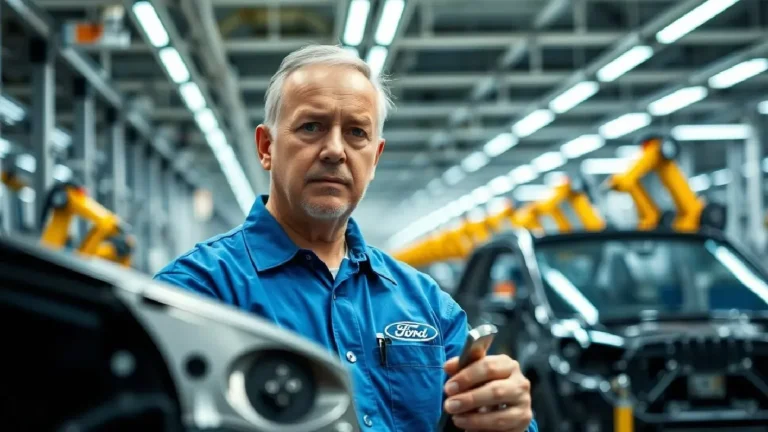
American automobile giant Ford has rehired around 350 veteran engineers after discovering that its artificial intelligence-powered quality control systems were unable to deliver the level of vehicle quality the company had expected.
The move comes as companies across industries increasingly adopt AI to improve productivity, automate workflows and cut costs. However, Ford’s experience has underscored an important lesson: while AI can enhance manufacturing processes, it cannot fully replace decades of human expertise and engineering judgment.
Ford Admits AI Alone Was Not Enough
Speaking about the company’s experience, Charles Poon, Ford’s Vice President of Vehicle Hardware Engineering, acknowledged that the automaker underestimated the value of its experienced engineers while expanding its AI capabilities.
“Artificial intelligence is a fantastic tool, but it’s only as good as the information you use to train it,” Poon said, according to the BBC.
He admitted that Ford should have placed greater emphasis on preserving the knowledge of long-serving engineers who had contributed across multiple vehicle development cycles.
“Over prior years, we didn’t pay as much attention as we should have to the experience of our most knowledgeable engineers that have been with us through many product cycles,” he said.
Experience Could Not Be Replaced By Algorithms
According to Poon, Ford initially believed that feeding design requirements into AI-powered systems would automatically result in high-quality vehicles.
However, the company eventually realised that automated tools lacked the practical knowledge and real-world experience accumulated by veteran engineers over decades.
Many of those experienced employees had already left the company before their expertise could be incorporated into training the AI systems.
“Mistakenly, we thought that by just introducing artificial intelligence and ingesting the design requirements that we had, that would produce a high-quality product,” Poon admitted.
The shortcomings prompted Ford to bring back approximately 350 experienced engineers, whose expertise is now expected to complement the company’s AI-powered quality processes.
Ford’s AI Push Across Manufacturing
The development comes less than a year after Ford reaffirmed its commitment to integrating AI across its manufacturing operations.
Last year, Chief Operating Officer Kumar Galhotra said the company was “deploying AI across the entire industrial system” as part of its broader digital transformation strategy.
As part of that initiative, Ford installed nearly 900 AI-powered cameras across its manufacturing facilities to identify production defects early, improve quality control and reduce supply chain disruptions.
While those technologies remain an important part of Ford’s manufacturing process, the company now appears to be shifting towards a hybrid approach that combines AI capabilities with experienced human oversight.
General Motors Faces Criticism Over Robot Expansion
Ford’s decision contrasts sharply with the strategy adopted by fellow American automaker General Motors (GM).
Instead of bringing back experienced workers, GM has faced criticism from labour unions after replacing more than 1,000 employees at its flagship Detroit assembly plant with approximately 50 robotic units.
The company said the robots are part of its long-term automation strategy aimed at improving manufacturing efficiency while enhancing workplace safety.
GM spokesperson Kevin Kelly defended the decision, saying collaborative robots—or “cobots”—are being introduced alongside employees rather than completely replacing them.
“We’ve been installing cobots across our manufacturing footprint as part of a broader push to bring more advanced technology into our operations,” Kelly said.
He added that the robots are intended to improve worker safety, ergonomics and operational flexibility while helping the company remain competitive.
“At Factory ZERO, we are implementing them alongside our team, helping improve safety and ergonomics, while keeping our operations flexible and competitive.”
AI’s Growing Role—But Human Expertise Still Matters
Ford’s experience highlights an increasingly important reality as companies embrace artificial intelligence across manufacturing and engineering.
While AI can analyse enormous volumes of data, automate repetitive tasks and improve operational efficiency, it still depends heavily on the quality of the information used to train it. Practical judgment, intuition and decades of engineering experience remain difficult to replicate through algorithms alone.
By rehiring experienced engineers, Ford appears to be recognising that the most effective manufacturing model may not be AI versus humans—but AI working alongside skilled professionals.