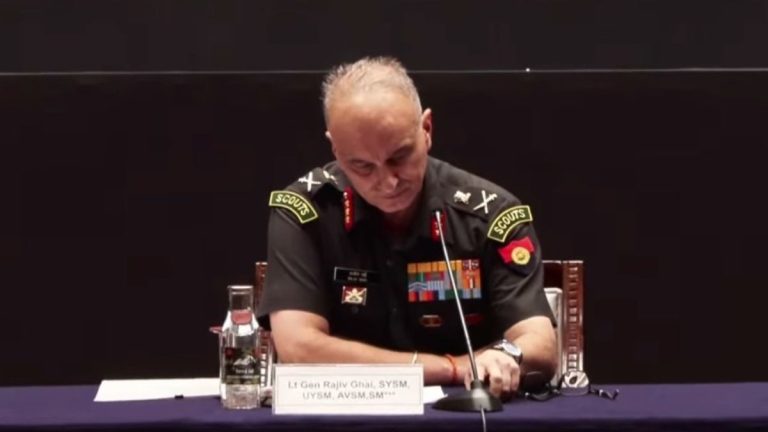
Former DGMO Rajiv Ghai said Operation Sindoor transformed India’s approach to cross-border terrorism and reflected a more assertive national security policy.
May 7, 2026: On the first anniversary of Operation Sindoor, former Director General of Military Operations Rajiv Ghai described the mission as a turning point in India’s evolving security doctrine. Addressing a press conference in Jaipur, Lieutenant General Ghai said the operation launched on May 7, 2025, fundamentally changed India’s counter-terrorism strategy. Conducted in response to the deadly Pahalgam attack that killed 26 civilians, the operation targeted terror infrastructure across the Line of Control and the international boundary.
Calling the mission “the beginning, not the end” of India’s fight against terrorism, Ghai said the country had moved beyond its earlier defensive methods. He stated that the government provided clear political objectives while granting the armed forces full operational freedom during the offensive. According to him, the operation was designed not only to eliminate terror launchpads but also to weaken planning networks, disrupt support systems and deter future attacks. Quoting a poetic line during his address, Ghai stressed that the mission aimed to bring lasting change in India’s security posture.
During Operation Sindoor, Indian forces reportedly struck nine major terror launchpads in Pakistan and Pakistan-occupied Jammu and Kashmir. The targets were said to be linked to Lashkar-e-Taiba, Jaish-e-Mohammed and Hizbul Mujahideen. Official accounts claimed that more than 100 militants were eliminated during the operation. One year later, officials continue to describe Operation Sindoor as one of India’s most decisive counter-terror offensives, highlighting its role in reshaping the country’s military and strategic response framework.