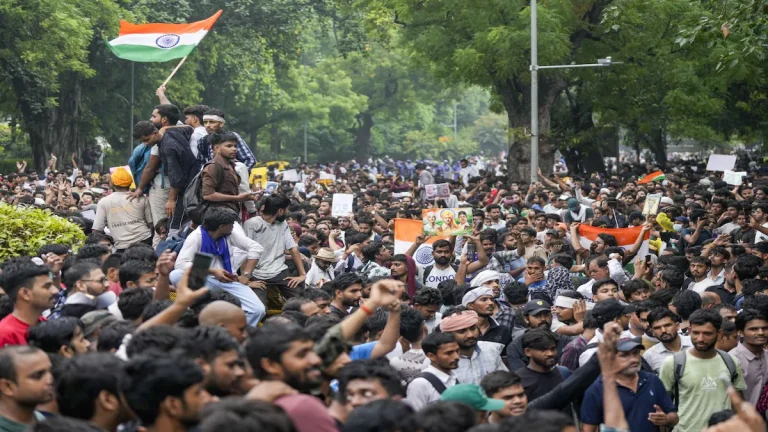
New Delhi: Amid escalating student protests over the alleged NEET paper leak controversy, the Centre is preparing to further strengthen the Public Examinations (Prevention of Unfair Means) Act, 2024, with tougher penalties and faster prosecution of offenders.
A day after Prime Minister Narendra Modi announced a series of measures to tackle examination fraud, sources told NDTV that the Union Cabinet is expected to approve amendments to the existing law during its meeting on Friday afternoon.
The proposed changes are aimed at making the legislation more stringent and ensuring quicker justice in paper leak cases.
Fast-Track Courts Likely To Be Added
According to sources, one of the key amendments under consideration is the introduction of a legal provision for fast-track courts dedicated to hearing paper leak cases.
Earlier on Thursday, Prime Minister Modi had announced that he had directed authorities to establish fast-track courts to ensure speedy trials and strict punishment for those involved in examination fraud.
The move is intended to accelerate investigations and convictions in cases that have sparked nationwide concern among students and parents.
Harsher Punishments Under Consideration
Sources also said the proposed amendments are likely to increase both the term of imprisonment and financial penalties for individuals found guilty of paper leaks.
Under the current provisions of the Public Examinations (Prevention of Unfair Means) Act, 2024:
- Individuals convicted in paper leak cases face three to five years’ imprisonment and a fine of up to ₹10 lakh.
- Service providers that fail to report suspected offences can be fined up to ₹1 crore.
- Cases involving organised crime attract five to ten years’ imprisonment along with a minimum fine of ₹1 crore.
The revised law is expected to prescribe even stricter punishments to deter organised cheating networks.
Amendment Bill Likely In Parliament Next Week
Following Cabinet approval, the Amendment Bill is expected to be introduced in the Lok Sabha on Monday, when Parliament reconvenes for the second week of the Monsoon Session.
The move comes amid mounting political pressure over alleged irregularities in competitive examinations, including NEET.
PM Modi Promises More Action
The proposed amendments follow Prime Minister Modi’s late-night video message on Thursday, in which he described paper leaks as a serious issue affecting millions of students.
“Friends, I know that paper leak is not an ordinary issue. It is very painful for lakhs of students and their families. That is why many steps have been taken in the last two and a half months.”
The Prime Minister said several accused had already been arrested.
“The culprits have been caught and are in jail. Our most important responsibility was to ensure that students do not waste a single year. It was very important to conduct the exams immediately.”
He added that the government mobilised all available resources to conduct examinations for nearly 22 lakh students.
Explaining the timeline for the proposed amendments, PM Modi said:
“I gave instructions to the departments for the fast-track court. Today, the departments worked hard and gave me the approval late at night. Tomorrow, there will be a discussion in the Cabinet. After the suggestions of the Cabinet members, it will be given its final form. And from Monday, when the second week of Parliament starts, we will try to get that Bill passed as soon as possible.”
Opposition Continues Attack
The government’s move comes after Leader of Opposition Rahul Gandhi claimed in Parliament that around 150 paper leaks had occurred over the past decade without a single conviction.
Following the Prime Minister’s latest announcement, Rahul Gandhi reiterated the Opposition’s demand for the resignation of Union Education Minister Dharmendra Pradhan, maintaining that students continue to seek accountability over the alleged examination irregularities.
The proposed amendments are expected to become a key focus of debate in Parliament as the government seeks to strengthen the legal framework against paper leaks while responding to nationwide student protests.