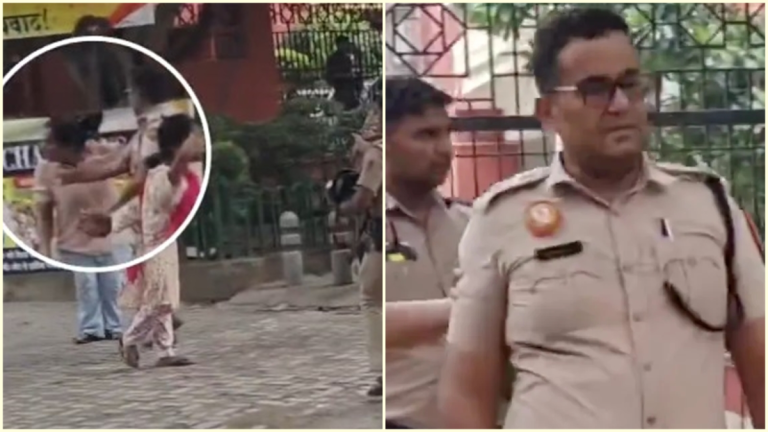
New Delhi: A senior Delhi Police officer who was caught on camera allegedly slapping a woman protester during the Cockroach Janta Party’s (CJP) “Chalo Sansad” march has been removed from duty at the Jantar Mantar protest site, amid growing scrutiny over the police’s handling of demonstrations against alleged examination irregularities.
Sandeep Lamba, Additional Deputy Commissioner of Police (North East District), was seen in a widely circulated video allegedly slapping a female protester during the July 20 march, where thousands of CJP supporters gathered to demand the resignation of Union Education Minister Dharmendra Pradhan over the NEET paper leak controversy and other examination-related issues.
Police Complaint Filed
Former Trinamool Congress MP Saket Gokhale said he has lodged a police complaint against the officer, claiming the government’s submissions before the Delhi High Court prompted the move.
“Yesterday, in the Delhi High Court, the Government’s answer to the petitions on police brutality was that nobody had approached the police for an FIR. So today I filed a police complaint,” Gokhale posted on X.
Officer Named During High Court Hearing
Lamba’s conduct also came under judicial scrutiny during a hearing in the Delhi High Court on Wednesday, where petitions alleged excessive use of force against CJP protesters.
Appearing for the petitioners, senior advocate Gopal Sankaranarayanan referred to the viral video while urging the court to hold the officer accountable.
“Additional DCP Sandeep Lamba is seen slapping a woman who is doing nothing. She is not moving. I can show the video right now. Let us not be scared to name our thugs in uniform when they deserve to be named. He should be summoned here and he should be asked to be accountable,” he told a bench headed by Chief Justice D.K. Upadhyaya and Justice Tejas Karia.
The advocate also alleged that police failed to follow standard crowd-control procedures.
According to him, authorities did not deploy water cannons—the first recommended method for dispersing crowds—but instead resorted to firing tear gas directly at protesters, despite it being a measure of last resort.
High Court Seeks Response
The Delhi High Court issued notices to the Delhi Police, the Central Government, and the National Human Rights Commission (NHRC) on the public interest litigations filed by Umesh Kumar and Anshul Kumar.
The court granted four weeks for the authorities to file their responses and directed them to preserve all evidence related to the police action, including CCTV footage and video recordings.
What Happened During the ‘Chalo Sansad’ March?
The confrontation took place on July 20, the opening day of Parliament’s Monsoon Session, when thousands of CJP supporters gathered at Jantar Mantar before attempting to march towards Parliament despite not receiving police permission.
Security personnel used tear gas shells, batons and lathis to disperse the crowd after protesters allegedly tried to breach barricades.
The demonstration was organised to protest alleged irregularities in NEET and other competitive examinations while demanding the resignation of Education Minister Dharmendra Pradhan.
Authorities said several protesters and police personnel sustained injuries during the clashes. Official sources estimated that around 50 police personnel were injured.
Following the violence, two CJP spokespersons met Union Health Minister JP Nadda, submitting a memorandum that included a demand for Pradhan’s resignation.
Rise of the Cockroach Janta Party
The Cockroach Janta Party (CJP) was launched in May by Abhijeet Dipke as a satirical digital platform after controversy surrounding remarks by Chief Justice of India Surya Kant referring to “parasites” and “cockroaches.”
The movement quickly gained traction on social media, attracting millions of followers and support from opposition leaders, activists, artists and sportspersons.
Dipke, who had been living in the United States, returned to India in June to lead nationwide protests seeking reforms in the education system after alleged paper leaks and examination irregularities.
The movement later received support from activist Sonam Wangchuk, who began an indefinite hunger strike at Jantar Mantar on June 28.
Wangchuk was shifted by police to a government hospital citing health concerns before obtaining court permission to continue treatment at Medanta Hospital in Gurugram.
The controversy surrounding the police action and the ongoing protests continues to fuel political debate, with the Opposition demanding accountability over both the handling of the demonstrations and the examination paper leak issue.