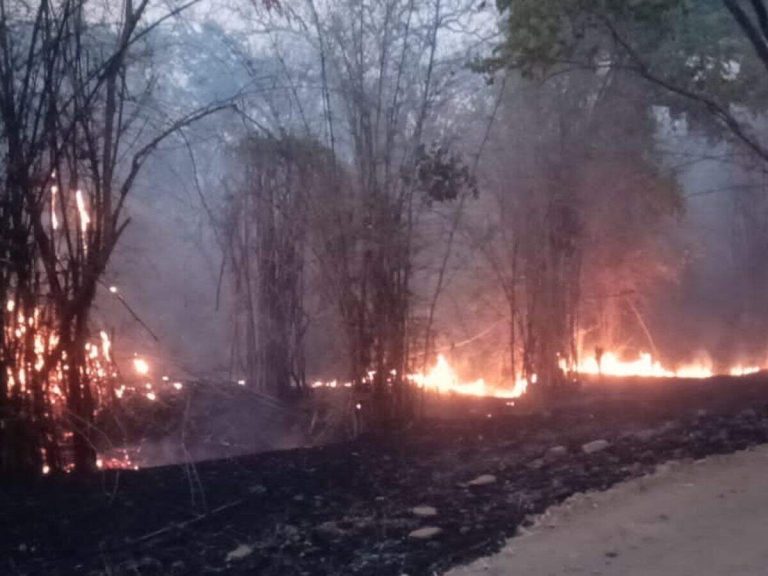
New Delhi: A severe heatwave sweeping across India has triggered widespread forest fires in more than a dozen states, destroying vast stretches of green cover and raising fresh environmental concerns.
From Uttarakhand in the north to Gujarat in the west and Andhra Pradesh in the south, multiple regions have reported significant fire activity over the past month.
Among all affected areas, Madhya Pradesh has emerged as the worst-hit, according to government assessments and satellite-based monitoring.
Hundreds of Large Fires Detected
Data from the Forest Survey of India (FSI) and remote sensing systems reveal a worrying scale of incidents. Over 634 “large fire” events were recorded in Madhya Pradesh alone.
Other states have also seen significant fire activity — around 465 such incidents each in Maharashtra and Chhattisgarh, and more than 400 in Andhra Pradesh.
In the northeast, known for its fire-prone forests, Assam reported 190 fires, followed by Manipur with 128.
The FSI classifies “large forest fires” as those covering at least 40 hectares, detected through satellite imaging technology that tracks contiguous fire-affected zones.
Fires Burning for Days
According to the latest data, at least 10 forest fires were still burning continuously for more than three days as of Thursday. Alarmingly, eight of these had been active for five days or longer, indicating the intensity and persistence of the blaze.
Tourist and Ecologically Sensitive Areas Hit
Several well-known tourist and ecologically sensitive regions have also been affected. Fires have been reported near Lansdowne, Ranikhet, and the Valley of Flowers.
Other affected areas include Shimla, the Nilgiris, Seshachalam Forest, and the Baliguda Forest Division in Odisha.
In Uttarakhand alone, fires have damaged at least 130 hectares of forest land. Blazes have also been reported along parts of the Char Dham pilgrimage route, raising safety concerns for travellers.
Central and Southern India Most Vulnerable
Experts say central and southern India are currently bearing the brunt of the crisis. According to the Ministry of Environment, Forest and Climate Change’s 2021 report, regions such as western Maharashtra, southern Chhattisgarh, parts of Telangana, and central Odisha are emerging as “extremely prone” forest fire zones.
More broadly, data suggests that nearly half of India’s forested areas are vulnerable to fires, making such incidents a recurring environmental challenge.
Impact Beyond Numbers
While no human casualties have been reported so far in April, the ecological damage has been significant. Forest fires have led to the loss of wildlife, destruction of habitats, and long-term environmental degradation.
With rising temperatures and prolonged dry conditions, experts warn that the risk of further fires remains high in the coming weeks.