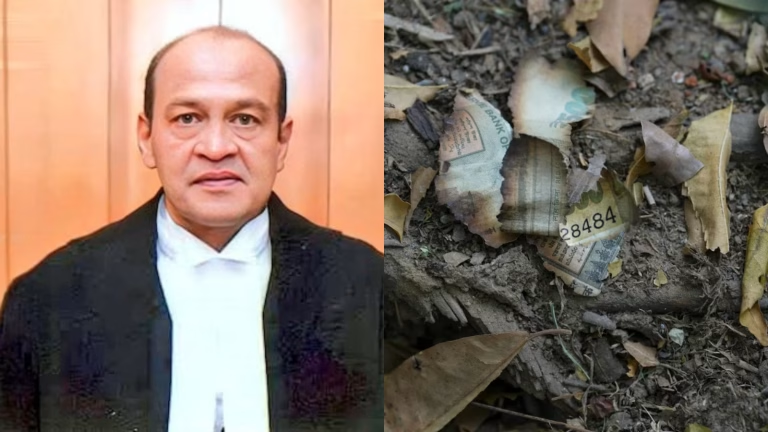
The resignation of Allahabad High Court Judge Yashwant Varma in April 2026—amid an active impeachment inquiry over a massive “cash-at-home” scandal—has pushed India into uncharted constitutional territory.
Lok Sabha Speaker Om Birla announced that the Statutory Inquiry Committee’s findings will be tabled during the upcoming Monsoon Session beginning July 20, 2026. This has triggered a profound constitutional debate: Can Parliament legally censure or impeach a judge who has already demitted office?
The Two Sides of the Constitutional Standoff
The core dilemma centers on whether an official’s resignation provides a protective shield against legislative action, or if accountability outlives their tenure.
1. The Argument Against Parliamentary Action (The “Infructuous” View)
- Immediate Effect: Under a landmark 1978 Supreme Court Constitution Bench ruling (Union of India v. Gopal Chandra Misra), a High Court judge’s resignation is a unilateral constitutional act that takes effect immediately upon receipt by the President and requires no formal acceptance.
- Impossible Objective: Opponents argue that because the judicial office is already vacant, the primary objective of an impeachment motion—which is explicitly “removal from office”—becomes entirely redundant. Parliament cannot remove someone from a post they no longer hold.
- Precedents: Historically, whenever judges facing impeachment resigned—such as Justice P.D. Dinakaran and Justice Soumitra Sen in 2011—Parliament dropped the proceedings, viewing the matter as infructuous.
2. The Argument for Parliamentary Action (The Accountability View)
- No Escape Route: Proponents, including the central government, argue that resignation should not be a legal loophole to escape constitutional accountability. The Judges (Inquiry) Act, 1968 does not explicitly state that an investigation must automatically stop if a judge steps down.
- Financial Accountability: A sitting judge’s post-retirement benefits (like pension and gratuity) depend entirely on a clean exit. If Parliament successfully votes on a finding of “proved misbehavior,” it establishes a legal basis to withhold these post-retirement benefits and state perks.
Key Milestone Timeline
The crisis escalated rapidly over a 16-month period, establishing a historic precedent as the committee continued its work ex parte even after the judge’s exit.
The Cash Discovery
March 2025
An accidental fire at Justice Varma’s Delhi bungalow reveals sacks of half-burnt, unaccounted currency notes totaling nearly ₹15 crore. The Supreme Court initiates an in-house panel and transfers him to the Allahabad High Court.
Impeachment Initiated
August 2025
Following the in-house panel’s finding of serious misconduct, 146 MPs sign a memorandum. Lok Sabha Speaker Om Birla admits the motion and sets up a three-member Statutory Inquiry Committee.
Supreme Court Greenlight
January 2026
Justice Varma legally challenges the Speaker’s power to form the panel. The Supreme Court dismisses his plea, ruling that “constitutional safeguards cannot come at the cost of paralyzing the removal process itself.”
Sudden Resignation
April 9, 2026
Just as the probe enters its final stages, Justice Varma resigns with immediate effect, alleging an “unfair” process. He surrenders his perks and revives his Bar Council membership to practice private law.
Report Submitted
May 2026
Setting a massive institutional precedent, the Inquiry Committee continues its proceedings ex parte and formally hands its finalized report to Speaker Om Birla.
What Happens Next?
If the Lok Sabha proceeds beyond merely tabling the report and attempts a formal vote on removal during the Monsoon Session, it will trigger an unprecedented legal showdown.
The case will inevitably land back in the Supreme Court. The apex court’s ultimate ruling will permanently decide whether an official exit legally strips Parliament of its disciplinary power, or if the legislature retains retrospective authority to penalize judicial corruption.