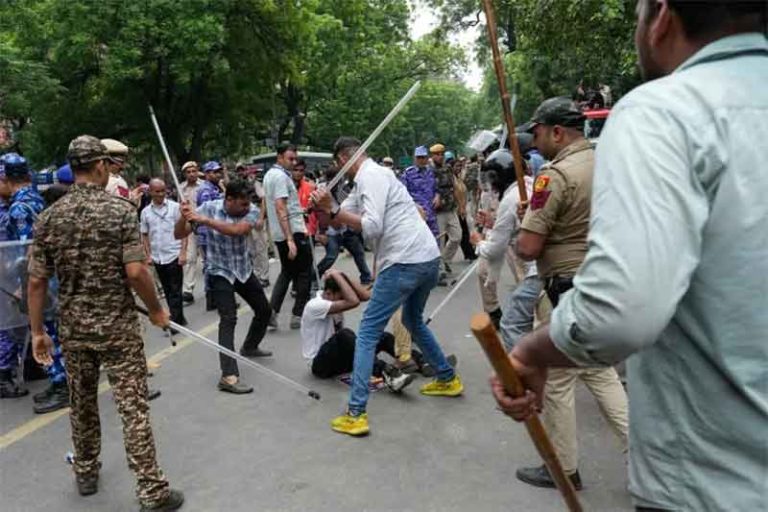
The sight of plainclothes police personnel wielding lathis during recent crowd-control operations at Delhi’s Jantar Mantar protests has reignited a debate over whether officers must identify themselves while enforcing the law. Here’s what Indian law actually says.
Can police work in plain clothes?
Yes. There’s no legal rule requiring officers to remain in uniform at all times. Plainclothes deployment is a long-standing and recognised practice used for intelligence gathering, surveillance, undercover operations, anti-crime work, VIP protection, and crowd control — particularly in situations where revealing an officer’s identity could compromise the operation.
Can they arrest or detain someone while in plain clothes?
Yes, with restrictions. Wearing civilian clothes doesn’t strip an officer of their legal powers — they can detain, arrest, use reasonable force, and take part in crowd control. However, these powers remain bound by the same legal limits that apply to uniformed police.
Do they have to identify themselves?
In most cases, yes. While there’s no absolute requirement for a plainclothes officer to display ID at all times, Indian law and Supreme Court guidance require officers to clearly identify themselves when carrying out arrests or using coercive powers. Under the Bharatiya Nagarik Suraksha Sanhita (BNSS), 2023, officers making an arrest must carry clear, accurate identification — a safeguard carried forward from the earlier Code of Criminal Procedure.
What has the Supreme Court ruled?
The landmark DK Basu vs State of West Bengal (1997) judgment set out mandatory arrest safeguards to prevent custodial abuse. These include requirements that arresting officers wear clear identification and name tags, that arrest details be properly recorded, that arrest memos be prepared, that family or friends be informed, and that medical examination and documentation take place. These guidelines still form the foundation of arrest procedure in India today.
What can you do if someone in plain clothes claims to be a police officer?
You’re entitled to ask for their name and designation, which police station or unit they belong to, to see their official ID where possible, and the reason you’re being stopped or questioned. If you’re formally arrested, you have further constitutional protections — including the right to be told the grounds for arrest and to be produced before a magistrate within 24 hours.
Why is this controversial at protests?
Critics argue that unidentifiable officers make accountability difficult — protesters can’t distinguish police from bystanders, and any allegations of excessive force become harder to investigate. Police maintain that plainclothes deployment is a standard operational tool for maintaining order during large demonstrations.
Can police conceal their identity entirely?
Generally, no — especially once they exercise powers like arrest. Courts have repeatedly emphasised that while operational secrecy can justify civilian clothing, officers are expected to be identifiable once they invoke police authority, as transparency remains a key safeguard against misuse of power.