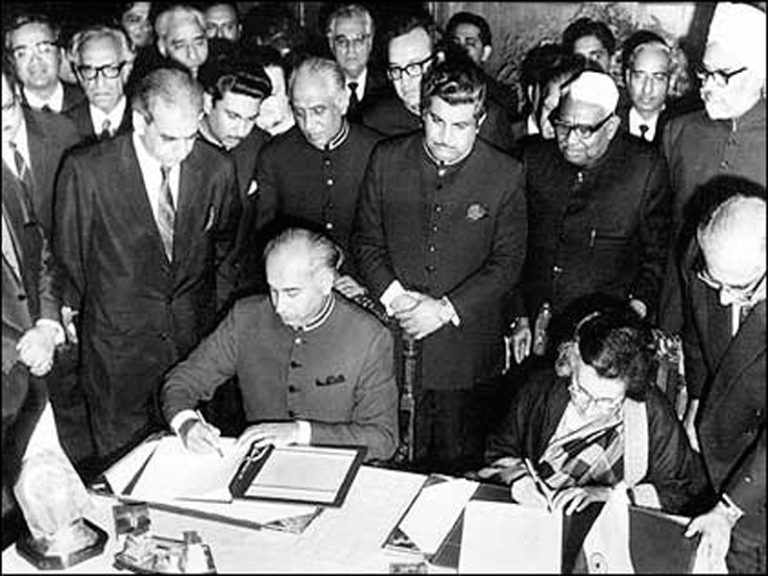
More than five decades after India and Pakistan signed the historic Shimla Agreement on July 2, 1972, the treaty continues to shape diplomatic discourse between the two neighbours. Signed in the aftermath of the 1971 India-Pakistan war, the agreement sought to restore peace, establish a framework for bilateral relations and lay the foundation for resolving disputes through dialogue.
The agreement, signed by then Prime Minister Indira Gandhi and Pakistan President Zulfikar Ali Bhutto, also recognised the Line of Control (LoC) in Jammu and Kashmir and Ladakh as the de facto boundary pending a final settlement.
However, despite its stated objectives, the pact has remained at the centre of differing interpretations and continued political tensions.
India And Pakistan Differ On Kashmir Interpretation
One of the biggest points of disagreement has been the issue of Jammu and Kashmir.
Pakistan maintains that the dispute should be resolved in accordance with various United Nations resolutions, while India has consistently argued that the Shimla Agreement clearly establishes that all outstanding issues between the two countries must be settled bilaterally, making third-party intervention inappropriate.
The agreement itself commits both nations to resolving differences through peaceful means and direct negotiations.
Agreement Went Beyond Bilateral Dialogue
The Shimla Agreement was not limited to dispute resolution alone.
Both countries also agreed to undertake measures aimed at fostering peaceful and friendly relations after the 14-day war of 1971.
The pact committed India and Pakistan to:
- Refrain from activities within their territories that could undermine peaceful relations.
- Discourage propaganda hostile to the other country.
- Promote exchanges of information and communication that strengthen goodwill and mutual understanding.
These provisions were intended to rebuild confidence and reduce hostility following the conflict.
Cross-Border Terrorism Remains A Major Flashpoint
Over the years, India’s position has been that Pakistan’s support for cross-border terrorism has undermined the principles underlying the Shimla Agreement.
Groups such as Lashkar-e-Taiba, responsible for the 2008 Mumbai terror attacks, and Jaish-e-Mohammed have long been accused by India of operating from Pakistani soil.
Both organisations have been designated as terrorist entities by the international community.
Pakistan also remained on the Financial Action Task Force (FATF) grey list from 2018 to 2022 over deficiencies in tackling terror financing.
More recently, India blamed The Resistance Front (TRF)—which Indian agencies describe as a proxy of Lashkar-e-Taiba—for the April 22, 2025 terror attack in Pahalgam, Jammu and Kashmir, in which 26 civilians were killed.
India’s National Investigation Agency (NIA) said its probe found evidence that the conspiracy was planned across the border.
Operation Sindoor And Information Warfare
Following the Pahalgam attack, India launched Operation Sindoor in May 2025, targeting what it described as terrorist infrastructure in Pakistan and Pakistan-occupied Kashmir (PoK).
During the military escalation, India also accused Pakistan of launching a large-scale misinformation campaign across social media.
According to Indian authorities, more than 1,400 Pakistan-linked URLs circulated false claims, including allegations about Indian fighter jets being shot down, cyberattacks on India’s power infrastructure and attacks on religious sites.
India has argued that such disinformation campaigns run contrary to the Shimla Agreement’s commitment to discourage hostile propaganda and promote peaceful relations.
Pakistan’s International Outreach On Kashmir
Another recurring area of disagreement concerns Pakistan’s efforts to raise the Kashmir issue on international platforms.
India has maintained that such moves contradict the bilateral framework established under the Shimla Agreement.
Pakistan has continued to engage international forums, including the United Nations Security Council, on Kashmir-related issues. Earlier this year, Islamabad convened an Arria-formula meeting at the UNSC and submitted communications regarding Kashmir.
India has consistently maintained that all issues relating to Jammu and Kashmir must be addressed through bilateral dialogue in accordance with the 1972 agreement.
Indus Waters Treaty Suspension
Following the Pahalgam attack, India also announced the suspension of the Indus Waters Treaty, stating that the agreement would remain in abeyance until Pakistan took credible steps to end support for cross-border terrorism.
The move reflected India’s position that long-term cooperation cannot be separated from security concerns and treaty obligations.
According to New Delhi, meaningful cooperation in areas such as water-sharing and dialogue depends on both countries adhering to commitments aimed at ensuring peace and preventing terrorism.
A Pact Still Central To India-Pakistan Relations
Fifty-four years after it was signed, the Shimla Agreement continues to serve as the principal diplomatic framework governing relations between India and Pakistan.
While the legal interpretation of specific provisions remains contested, the broader debate today centres on whether both countries have upheld the spirit of the agreement.
For India, repeated terror attacks, cross-border militancy and information warfare have weakened the trust that formed the basis of the 1972 accord. Pakistan, meanwhile, continues to emphasise international engagement on the Kashmir issue alongside its interpretation of the agreement.
As bilateral relations remain strained, the Shimla Agreement continues to be both a symbol of past diplomacy and a reference point in ongoing disputes between the two neighbours.