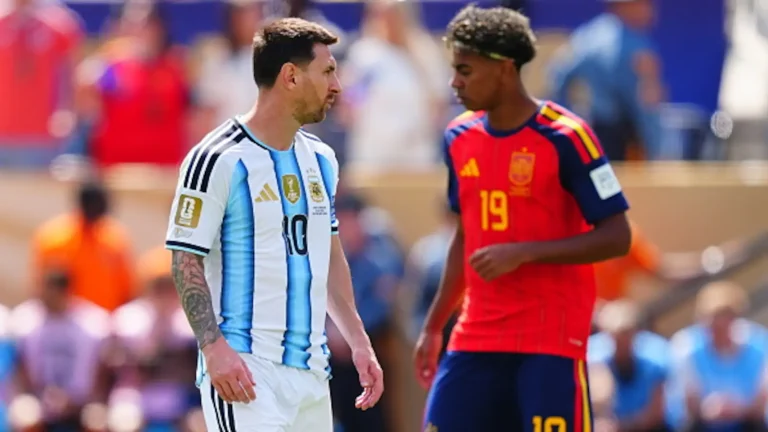
Spain reclaimed football’s biggest prize after defeating defending champions Argentina 1-0 after extra time in the FIFA World Cup 2026 final on Sunday, bringing an emotional end to Lionel Messi’s legendary World Cup journey.
A dramatic extra-time strike from Ferran Torres at the New York New Jersey Stadium in East Rutherford, United States, secured Spain’s second FIFA World Cup crown and denied Argentina back-to-back titles.
As the final whistle blew, Spain celebrated a historic triumph while Messi, playing what he had indicated would be his final FIFA World Cup match, walked off the pitch in tears.
Ferran Torres Delivers the Defining Moment
With the match finely balanced and heading towards a penalty shootout, substitute Ferran Torres produced the decisive moment in the 106th minute.
The Spanish forward reacted quickest to a loose ball inside the penalty area before firing a left-footed strike beneath the crossbar, sparking wild celebrations among the Spanish players and supporters.
Reflecting on the goal after the match, Torres said:
“It was a goal scored by 47 million people.”
The remark referred to Spain’s population, underlining the significance of the country’s second World Cup triumph.
Argentina Finish With 10 Men
Argentina’s task became even more difficult late in regulation time after midfielder Enzo Fernández received a red card following a reckless challenge.
Reduced to 10 men, Lionel Scaloni’s side fought bravely through extra time but ultimately failed to find an equaliser against Spain’s disciplined defence.
Tensions spilled over after the final whistle, with members of both teams, including coaching staff, appearing to exchange heated words before officials intervened.
Spain’s Defence Sets New World Cup Record
Spain’s triumph was built on one of the finest defensive campaigns in FIFA World Cup history.
The European champions conceded just one goal in eight matches, setting a new record for the fewest goals allowed by a World Cup-winning team.
Having also lifted the trophy in 2010, Spain now joins an elite group of nations with multiple FIFA World Cup titles.
Emotional End to Lionel Messi’s World Cup Career
For Lionel Messi, the defeat marked a heartbreaking conclusion to an extraordinary World Cup journey spanning six tournaments.
The 39-year-old had guided Argentina to World Cup glory in the previous edition and entered the 2026 tournament hoping to become the first Argentine captain to win consecutive FIFA World Cup titles.
Although the dream ended in defeat, Messi once again played a central role in Argentina’s campaign and finished among the tournament’s standout performers.
FIFA World Cup 2026 Prize Money
The FIFA Council approved a record USD 727 million financial package for the 2026 FIFA World Cup, with USD 655 million distributed among the 48 participating nations.
Prize Money Breakdown
- Champions (Spain): USD 50 million
- Runners-up (Argentina): USD 33 million
- Third Place (England): USD 29 million
- Fourth Place (France): USD 27 million
- Quarter-finalists (5th-8th): USD 19 million each
- Round of 16 Teams (9th-16th): USD 15 million each
- Round of 32 Teams (17th-32nd): USD 11 million each
- Group Stage Teams (33rd-48th): USD 9 million each
FIFA World Cup 2026 Award Winners
Several players were recognised for their outstanding performances throughout the tournament.
- Golden Ball: Rodri (Spain)
- Silver Ball: Lionel Messi (Argentina)
- Bronze Ball: Kylian Mbappé (France)
- Golden Boot: Kylian Mbappé (France)
- Silver Boot: Lionel Messi (Argentina)
- Bronze Boot: Jude Bellingham (England)
- Golden Glove: Unai Simón (Spain)
- FIFA Young Player Award: Pau Cubarsí (Spain)
- FIFA Fair Play Trophy: Netherlands
Spain’s triumph capped a remarkable tournament that featured the first-ever 48-team FIFA World Cup, while Messi’s emotional farewell marked the end of one of the greatest international careers the sport has ever witnessed.