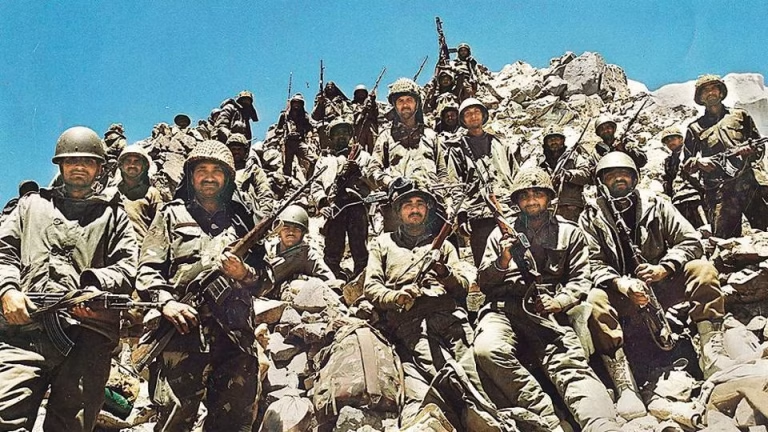
The battles for Tololing and Point 5140 marked the first major breakthroughs for the Indian Army during Operation Vijay in the 1999 Kargil War. Fought in the rugged heights above Dras, these victories shifted the momentum of the conflict, paving the way for subsequent successes, including the capture of Tiger Hill, and ultimately India’s victory.
The Strategic Importance of Dras
In the summer of 1999, Pakistani troops from the Northern Light Infantry, supported by irregular fighters, occupied several strategic positions on the Indian side of the Line of Control (LoC) in the Kargil-Dras-Batalik sector. These heights overlooked National Highway 1A (NH1A), the crucial route connecting the Kashmir Valley with Ladakh and the Siachen Glacier.
Operation Vijay was launched to evict the intruders while adhering to the government’s directive not to cross the LoC. Among the most critical objectives were Tololing and Point 5140, whose capture was essential to secure the highway and regain tactical advantage.
Battle of Tololing: The First Major Breakthrough
Tololing was one of the earliest and toughest objectives in the campaign. Pakistani forces had established heavily fortified bunkers along the steep ridgeline, forcing Indian soldiers to climb exposed slopes under intense machine-gun and mortar fire.
Troops from the 8 Mountain Division, under Major General Mohinder Puri, and the 121 Independent Infantry Brigade, led by Brigadier O.P. Nandrajog, spearheaded the operation. Initial assaults in late May faced fierce resistance, resulting in significant casualties, including Major Rajesh Adhikari of 2 Rajputana Rifles, who was killed while leading his men in combat.
Following weeks of determined attacks supported by heavy artillery, Indian forces launched a decisive assault. Major Vivek Gupta led a flanking attack from an unexpected direction but was martyred during the operation. By mid-June, Indian troops successfully recaptured Tololing after intense close-quarters fighting.
The victory not only reduced enemy observation over NH1A but also demonstrated that fortified enemy positions at high altitudes could be recaptured through coordinated infantry assaults backed by artillery support.
Point 5140: A Decisive Victory
With Tololing secured, the Indian Army turned its attention to Point 5140, one of the highest and most strategically important peaks overlooking the Dras sector.
The mission was assigned to 13 Jammu and Kashmir Rifles (13 JAK Rif) under Lieutenant Colonel Yogesh Kumar Joshi. The assault involved two companies led by Captain Sanjeev Singh Jamwal and Captain Vikram Batra, who approached the objective from different directions under heavy artillery cover.
During the operation, Captain Jamwal successfully led his troops in clearing multiple enemy bunkers, while Captain Vikram Batra spearheaded a daring assault up a steep eastern slope, engaging enemy soldiers in close combat despite sustaining injuries.
After successfully capturing the objective in the early hours of June 20, 1999, Captain Batra famously radioed the words, “Yeh Dil Maange More!”, a phrase that became synonymous with courage and patriotism during the Kargil War.
The operation resulted in the elimination of several enemy soldiers and the capture of weapons, including a heavy machine gun. Remarkably, the assault achieved its objective without any fatal casualties among the attacking companies.
For their exceptional bravery, Captain Vikram Batra was posthumously awarded the Param Vir Chakra, while Lt Col Yogesh Kumar Joshi, Captain Sanjeev Jamwal, Naik Dev Prakash, and Rifleman Mehar Singh received the Vir Chakra.
Turning Point in the Kargil War
The successful capture of Tololing and Point 5140 fundamentally altered the battlefield. It weakened Pakistani positions across the Dras sector, improved India’s ability to secure NH1A, and created launch pads for further offensives against strategic peaks, including Tiger Hill and Point 4875.
These victories also boosted the morale of Indian forces and reinforced public confidence in the military’s ability to reclaim occupied territory under extremely challenging conditions. The momentum generated by these operations ultimately contributed to Pakistan’s withdrawal and India’s declaration of victory on July 26, 1999, commemorated each year as Kargil Vijay Diwas.