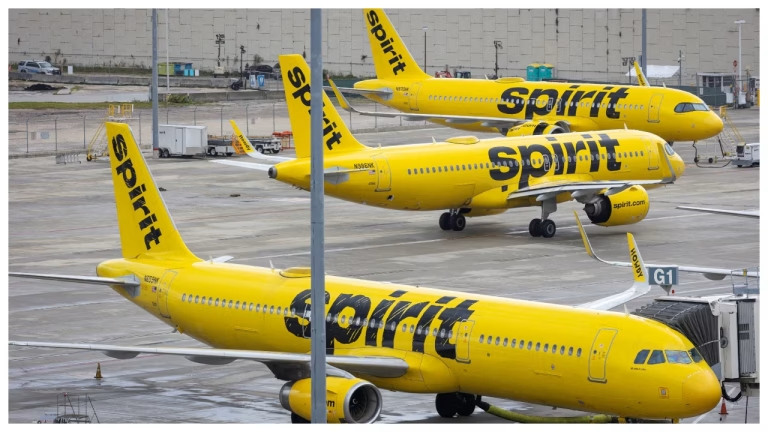
Spirit Airlines, the pioneer of ultra-low-cost “a la carte” travel in the United States, officially ceased operations on Saturday, May 2, 2026. The airline’s leadership announced an immediate and “orderly wind-down,” citing an insurmountable financial crisis exacerbated by the ongoing conflict in Iran and a subsequent doubling of jet fuel prices.
The news has sent shockwaves through the aviation industry, leaving thousands of employees facing layoffs and hundreds of thousands of passengers stranded.
A Failed Lifeline in Washington
The airline’s demise follows weeks of intense speculation regarding a potential federal intervention. President Donald Trump had proposed a $500 million bailout package aimed at preserving the carrier, which accounted for roughly 5% of all domestic flights. However, the plan faced fierce opposition in Congress and from within the administration’s own advisory circles. Despite last-minute negotiations, the White House confirmed that an agreement could not be reached that satisfied both the government’s fiscal requirements and the demands of Spirit’s creditors.
The “Fuel Shock” and Market Reality
While Spirit had previously navigated a complex bankruptcy restructuring, the “material increase in oil prices” proved to be the final blow. According to industry data, the carrier’s survival was contingent on jet fuel remaining near $2.24 per gallon; by late April 2026, prices had surged to over $4.50. Without a massive infusion of capital, the airline’s business model—predicated on thin margins and high volume—became fundamentally unviable. Transportation Secretary Sean Duffy noted that no other major airlines were willing to acquire the struggling carrier, essentially declaring the company a “corpse” that could no longer be revived.
Legacy of the “Yellow Planes”
Spirit Airlines leaves behind a polarizing but significant legacy. By unbundling fares and charging separately for bags, seats, and refreshments, it forced larger legacy carriers to introduce “Basic Economy” tiers, permanently lowering the entry price of flying for millions of Americans. Industry analysts warn that Spirit’s liquidation will likely result in decreased competition and a sharp spike in airfares across the U.S., particularly in hub cities like Fort Lauderdale, Las Vegas, and Orlando where the “yellow planes” once dominated.