
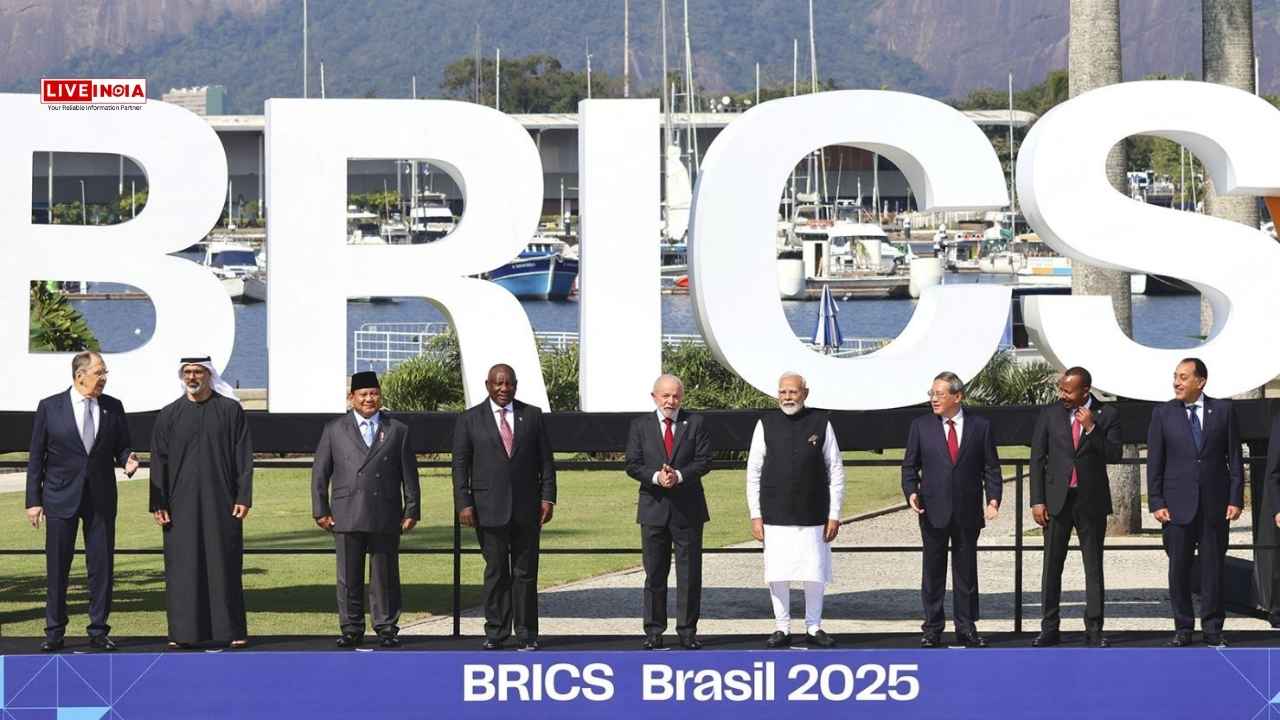


Beijing rebukes Trump’s “anti-America BRICS” remark, calls protectionism a dead-end; BRICS condemns US-Israel strikes, calls for global adherence to international law.
July-7, 2025: In a pointed response to U.S. President Donald Trump’s latest threat of imposing an additional 10% tariff on countries aligning with what he called “anti-America BRICS policies,” China on Monday stated that the BRICS bloc does not seek confrontation and that trade wars have no winners.
Also Read: LIVE: Israel Strikes Gaza, Yemen As Houthis Launch Fresh Missiles
Foreign Ministry spokeswoman Mao Ning addressed the media during a routine press briefing in Beijing and said, “China has repeatedly stated its position that trade and tariff wars have no winners and protectionism offers no way forward.” Her remarks came amid a growing backlash over Trump’s statement following the 2025 BRICS Summit in Brazil, where the bloc condemned recent US-Israel airstrikes on Iranian military and nuclear installations, calling them “illegal.”
Also Read: “Why Is Xi Jinping Skipping the BRICS Summit for the First Time Ever?” Here You Know!
China Opposes Tariff-Based Political Coercion
Mao reiterated that tariffs should not be used as tools of political coercion, and emphasized that “the use of tariffs serves no one.” China’s reaction underscores its concern over Washington’s increasing use of trade barriers as leverage in global diplomacy, particularly in response to the BRICS coalition’s recent geopolitical stance.
Also Read: Pakistan Spy Jyoti Malhotra Was Hired By Kerala Tourism, Reveals RTI
BRICS Condemns U.S. and Israeli Airstrikes on Iran
The BRICS bloc, now expanded to ten member nations — Brazil, China, Egypt, Ethiopia, India, Indonesia, Iran, Russia, South Africa, and UAE — issued a joint declaration in Brazil condemning the U.S.-Israel strikes on Iran. The statement said such acts were in violation of international law, and also criticized the “indiscriminate rising of tariffs,” a not-so-subtle dig at U.S. trade policy under Trump.
Although the statement did not name the United States directly, the language and context were unmistakably pointed at Washington’s aggressive foreign and economic tactics. The declaration also called for global supply chain stability and respect for sovereignty in international affairs.
Trump Doubles Down, Letters “Ready” for 12 Countries
In response, Donald Trump announced that letters for imposing tariffs on 12 countries are “signed and ready”, and they will be issued at 12 PM EST on Monday. The announcement is expected to affect multiple BRICS member states, possibly including India, Brazil, and South Africa, who have all echoed criticisms against unilateral U.S. military actions and trade policies.
The U.S. is nearing the end of a 90-day pause on revised tariffs, which was extended after global outcry followed Trump’s April 2 announcement of sweeping trade hikes. That pause expires on July 9, and Trump’s Monday move signals a likely return to protectionist trade posturing.
Global South and the Gaza War
Beyond the Iran conflict, the BRICS declaration also highlighted concern over the ongoing war in Gaza, urging peaceful resolutions and opposing unilateral military action. It also voiced strong opposition to cross-border terrorism, referencing the Pahalgam terror attack in Jammu and Kashmir and calling for stricter action against terrorist financing networks.
Geopolitical Stakes Rising
With China emphasizing diplomacy and Trump escalating rhetoric with imminent economic penalties, the rift between the Global South and the West appears to be widening. BRICS, originally formed as a development-focused coalition, is now emerging as a more assertive counterweight to Western military and economic dominance.
The coming days will determine if Trump follows through on his tariff warnings, and how the BRICS nations, particularly India and China, will recalibrate their positions in response.
Tags:
Donald Trump, China, BRICS 2025, Tariff Threat, Trade War, US-Israel Iran Conflict, Xi Jinping, Global South, BRICS Declaration, World Trade, US Foreign Policy