
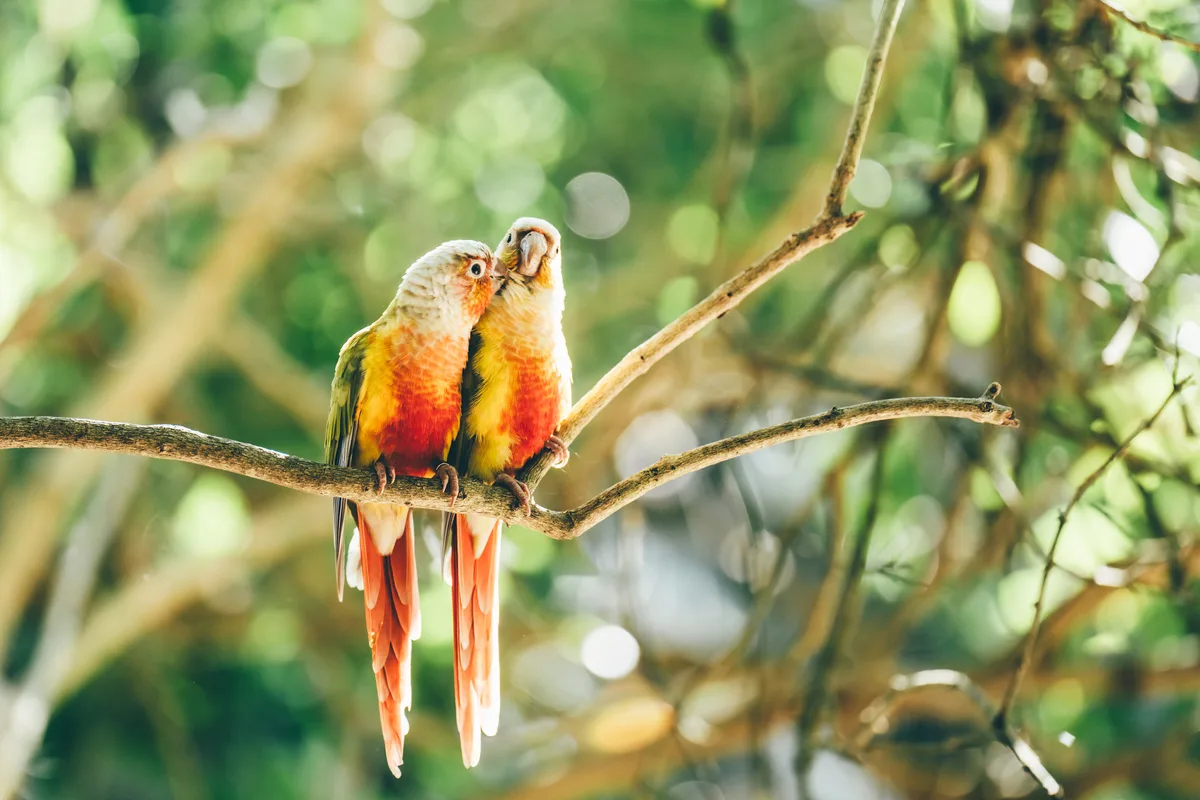


For decades, bird owners, breeders and even some animal experts have often viewed masturbation in birds—particularly pet parrots—as a behavioural problem linked to stress, loneliness, boredom or inadequate living conditions. However, a new scientific study is challenging that assumption and suggests the behaviour may actually be a normal and healthy part of bird biology.
Researchers have found that autoerotic behaviour is widespread across the avian world and appears to be a naturally occurring trait rather than an abnormal response to captivity. The study, led by evolutionary biologist Chloe Heys and her colleagues, is being described as the first large-scale evolutionary investigation into masturbation among bird species.
A Natural Behaviour Across Bird Species
Unlike most mammals, birds do not possess external genitalia. Instead, they reproduce through a cloaca, a multi-purpose opening used for reproduction, urination and defecation.
According to the researchers, avian masturbation generally involves birds rubbing their cloaca against an object such as a branch, twig, perch or toy. The behaviour is often accompanied by wing movements, body motions and vocalisations.
“Avian self-pleasure is usually a rather inelegant affair in which a bird rubs their cloaca against an object, like a branch, twig, or toy. This is often accompanied by a lot of flapping and self-satisfied vocalization,” the research team noted.
Lead researcher Chloe Heys said the findings challenge common assumptions about the behaviour.
“Despite assumptions that masturbation among captive birds like parrots is a result of their often-solitary living, our study finds that it is natural, healthy and widespread across diverse bird species, even in different environments,” she explained.
First Major Evolutionary Analysis
Masturbation has previously been documented in a variety of animal species, including primates, dolphins, horses, squirrels, marine iguanas and penguins. However, birds have received relatively little scientific attention in this area.
To address that gap, evolutionary biologists from the Universities of Lancashire, Swansea and Oxford analysed behavioural records from 120 bird species representing 22 major avian groups.
The researchers examined multiple factors, including:
- Age and sex of the birds
- Whether the birds lived in captivity or in the wild
- Interactions with members of the same or different species
- Mating systems and reproductive behaviour
- Environmental conditions
Their findings revealed that masturbation occurs across a broad range of bird species, suggesting that the behaviour may have deep evolutionary roots and has likely existed throughout much of avian evolutionary history.
Males More Frequently Observed, But Females Too
The study found that male birds accounted for most recorded observations.
Approximately 55 per cent of documented cases involved males, while females represented 36 per cent of observations. The remaining cases involved birds whose sex could not be conclusively identified.
Researchers say the data clearly demonstrates that self-stimulation is not limited to one sex and occurs naturally among both male and female birds.
Why The Findings Matter
The discovery is significant because many bird owners and animal caretakers have traditionally treated masturbation as a behavioural issue requiring intervention.
In some cases, bird keepers have attempted to discourage the behaviour through environmental modifications, behavioural training, veterinary treatments or even medication.
The researchers argue that such responses may be based on misconceptions.
According to the study, the available evidence suggests that masturbation is not necessarily linked to poor welfare, frustration or psychological distress. Instead, it appears to be a normal component of avian sexual behaviour.
Possible Evolutionary Benefits
Scientists believe the behaviour may offer several biological and reproductive advantages.
One theory suggests that masturbation serves as an outlet for strong reproductive urges, particularly during breeding periods. However, the study indicates that its role may extend beyond simple sexual release.
Researchers observed that self-stimulatory behaviour was reported more frequently in bird species that mate with multiple partners. This pattern suggests the behaviour may be linked to reproductive competition and could potentially improve the likelihood of successful fertilisation.
The findings support the idea that masturbation may provide evolutionary benefits, helping birds maximise reproductive success in competitive mating environments.
Changing Perceptions Of Bird Behaviour
The study’s authors hope their findings will encourage bird owners, breeders and animal welfare experts to reconsider how they interpret such behaviours.
Rather than viewing masturbation as a warning sign of poor welfare, the researchers suggest it should often be understood as a normal and naturally occurring aspect of avian biology.
The study also highlights how much remains unknown about bird behaviour and sexuality, opening the door for future research into the evolutionary functions of self-stimulation across different species.
Ultimately, the findings reinforce a growing scientific understanding that masturbation is not unique to humans or mammals but is a widespread behaviour found throughout the animal kingdom, including among birds.