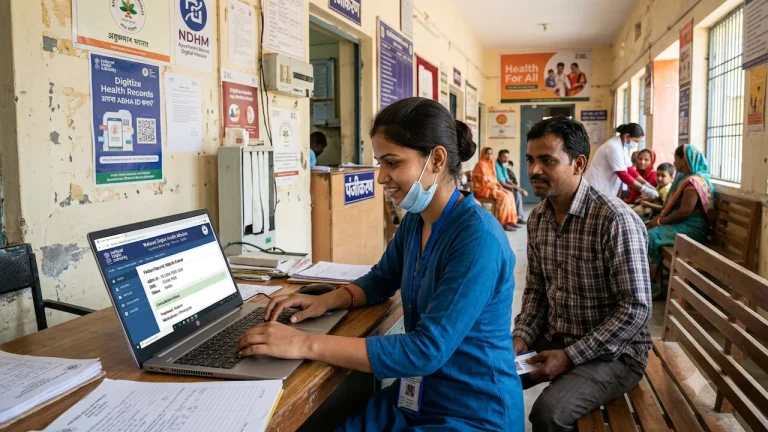
India has taken a major step towards building a truly connected digital healthcare ecosystem with the launch of the Bharat Health Terminology Service (BHTS) and the Common Lab Codes for India (CLCI). Introduced by Union Health Minister J.P. Nadda, the two platforms are expected to eliminate one of the biggest challenges in India’s healthcare system—fragmented medical records and inconsistent health data across hospitals and laboratories.
Developed by the National Resource Centre for EHR Standards (NRCeS) in collaboration with the National Health Authority (NHA), the platforms will strengthen the Ayushman Bharat Digital Mission (ABDM) by ensuring that healthcare providers across the country use a standardised digital language while recording diagnoses, laboratory tests and medical procedures.
Why India Needed A Unified Digital Health Language
For years, India’s healthcare sector has struggled with inconsistent medical terminology across hospitals, clinics and diagnostic laboratories.
A simple blood sugar test or lipid profile could be recorded under different names or codes depending on the hospital management software being used. As a result, patients often had to undergo duplicate diagnostic tests, doctors faced incomplete medical histories, and insurance processing frequently suffered delays due to incompatible health records.
Although electronic health records (EHRs) have become increasingly common, they often lacked semantic interoperability—the ability of different healthcare systems to understand and interpret medical information in the same way.
For example, one hospital may record a patient’s condition as “Type 2 Diabetes Mellitus,” another may use “T2DM,” while a rural health centre could simply mention “Sugar.” While doctors understand these terms refer to the same condition, software systems cannot automatically interpret such variations without standardisation.
What Is Bharat Health Terminology Service (BHTS)?
The Bharat Health Terminology Service (BHTS) serves as India’s central repository for standardised medical terminology and clinical vocabularies.
It functions as a secure, FHIR-compliant (Fast Healthcare Interoperability Resources) terminology server that enables hospitals, healthcare applications, insurers and software developers to access a common set of healthcare codes through APIs.
The platform integrates globally accepted medical standards such as SNOMED CT for diseases, clinical procedures and anatomy while adapting them for India’s healthcare ecosystem, including support for multiple Indian languages.
This means that regardless of whether a patient’s medical record is generated in a government hospital, a private healthcare chain or a rural primary health centre, the underlying digital information will remain consistent and universally understandable.
Common Lab Codes To Standardise Diagnostic Testing
Alongside BHTS, the government has also introduced the Common Lab Codes for India (CLCI) to bring uniformity to laboratory reporting across the country.
The CLCI has been developed using LOINC (Logical Observation Identifiers Names and Codes), one of the world’s most widely accepted international standards for laboratory tests and clinical observations.
The platform assigns unique digital identifiers to commonly conducted laboratory tests in India, ensuring every blood test, urine analysis or diagnostic investigation is recorded under a standard code irrespective of where it is conducted.
This standardisation will allow test reports to be seamlessly shared between hospitals, diagnostic centres and digital health applications linked to the Ayushman Bharat Health Account (ABHA).
How The New Platforms Will Benefit Patients
The launch of BHTS and CLCI is expected to significantly improve the healthcare experience for patients across the country.
Reduced Duplicate Medical Tests
Patients changing hospitals or consulting specialists in different cities will no longer need to repeat expensive diagnostic tests simply because previous reports cannot be interpreted by another hospital’s software.
Faster Health Insurance Claims
Standardised clinical terminology will help the National Health Claims Exchange (NHCX) automate claim verification, reducing delays in insurance approvals and reimbursements.
Improved Patient Safety
BHTS also complements the newly introduced National Drug Registry, providing standardised digital identities for more than 1.23 lakh medicines. This is expected to reduce prescription errors caused by similarly named medicines.
Better Digital Health Records
Medical histories stored under the Ayushman Bharat Digital Mission and linked to ABHA accounts can now be shared seamlessly across healthcare providers, creating more comprehensive and accessible patient records.
Supporting India’s Expanding Digital Health Ecosystem
India’s digital healthcare infrastructure has expanded rapidly over the past few years.
According to government data, more than 90 crore ABHA accounts have already been created, with over 100 crore health records linked to the digital ecosystem.
However, experts have consistently pointed out that digital infrastructure alone cannot ensure efficient healthcare unless different systems are capable of communicating using the same medical standards.
The introduction of BHTS and CLCI addresses this critical gap by providing a common language that enables hospitals, laboratories, insurers and digital health applications to exchange medical information accurately.
A Step Towards Intelligent Healthcare
Beyond improving day-to-day healthcare delivery, these platforms are expected to play a crucial role in the future of artificial intelligence-driven healthcare, clinical decision support systems and nationwide disease surveillance.
As healthcare increasingly relies on digital records and automated analysis, consistent and accurate medical terminology becomes essential for generating reliable insights and improving patient outcomes.
While successful implementation will depend on widespread adoption by hospitals, laboratories and software providers across India, the launch of BHTS and Common Lab Codes marks an important milestone in the country’s effort to build an integrated, intelligent and patient-centric healthcare system.