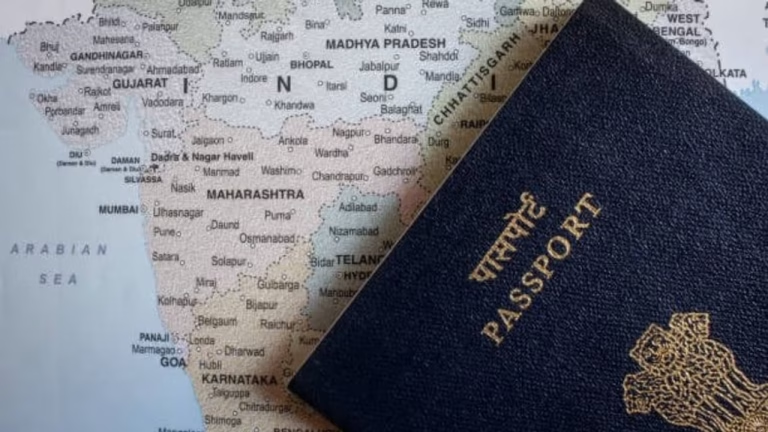
Weeks after a political debate over whether a passport constitutes proof of Indian citizenship, the Ministry of External Affairs (MEA) has clarified that a passport is primarily a travel document issued to regulate the departure of Indian citizens from the country.
Addressing the weekly media briefing on Tuesday, MEA spokesperson Randhir Jaiswal explained that the issuance of passports is governed by the Passports Act, 1967, and the Passports Rules, 1980, with every application undergoing an established verification process before approval.
Passport Issued After Due Verification
Responding to questions on the legal status of passports, Jaiswal said an Indian passport is issued only after completing the verification procedures prescribed under the law.
“An Indian passport is a document that, as per the Passports Act, 1967, is issued by the Government of India to regulate the departure from India of citizens of India.”
“It is issued after due verification laid out by an established process. The issue of passports to Indian citizens or any other individual is governed by The Passports Act, 1967 and the Passports Rules, 1980,” he added.
Jaiswal also noted that less than eight per cent of India’s population currently holds a passport, highlighting that passport ownership remains limited despite the country’s large population.
Clarification Comes Amid Electoral Roll Debate
The clarification comes amid questions over whether a passport can be accepted as proof of citizenship during the Special Intensive Revision (SIR) of electoral rolls being conducted by the Election Commission in several states.
Officials reiterated that while passports are issued to Indian citizens after due verification, the document’s principal function is to facilitate international travel and establish the holder’s identity while abroad.
Earlier MEA Position on Passports
The latest remarks follow an earlier clarification made by the MEA on June 24, during a briefing held on Passport Seva Divas, when the ministry stated that an Indian passport should be regarded strictly as a travel document and not as standalone proof of citizenship.
Government Sources Cite Legal Position
According to government sources, the legal framework under the Passports Act, 1967, allows passports to be issued in certain circumstances to individuals who may not necessarily qualify as Indian citizens.
They also referred to a 2013 Bombay High Court judgment, which observed that mere possession of a passport cannot be treated as conclusive or definitive proof of Indian citizenship.
Political Row Over Passport’s Legal Status
The government’s clarification has sparked political debate, with critics pointing out that obtaining an Indian passport involves extensive scrutiny, including document verification and police verification of an applicant’s residential credentials.
The discussion has gained prominence amid ongoing scrutiny of citizenship-related documentation and electoral roll verification exercises across several states.