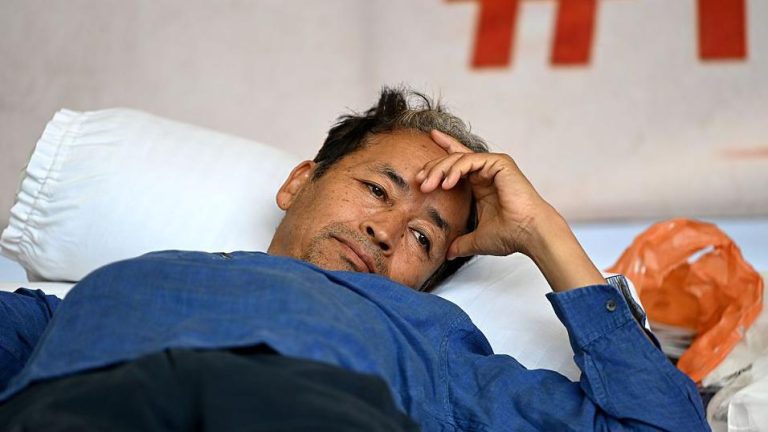
As climate activist and educationist Sonam Wangchuk’s indefinite hunger strike entered its 19th day, concerns over his health have brought renewed attention to the legal status of hunger strikes in India. The Delhi High Court recently directed the Centre and the Delhi government to ensure regular health monitoring and provide medical assistance whenever required, highlighting the balance between an individual’s right to protest and the State’s duty to protect life.
Wangchuk began his fast at Delhi’s Jantar Mantar on June 28 as part of a protest demanding the resignation of Union Education Minister Dharmendra Pradhan over alleged irregularities in examinations, including NEET.
Is Going On A Hunger Strike Illegal In India?
No. There is no specific law in India that makes going on a hunger strike a criminal offence.
The Constitution protects citizens’ right to freedom of speech and expression under Article 19(1)(a) and the right to assemble peacefully under Article 19(1)(b). Peaceful forms of protest, including sit-ins and symbolic fasts, are generally considered part of democratic expression.
However, these rights are subject to reasonable restrictions related to public order, security, morality and other grounds mentioned under Article 19.
Is An Indefinite Fast Different From A Regular Protest?
Legally, an indefinite hunger strike raises different concerns when it begins to pose a serious threat to a person’s life.
While choosing to fast is not illegal, the government has a responsibility under Article 21, which guarantees the right to life, to protect citizens when their health is at significant risk.
This is why authorities often monitor hunger strikers, arrange medical check-ups and intervene if their condition becomes critical.
Can Authorities Force-Feed A Hunger Striker?
There is no general law that automatically permits authorities to force-feed every person undertaking a hunger strike.
In most cases, officials rely on medical advice, discussions and persuasion. If doctors believe a person’s life is in immediate danger, hospitalisation or medical treatment may become necessary, depending on the circumstances and legal directions.
Courts have generally attempted to balance two principles — an individual’s personal autonomy and the State’s responsibility to preserve life.
In Wangchuk’s case, the Delhi High Court has not ordered force-feeding. Instead, it has directed authorities to conduct daily health monitoring and provide medical support whenever required.
Can Police Stop A Hunger Strike?
Authorities can restrict or stop a protest under certain circumstances, but not simply because it involves fasting.
Police action may be taken if:
- The protest violates legal restrictions or prohibitory orders
- It creates a law-and-order situation
- It blocks public spaces or causes major disruption
- Required permissions have not been obtained
In previous cases, authorities have detained hunger strikers or moved them to hospitals citing public safety and health concerns.
What Have Indian Courts Said About Hunger Strikes?
Indian courts have generally recognised peaceful protest as an important democratic right while also emphasising that the government cannot ignore threats to human life.
During the hearing related to Wangchuk’s fast, the Delhi High Court observed that every citizen’s life is valuable and directed authorities to ensure regular medical supervision.
India’s History Of Hunger Strikes
Hunger strikes have played a significant role in India’s political and social movements.
Mahatma Gandhi used fasting as a method of non-violent resistance during the freedom struggle. In independent India, activists and leaders such as Anna Hazare and Irom Sharmila have also used indefinite fasts to highlight public issues and demand action.
Governments have often allowed such protests but have intervened through medical supervision, detention or hospitalisation when health risks became severe.
Wangchuk Continues Fast, Appeals For July 20 March
Wangchuk has maintained that ending his fast without a response from the government would weaken the message of the protest. He has urged supporters to participate in the proposed “Chalo Sansad” march on July 20, which coincides with the beginning of Parliament’s Monsoon Session.
The activist has also appealed to students and citizens to participate, describing peaceful protest as an important lesson in democracy.