
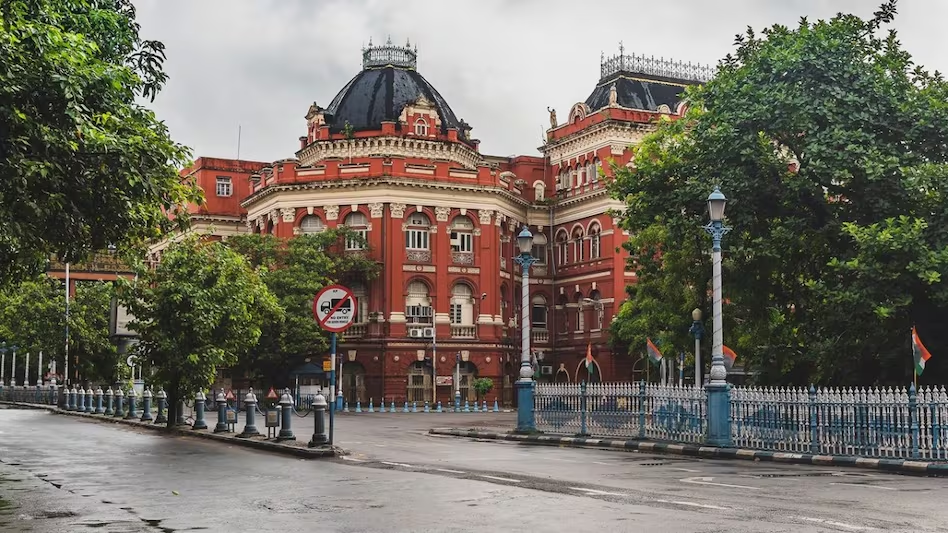


As political attention once again turns toward West Bengal, Kolkata’s iconic Writers’ Building has returned to the spotlight. Known for its striking red façade and deep historical significance, the landmark has long stood as one of the most powerful symbols of governance and political authority in Bengal.
Where Colonial Kolkata’s Administrative Story Began
Constructed in 1777 and completed around 1780, Writers’ Building was originally built to accommodate the junior clerks, known as “writers,” of the British East India Company. Located in the heart of colonial Calcutta, the structure later evolved into a major administrative headquarters during British rule in India.
The building was designed by architect and builder Thomas Lyon and was initially created with a simple and practical design focused on functionality rather than grandeur.
Kolkata’s First Three-Storey Landmark
At the time of its construction, Writers’ Building was believed to be Kolkata’s first three-storey structure. As British influence expanded across India, the building underwent several transformations and gradually adopted more elaborate European architectural styles.
French Renaissance influences, long verandas, decorative façades, and towering Ionic columns were later added to project imperial authority and administrative power.
A Landmark Connected To India’s Freedom Movement
Writers’ Building also occupies an important place in India’s independence movement. In 1930, Bengali revolutionaries Benoy Basu, Badal Gupta, and Dinesh Gupta launched a historic attack inside the building and assassinated British official N. S. Simpson.
The incident became one of Bengal’s most remembered anti-colonial acts, and the surrounding area was later renamed B. B. D. Bagh in honour of the three revolutionaries.
Bengal’s Political Power Centre
For decades, Writers’ Building functioned as the administrative headquarters of the West Bengal government and became widely known as “Mahakaran.” Thousands of government employees worked inside the massive complex, making it the nerve centre of state administration.
The building also became deeply woven into Kolkata’s political culture, with protests, rallies, and demonstrations often gathering outside its gates.
A Blend Of Architecture And History
Over the centuries, multiple additions transformed the original structure into a sprawling interconnected complex. Decorative statues representing justice, commerce, science, and agriculture were incorporated into the exterior, combining colonial symbolism with European artistic influences.
Despite extensive modifications, parts of the original 18th-century structure designed by Thomas Lyon are still believed to exist within the complex today.
Restoration And Preservation Efforts
Today, Writers’ Building remains one of Kolkata’s most recognisable heritage landmarks. Restoration and conservation work continues as authorities attempt to preserve the building’s historical and architectural significance while adapting it for modern administrative needs.
Beyond its political importance, the structure stands as a reminder of Kolkata’s colonial past, freedom struggle, and evolving identity through centuries of change.