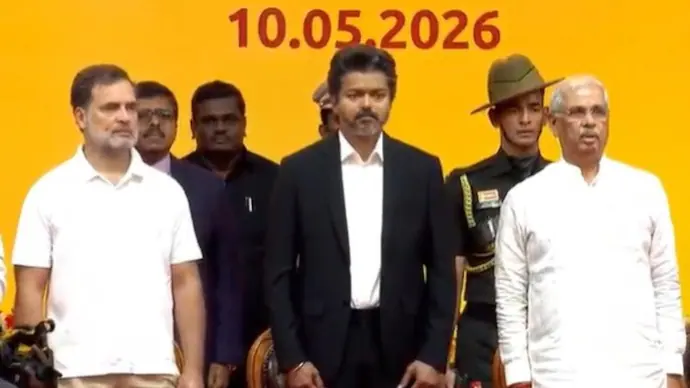
In a political masterstroke that has left both allies and rivals talking, the swearing-in ceremony of Vijay as the Chief Minister of Tamil Nadu saw a rigorous adherence to the Union Home Ministry’s controversial new guidelines on the national song.
While the Narendra Modi government faced a political firestorm for mandating the full six-stanza rendition of Vande Mataram earlier this year, Vijay’s administration chose to lead with the song in its entirety, followed by the national anthem. The move was particularly striking as it took place in the presence of Rahul Gandhi, signaling a calculated balance between regional identity and national protocol.
A Contrast in Ceremonies: Kolkata vs. Chennai
The decision to play the full version of the song, penned by Bankim Chandra Chattopadhyay, highlighted a sharp contrast with the swearing-in ceremony of the BJP’s first Chief Minister in West Bengal just a day prior. Despite the presence of PM Modi and Home Minister Amit Shah at Kolkata’s Brigade Parade Ground, the full six stanzas were notably absent from that event.
By incorporating the full rendition, Vijay has effectively “done one better” than the BJP, demonstrating a commitment to the MHA’s January 28 directive while simultaneously neutralizing potential criticism regarding nationalist credentials.
The Six-Stanza Dispute and Historical Friction
The MHA’s directive, which moved away from the 1950 practice of singing only the first two stanzas, had previously sparked intense debate.
Critics, including the Congress and former West Bengal CM Mamata Banerjee, argued that the move disregarded historical sensitivities established in 1937 under the guidance of Rabindranath Tagore. Banerjee had even termed the mandate an insult to Tagore, insisting that the national anthem should not take a back seat to Vande Mataram.
However, by placing both songs center stage today, the new Tamil Nadu government has navigated a path that adheres to federal guidelines while maintaining a high-profile alliance with the Congress leadership.
Political Implications of the ‘Anthem Diplomacy’
This “anthem diplomacy” suggests a sophisticated strategy by Vijay’s TVK to avoid the “anti-national” labels often used in polarized political discourse. By embracing a song that has been a point of friction between the Centre and Opposition-led states, Vijay has signaled that his government can be both a partner in national protocols and a fierce guardian of state interests.
As the 2026 political landscape shifts, this ceremony at the Secretariat may well be remembered as the moment the actor-turned-politician proved his mettle in the complex arena of symbolic politics.