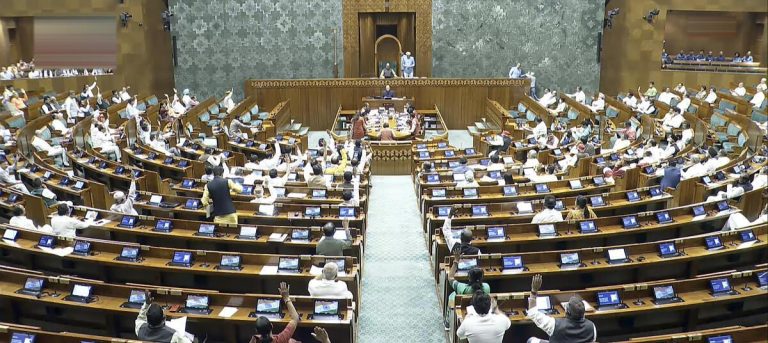
New Delhi: The proposed Constitution Amendment Bill aimed at modifying the implementation framework of the women’s reservation law was defeated in the Lok Sabha after a division of votes, dealing a significant setback to the government’s legislative agenda.
Following the defeat, the government announced that it would not proceed with two related legislations — the Delimitation Bill and the Union Territories Laws (Amendment) Bill — both of which were linked to the broader rollout of women’s reservation provisions.
Two-Thirds Majority Requirement Proved A Major Hurdle
A Constitution amendment requires the support of at least two-thirds of members present and voting in the Lok Sabha to be passed.
However, the ruling National Democratic Alliance (NDA) did not have the necessary numbers to secure the required majority, leading to the defeat of the amendment bill during voting.
Given the constitutional threshold, even a simple majority was insufficient to push the bill through, making the lack of numbers a decisive factor in its rejection.
Linked Bills Also Dropped After Amendment Defeat
With the main constitutional amendment failing to pass, the government decided not to move forward with the Delimitation Bill and the Union Territories Laws (Amendment) Bill.
One of these bills was considered crucial for extending the women’s reservation framework to Union Territories such as:
- Delhi
- Puducherry
- Jammu and Kashmir
Had the constitutional amendment cleared the Lok Sabha, these supplementary laws would have enabled the practical implementation of reservation provisions in the above Union Territories.
Implications For Women’s Reservation Rollout
The defeat of the Constitution Amendment Bill raises fresh uncertainty around the timeline and framework for implementing the women’s reservation policy.
Since constitutional amendments form the legal backbone for structural electoral reforms, the inability to secure the required majority suggests that the government may need to revisit its legislative strategy or seek broader political consensus before reintroducing similar proposals in the future.