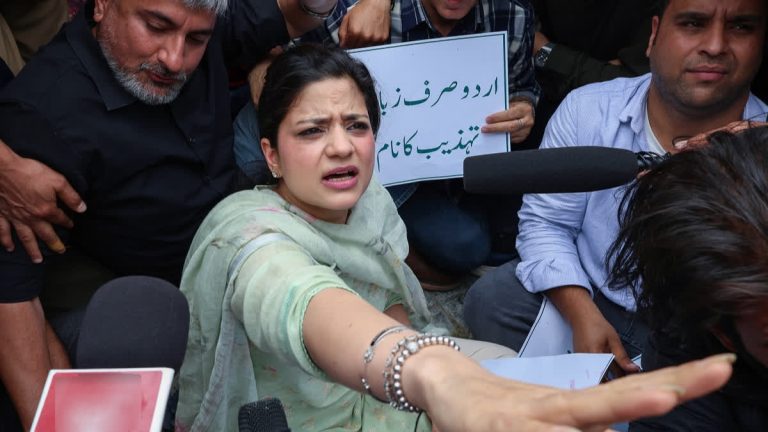
A proposed amendment to Jammu and Kashmir’s Revenue Service recruitment rules has triggered a wider political and cultural debate, turning an administrative proposal into a contentious issue over language, identity, and governance.
The draft notification, currently open for public feedback, has drawn criticism from the Peoples Democratic Party (PDP), which argues that it could weaken the role of Urdu in government services. However, the National Conference-led administration has dismissed these concerns, stating that no final decision has been taken.
Protests and Political Reactions
The issue escalated in Srinagar, where PDP leader Iltija Mufti led protests, calling the proposal a threat to the region’s linguistic heritage. She emphasised that Urdu has historically acted as a unifying administrative language across diverse communities in Jammu and Kashmir.
Government officials, however, clarified that the notification is part of a routine consultation process. Advisor Nasir Aslam Wani stated that Urdu continues to play a key role in revenue administration and remains integral to the system.
Why Urdu Matters in Governance
Urdu has long been central to land and revenue administration in Jammu and Kashmir. For decades, it was mandatory for posts such as Patwari and Naib Tehsildar, as official records were maintained in the language. Officials argue that removing the requirement without a transition plan could create difficulties in handling existing documents.
Historical Background
Urdu was established as the court and administrative language in 1889 under Maharaja Pratap Singh, replacing Persian. It remained the primary official language for more than a century and served as a bridge language among Kashmiri, Dogri, Punjabi, and other linguistic groups.
After the abrogation of Article 370 and the reorganisation of Jammu and Kashmir into a Union Territory, the government expanded the list of official languages to include Kashmiri, Dogri, Hindi, and English alongside Urdu, ending its exclusive official status.
The Core Debate
The controversy highlights a broader policy question: should recruitment rules prioritise administrative efficiency or protect historical linguistic continuity?
Supporters of the change, including political voices associated with the Bharatiya Janata Party, argue that removing mandatory Urdu requirements would make recruitment more inclusive for candidates from different linguistic backgrounds.
Opponents warn that reducing Urdu’s role could weaken a language deeply embedded in administrative systems and historical records, potentially complicating governance if not managed carefully.
What Happens Next
With the proposal still under review, authorities have stressed that public consultation will guide the final decision. The outcome is expected to balance administrative practicality, inclusivity, and cultural preservation.
For now, the debate reflects a larger tension in Jammu and Kashmir between modernization of governance systems and preservation of linguistic identity.