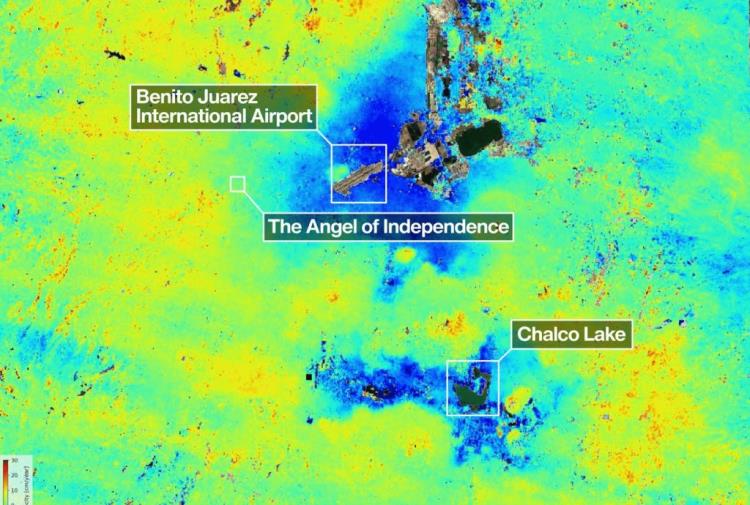
Mexico City: Mexico City is sinking at an alarming rate of nearly 10 inches (around 25 centimetres) each year, according to new satellite data released by NASA. The findings place the Mexican capital among the fastest-sinking cities in the world, highlighting a growing environmental and urban crisis.
The data, collected between October 2025 and January 2026, comes from the advanced NISAR satellite, a joint project between NASA and the Indian Space Research Organisation (ISRO). The satellite is designed to monitor subtle changes on Earth’s surface, offering unprecedented insights into land movement.
A City Built on a Fragile Foundation
Spanning roughly 3,000 square miles and home to nearly 22 million people, Mexico City and its surrounding urban areas are built on what was once an ancient lakebed. Historically, much of the city featured canals — remnants of which still exist in some outer regions.
Over decades, excessive groundwater extraction combined with rapid urban expansion has caused the underlying aquifer to shrink. This has led to continuous land subsidence for more than a century.
The effects are already visible. Several historic structures, including the iconic Metropolitan Cathedral, have developed noticeable tilts due to the uneven sinking of the ground beneath them.
Impact on Infrastructure and Daily Life
Experts warn that the consequences go far beyond aesthetics. Enrique Cabral, a geophysics researcher at the National Autonomous University of Mexico, said the phenomenon is severely affecting essential infrastructure.
“It damages critical systems such as the subway, drainage networks, water supply, housing, and roads,” he noted, calling it a “very big problem.”
In some areas — including near the city’s main airport and the famous Angel of Independence — subsidence is occurring at an average rate of about 0.78 inches (2 centimetres) per month.
Over the past century, parts of the city have sunk by more than 39 feet (12 metres), underscoring the long-term severity of the issue.
Satellite Technology Reveals the Full Picture
Scientists say the real breakthrough lies in how clearly the problem can now be observed from space. According to NISAR scientist Paul Rosen, the satellite provides a detailed view not just of surface changes, but also of what is happening beneath the ground.
“It’s essentially documenting these changes across the entire city,” Rosen explained, adding that the technology reveals the full scale of the crisis.
In the future, researchers hope to refine the data further, potentially enabling building-level monitoring of subsidence.
Global Applications and Future Solutions
Beyond Mexico City, the NISAR mission could play a key role worldwide — tracking earthquakes, monitoring fault lines, studying climate change impacts in regions like Antarctica, and even improving early warning systems for disasters such as volcanic eruptions.
For Mexico City, however, the immediate focus is understanding and mitigating the crisis. While authorities have historically taken limited action — mostly stabilising key monuments — increasing water shortages have prompted renewed attention and funding for research.
Experts believe that detailed satellite data will be crucial in shaping long-term solutions.
“To mitigate the problem, the first step is to fully understand it,” Cabral said.