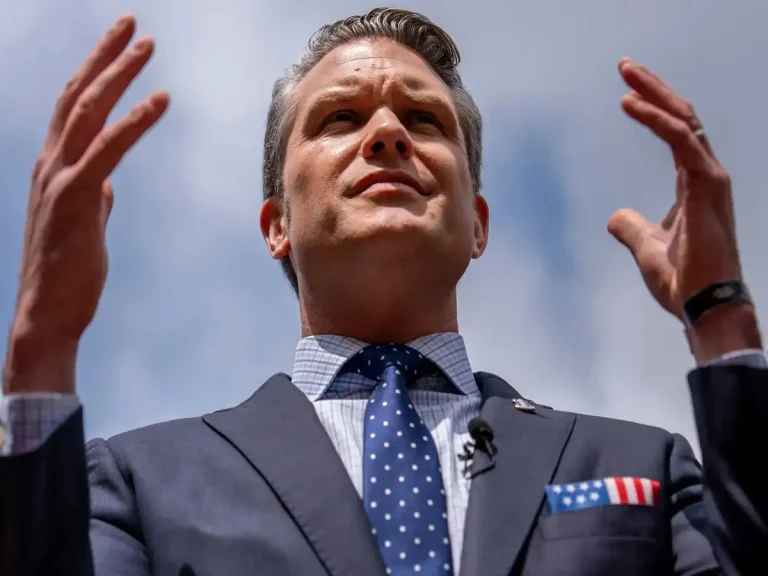
Washington: Pete Hegseth has triggered controversy after reciting a prayer during a worship service at the Pentagon that closely resembled lines from the 1994 Hollywood classic Pulp Fiction.
The moment drew widespread attention due to both the wording of the prayer and the setting in which it was delivered — inside the headquarters of the US military.
Hegseth told attendees that the prayer had been shared with him by the lead mission planner involved in a rescue operation for two US Air Force personnel who had been shot down over Iran. He described the prayer as one traditionally used in combat search-and-rescue (CSAR) missions.
Prayer Linked to Combat Search-and-Rescue Missions
Speaking at the service, Hegseth explained that the prayer was associated with rescue teams known as “Sandys,” referring to A-10 aircraft crews involved in CSAR operations.
“This prayer was recited by Sandy 1, to all Sandys, all those A-10 crews, prior to all CSAR missions, but especially this CSAR mission that happened in real time,” he said.
He added that the prayer was known as CSAR 25:17, which he suggested was inspired by the Biblical verse Book of Ezekiel chapter 25, verse 17.
The lines he recited included:
“The path of the downed aviator is beset on all sides by the iniquities of the selfish and the tyranny of evil men… And you will know my call sign is Sandy One, when I lay my vengeance upon thee. Amen.”
Similarity to ‘Pulp Fiction’ Monologue Raises Questions
Media outlets quickly pointed out that the wording closely mirrors a famous monologue delivered by Samuel L. Jackson in Pulp Fiction, directed by Quentin Tarantino.
In the film, Jackson’s character quotes what is presented as a Biblical verse from Ezekiel 25:17. However, scholars note that the version used in the movie is largely fictional and significantly expanded for dramatic effect.
The original Biblical verse is far shorter and differs in tone. It reads:
“And I will execute great vengeance upon them with furious rebukes; and they shall know that I am the Lord, when I shall lay my vengeance upon them.”
Observers noted that the Pentagon version replaced references to God with military terminology, including phrases tied to mission roles and call signs — a change that has fuelled debate about mixing religious imagery with combat rhetoric.
Controversy Intensifies Amid Wider Political Tensions
The controversy comes at a sensitive moment in US political and diplomatic circles, particularly as tensions continue between Donald Trump and Pope Leo.
Trump recently criticised the Pope, accusing him of being weak on crime and ineffective in foreign policy due to his opposition to US involvement in the Iran conflict.
In response, Pope Leo adopted a measured tone, saying he had no fear of the Trump administration while urging global leaders to pursue peace. He also warned against invoking religion as a justification for military action — comments seen by many as indirectly linked to the Pentagon incident.