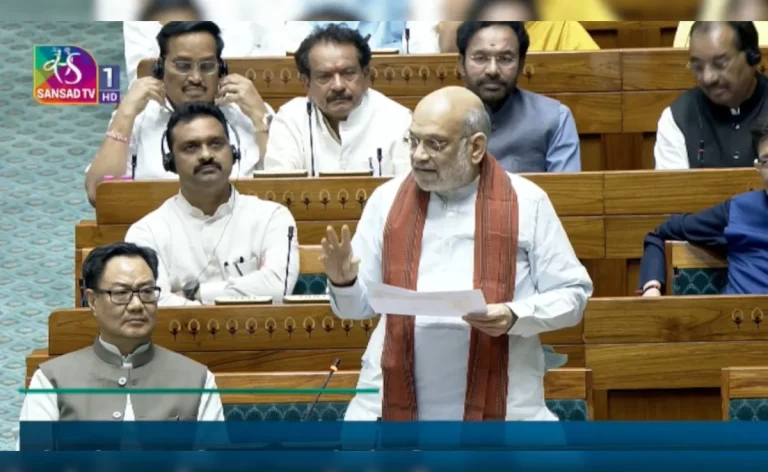
New Delhi: Union Home Minister Amit Shah on Thursday addressed mounting concerns over the proposed delimitation exercise, firmly rejecting claims that southern states would lose representation in the Lok Sabha after the expansion of parliamentary seats.
Speaking during a debate in Parliament on bills related to amendments in the women’s reservation law and the formation of a delimitation commission, Shah described fears raised by opposition leaders as “completely false” and “misleading.” He emphasised that the delimitation exercise would actually strengthen representation across regions rather than weaken it.
Southern States To See Significant Seat Increase
Addressing one of the key concerns raised by opposition parties, Shah presented a detailed breakdown of projected seat increases for southern states once the total strength of the Lok Sabha is expanded.
He stated that the combined Lok Sabha seats of the five southern states would rise from 129 seats to 195 seats, marking an increase of nearly 50 percent.
According to the proposed distribution:
- Karnataka: 28 seats → 42 seats
- Andhra Pradesh: 25 seats → 38 seats
- Telangana: 17 seats → 26 seats
- Tamil Nadu: 39 seats → 59 seats
- Kerala: 20 seats → 30 seats
Shah also noted that the southern region’s overall share in Lok Sabha representation would see a slight rise, moving from 23.76 percent to approximately 23.87 percent, countering concerns that their relative influence would decline.
Lok Sabha Strength Likely To Rise To 816 Seats
The Home Minister clarified that although legislation allows the Lok Sabha’s total strength to increase up to 850 seats, the current proposal fixes the number at 816 seats, representing exactly 50 percent more seats than the present strength.
He said the framework for delimitation mirrors earlier laws and does not introduce new changes.
“There is no change, not even a comma or a full stop,” Shah said, dismissing allegations that the government was attempting to alter the rules for political advantage.
Women’s Reservation To Be Implemented From 2029
Clarifying the timeline for the women’s reservation law, Shah said the provisions reserving 33 percent of seats for women would only come into effect from 2029.
He explained that elections scheduled before 2029 will continue under the existing electoral framework, without implementing the reservation provisions.
This clarification came amid political debate over the timing of the reservation rollout and its possible electoral implications.
Opposition Concerns Rejected
Shah also dismissed allegations that the government was timing the delimitation and women’s reservation initiatives to influence upcoming elections, including those in key states such as West Bengal.
Taking a political swipe during the debate, he remarked that Samajwadi Party chief Akhilesh Yadav need not worry about future elections in Uttar Pradesh.
On the issue of caste census, Shah reiterated that the government had already decided to conduct caste enumeration alongside the nationwide population census. However, he clarified that the ongoing household enumeration currently underway does not collect caste-related data.
Why The Delimitation Debate Matters
The proposed delimitation exercise has become a major political issue because it will determine how parliamentary seats are distributed across states based on population changes.
Southern states have voiced concerns that states with higher population growth in northern India could gain more seats, potentially shifting political influence. Shah’s remarks were aimed at reassuring these states that their representation would increase both in numbers and overall share.