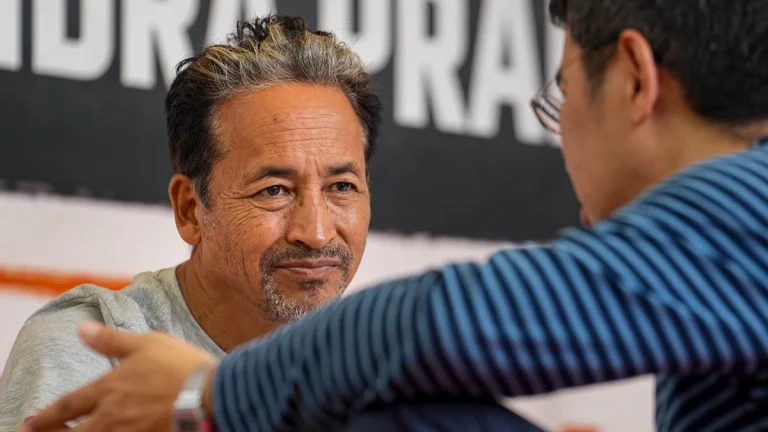
Activist and educator Sonam Wangchuk, who has been on a hunger strike for more than 20 days, has said he is prepared to end his fast—but only if three key conditions are met.
In a handwritten letter shared from what he described as his “illegal detention” at Delhi’s Safdarjung Hospital, Wangchuk said his fast would continue until after the proposed ‘Sansad Chalo’ (March to Parliament) unless the government and political leaders fulfill his demands.
Three Conditions to End the Hunger Strike
In his letter, Wangchuk outlined three conditions under which he would agree to end his indefinite fast.
1. Government Must Accept Responsibility
His first demand is for the Union government to acknowledge and take responsibility for what he described as failures in the country’s education system, particularly the alleged NEET question paper leak that sparked nationwide outrage.
According to Wangchuk, accountability is essential to restore public trust in India’s examination process.
2. Opposition Must Raise NEET Issue in Parliament
His second condition is that political leaders publicly assure him that the issue of alleged examination irregularities and paper leaks will be raised during the ongoing Parliament session.
Wangchuk said the matter should receive serious discussion inside Parliament to ensure meaningful reforms.
3. Senior Political Leaders Must Meet Him
His final condition is for senior political leaders to visit him at Safdarjung Hospital and personally assure him that the first two demands will be pursued, particularly if his health prevents him from participating in the planned Parliament march.
Sharing his letter on social media, Wangchuk wrote:
“WHEN WILL I END THE FAST….! Notwithstanding my health my fast continues till after the Sansad Chalo March, and will be broken only under the following circumstances…”
The activist concluded the letter by alleging that his “freedom of movement, speech, and all communication are restricted at the illegal detention.”
Shifted to Hospital After Health Deteriorated
Wangchuk joined the Cockroach Janta Party (CJP) protest at Delhi’s Jantar Mantar on June 28, demanding the resignation of Union Education Minister Dharmendra Pradhan over the alleged NEET paper leak. He simultaneously began an indefinite hunger strike in support of education reforms and greater accountability.
On July 18, the 21st day of his fast, Delhi Police shifted Wangchuk from the protest site to Safdarjung Hospital after doctors reportedly warned that his condition had become critical, raising concerns about possible organ failure.
The police action came shortly after the Delhi High Court directed authorities to ensure that every possible measure was taken to safeguard Wangchuk’s life.
Delhi High Court Refuses Interim Relief
Meanwhile, Wangchuk’s wife, Gitanjali Angmo, approached the Delhi High Court seeking permission to shift him to a private hospital.
However, the court declined to grant interim relief, observing that the government was within its rights to move Wangchuk to Safdarjung Hospital given his deteriorating health and refusal to voluntarily seek medical treatment.
Justice Mini Pushkarna noted that doctors were closely monitoring Wangchuk and that he had accepted oral medication voluntarily.
“Since doctors of the hospital are closely monitoring him and gave him oral medicine with his consent, it cannot be said that force is being used or his autonomy is being violated… No interim orders are required to be passed at this stage.”
Senior advocate Vivek Tankha, appearing for Wangchuk’s family, told NDTV that the High Court’s order is likely to be challenged before a division bench, with an urgent hearing expected.
Protest Focused on Education Reforms
Over the years, Sonam Wangchuk has led several campaigns on issues concerning Ladakh, environmental conservation and educational reforms.
His latest protest has focused on transparency in India’s examination system, with demands for accountability following the alleged NEET paper leak and broader reforms aimed at strengthening public confidence in the country’s education system.
With the proposed Parliament march set to take place today, all eyes remain on whether the government or opposition parties respond to Wangchuk’s three conditions and whether the veteran activist finally brings his prolonged hunger strike to an end.