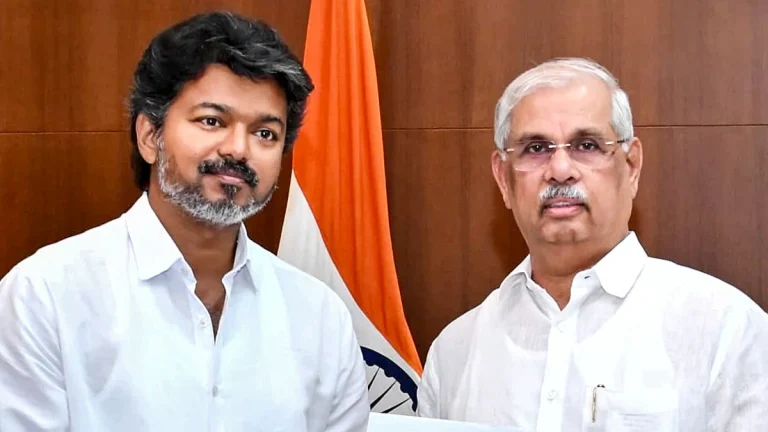
For Tamilaga Vettri Kazhagam (TVK) chief Vijay, the race to form the Tamil Nadu government has turned into a story of being “so close, yet so far”. Hours after the actor-politician met Governor RV Arlekar and staked claim to form the government, two key potential allies — the Indian Union Muslim League (IUML) and TTV Dhinakaran’s Amma Makkal Munnetra Kazhagam (AMMK) — publicly distanced themselves from supporting the TVK-led effort.
According to sources in the Governor’s office, Vijay has not been invited to take oath as Chief Minister because he could not furnish written proof of support from at least 118 MLAs, the majority mark in the 234-member Tamil Nadu Assembly.
Despite intense backroom negotiations with several parties and independent legislators, the TVK reportedly managed support from only 116 MLAs, falling short by two seats. Vijay and his party had been engaged in last-minute talks with the Viduthalai Chiruthaigal Katchi (VCK), AMMK, and an IUML MLA in a bid to secure the numbers required to form the government.
However, hopes of gaining crucial support suffered a major setback when the IUML released an official statement clarifying that it was not part of any TVK-led alliance. Soon after, AMMK chief TTV Dhinakaran also wrote to Governor Arlekar, urging him to instead invite the AIADMK to form the government.
Vijay had met Governor Arlekar earlier in the evening and claimed that he enjoyed the backing of 118 MLAs. But sources said the Governor insisted on written letters of support from the legislators before extending any invitation to form the government.
The political uncertainty comes despite TVK’s stunning electoral debut. Vijay’s party won 108 seats in the recently concluded Assembly election, ending the decades-long dominance of Tamil Nadu’s two Dravidian giants — the DMK and the AIADMK — over state politics. The election result was widely seen as a political earthquake, with TVK emerging as the single-largest party in its first-ever Assembly contest.
But celebrations quickly gave way to uncertainty after Governor Arlekar made it clear that numerical strength alone was not enough without formal proof of majority support.
Sources said the Governor held two rounds of meetings with Vijay over Wednesday and Thursday, during which he repeatedly stressed that a government could only be formed after demonstrating support from at least 118 MLAs. Vijay, however, only had the 108 legislators elected on the TVK symbol at the time.
The Congress party, which had broken ranks with its long-time ally Dravida Munnetra Kazhagam (DMK), contributed five MLAs to Vijay’s bloc. However, the Congress reportedly attached conditions to its support, including that the TVK should avoid aligning with what it termed “communal parties” — an indirect reference to the Bharatiya Janata Party (BJP), which remains allied with the AIADMK.
The split between the DMK and Congress after years of electoral cooperation added another dramatic layer to Tamil Nadu’s post-election political crisis. Leaders from both camps accused each other of betrayal as the power struggle intensified.
To bridge the gap, TVK also opened communication channels with the VCK, Communist Party of India (Marxist), and Communist Party of India. These parties, traditionally aligned with the DMK, were simultaneously exploring multiple political possibilities, including continuing with MK Stalin’s camp or supporting alternative arrangements.
Vijay had additionally reached out to one of the two IUML MLAs and the lone AMMK legislator for support. While the CPI and CPM eventually agreed to extend outside support to the TVK, both Left parties clarified they would not join a Vijay-led cabinet. Meanwhile, Congress is believed to be seeking two ministerial berths in exchange for its backing.
The high-voltage political drama also triggered speculation about a possible understanding between the DMK and AIADMK — parties that are ideological rivals despite sharing roots in the Dravidian social justice movement inspired by EV Ramasamy “Periyar”.
Political observers said both parties were motivated by a common concern over Vijay’s rapid rise. For the DMK, the situation revived memories of the MGR era between 1977 and 1987, when the party remained out of power for a decade. Within the AIADMK too, concerns have reportedly grown after suffering three consecutive electoral defeats to MK Stalin over the past decade.
Despite the speculation, senior leaders from both camps reportedly dismissed the possibility of a formal DMK-AIADMK alliance, saying ideological opposition within their parties would never allow such an arrangement to survive.
There was also brief buzz around a possible understanding between the TVK and the AIADMK, which won 47 seats in the election, but no such development materialised.
Meanwhile, the BJP has rejected allegations that it played any role in the ongoing deadlock between Vijay and Governor Arlekar.
Calling it a “fractured verdict”, BJP state spokesperson Narayan Thirupathy said the Governor would act strictly according to constitutional norms.
“If Vijay proves majority support, the Governor will constitutionally accept it. There is no confusion,” Thirupathy told news agency PTI.
He also dismissed allegations that the BJP was influencing the Governor against Vijay.
“This is a democratic country. Elections happen democratically. TVK has emerged with more seats. Everything will happen democratically. These allegations are only political rhetoric,” he said.
With the numbers still uncertain and alliance negotiations continuing behind closed doors, Tamil Nadu remains gripped by political suspense over who will eventually form the next government.