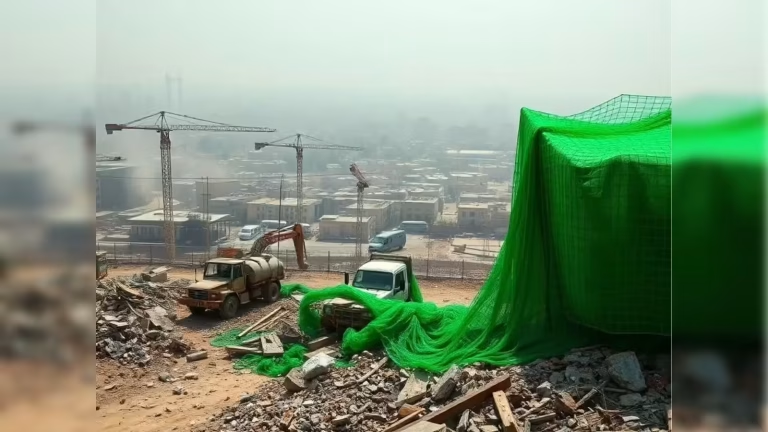
Green mesh covers hanging around construction sites have become a common sight across Delhi, promoted as a key solution to curb dust pollution. However, a recent assessment by the Delhi Pollution Control Committee has raised concerns about whether many of these nets are actually effective.
Following the review, authorities have introduced stricter rules requiring green construction nets to meet minimum quality standards.
Delhi Introduces New Rules For Green Nets
The Delhi government has now made it mandatory for green construction nets to have a minimum thickness of 100 GSM (grams per square metre).
According to Environment Minister Manjinder Singh Sirsa, the move aims to ensure that dust-control measures are functional rather than merely cosmetic.
Officials said earlier rules required construction sites to use green nets or tarpaulin sheets, but no minimum material quality standard existed until now.
Authorities have warned of strict action against construction sites failing to comply with the revised norms.
Why Green Nets Are Used At Construction Sites
Green mesh covers are designed to reduce the spread of dust generated during:
- Excavation
- Demolition
- Drilling
- Debris movement
- Material transportation
The nets help slow airflow around construction zones and are intended to stop larger dust particles from spreading into nearby residential and commercial areas.
Construction dust is a major contributor to air pollution and can worsen respiratory illnesses and other health conditions.
Construction Dust Remains A Major Pollution Source
Studies by The Energy and Resources Institute and Automotive Research Association of India found that construction and road dust account for a significant share of Delhi’s particulate pollution.
According to the research:
- Dust contributes heavily to PM10 pollution levels
- It also forms a major portion of PM2.5 pollution, especially during summer months
These microscopic particles are considered especially dangerous because they can enter deep into the lungs.
Experts Say Green Nets Alone Are Not Enough
Environmental experts say green covers can reduce larger dust particles if installed correctly and maintained properly.
However, they caution that:
- Poorly fitted or damaged nets allow dust to escape easily
- Fine particles like PM2.5 can pass through porous mesh material
- Many sites fail to properly secure or maintain the covers
Experts also argue that green nets should be viewed as just one part of a broader dust-control strategy.
Additional Dust-Control Measures Needed
Specialists recommend multiple pollution-control steps alongside green covers, including:
- Regular water sprinkling
- Covering debris during transport
- Wheel-washing systems for trucks
- Vacuum road sweeping
- Proper storage of construction materials
Without these supporting measures, experts warn that green nets risk becoming symbolic rather than effective.
Delhi Working On Dust Portal 2.0
The Delhi government is also developing “Dust Portal 2.0,” a centralised monitoring system aimed at improving oversight of construction and demolition sites.
Officials have already made registration of construction sites on the portal compulsory to strengthen enforcement and pollution-control compliance.
Bigger Challenge For Delhi’s Air Quality
Construction dust continues to remain one of Delhi’s largest pollution challenges due to rapid urbanisation, infrastructure projects, metro expansion, and real-estate development.
Experts say meaningful improvement in air quality will require stricter enforcement, better site management, and a combination of technologies rather than reliance on green mesh sheets alone.