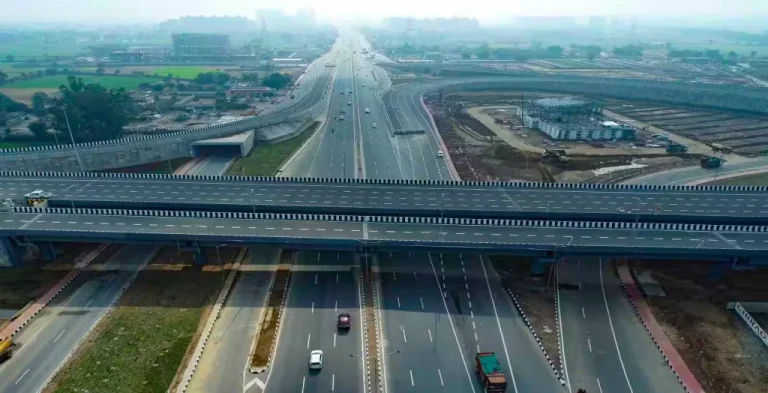
The idea of distance in the National Capital Region is rapidly changing.
What once felt like long, exhausting journeys from Delhi to neighbouring towns can now be completed in under 90 minutes, thanks to a massive push in highways, expressways, rapid rail systems and metro expansion projects.
A few years ago, towns such as Meerut, Sohna, Baghpat, Alwar and parts of Faridabad were considered too far for daily commuting or regular business activity. Today, improved connectivity has integrated these regions into Delhi’s growing economic ecosystem, triggering a surge in real estate demand, logistics expansion, tourism and commercial development.
The phrase “Delhi Ab Door Nahi” is no longer just a slogan. For many residents and businesses across NCR, it has become a reality.
Expressways Reshaping NCR’s Economic Geography
A series of large-scale road infrastructure projects has dramatically improved travel across the region.
The Dwarka Expressway has emerged as one of NCR’s fastest-growing residential corridors, with property prices reportedly rising more than three times over the past five years. Developers and investors see the project as a clear example of infrastructure-led growth transforming peripheral zones into premium real estate markets.
The Delhi-Mumbai Expressway and Urban Extension Road-II (UER-II) have further expanded NCR’s connectivity footprint. Areas like Alwar, Bhiwadi and Sohna, once considered distant weekend destinations, are now accessible through smoother and faster routes.
UER-II’s new Multilane Free Flow tolling system has also reduced congestion and eliminated long toll queues, improving travel efficiency for commuters and transporters alike.
Experts say these projects are doing much more than simply reducing travel time. They are redrawing economic maps by making smaller towns commercially viable for industries, logistics operators and real estate developers.
Logistics And FMCG Sectors Seeing Major Benefits
Improved road connectivity has accelerated commercial activity across industrial belts and warehousing hubs.
FMCG companies are increasingly targeting regions that were earlier considered inefficient for distribution due to long travel durations and high logistics costs. Faster transit has lowered operational expenses while improving supply chain efficiency.
Vijay Ram Rattan, Chairman of Ram Rattan Group, said weekend occupancy rates in the Alwar-Bhiwadi belt are now touching between 70 and 90 per cent during peak periods, reflecting the growing popularity of the region for tourism and second-home investments.
Roadside commercial activity has also intensified in industrial zones like Bhiwadi, where warehousing demand, freight movement and workforce mobility have increased alongside infrastructure upgrades.
Paritosh Ladhani, Director at SLMG Beverages, said improved highway connectivity acts as a strong demand multiplier for the beverage sector.
“Corridors that see high-frequency traffic typically deliver 20-to-25 per cent higher offtake growth in immediate consumption packs, driven by impulse purchases and better last-mile access,” he said.
RRTS And Metro Expansion Shrinking Distances
While expressways expanded the NCR’s reach, rapid rail systems have drastically reduced travel time.
The Delhi-Meerut Namo Bharat RRTS corridor, now fully operational, has cut travel time between Sarai Kale Khan and Meerut to under an hour. Trains on the corridor operate at speeds exceeding 160 kmph, fundamentally changing the way people commute between Delhi and western Uttar Pradesh.
Real estate experts believe the corridor has significantly improved the value of residential and commercial addresses across Ghaziabad and Meerut.
The government is also working on a proposed 64-km Namo Bharat corridor connecting Gurugram, Faridabad, Noida and Greater Noida, with integrated metro and RRTS stations aimed at creating a seamless regional mobility network.
Industry observers say these projects are not simply transportation upgrades but major quality-of-life improvements that allow professionals to live farther from Delhi without sacrificing connectivity.
Lower Logistics Costs Changing Industrial Dynamics
High-speed corridors are also helping businesses reduce transportation costs.
Industry estimates suggest logistics costs on expressway-linked routes have fallen by nearly 10 to 15 per cent due to faster transit times, reduced fuel consumption and lower idle time for transport vehicles.
The Alwar region is increasingly emerging as an attractive warehousing destination because of its strategic location near Delhi-NCR combined with lower land costs compared to core NCR areas.
Neemrana and nearby industrial hubs have already demonstrated how better connectivity can transform manufacturing and logistics economics in Rajasthan. Experts believe Alwar and Naugaon may now follow a similar growth trajectory.
The agriculture sector is also benefiting from faster transport networks. Reduced travel time to wholesale markets has reportedly cut spoilage of perishable goods by 20 to 30 per cent in several regions, helping farmers secure better returns for produce.
NCR’s Satellite Cities Witness Rapid Growth
Developers and market experts say NCR’s satellite towns are experiencing a major transformation.
Santosh Agarwal, Executive Director at Alpha Corp, described Meerut as one of North India’s most promising emerging growth centres due to the Delhi-Meerut RRTS and the Ganga Expressway.
Ghaziabad, meanwhile, is witnessing strong demand for luxury housing, premium office spaces and commercial developments, driven largely by metro connectivity and access via NH-9.
Faridabad is also emerging as a major investment hotspot. Aman Gupta of RPS Group said the city’s transformation resembles Gurugram’s growth story from a decade ago.
According to him, infrastructure projects including expressways, metro expansion and the upcoming Noida International Airport at Jewar are expected to accelerate residential, retail, warehousing and employment growth in Faridabad.
Property prices in several parts of Faridabad have already appreciated between 35 and 50 per cent in recent years due to improved connectivity.
Infrastructure Driving A New Urban Reality
Industry leaders say NCR is now evolving into a distributed urban network rather than a Delhi-centric region.
Abhishek Raj, founder of Jenika Ventures, said infrastructure is changing not just how people travel, but also how they choose where to live and work.
Land prices across Ghaziabad, Meerut, Saharanpur and Baghpat have reportedly risen between 15 and 30 per cent as new transport projects reduce travel friction and improve accessibility.
Sudhanshu Dutt, CEO of Elevate Homes, added that metro Phase IV expansion, UER-II and flyover projects are rewriting address value deep inside NCR, boosting buyer confidence and driving a sharp rise in housing launches in 2026.
Challenges Still Remain
Despite the rapid growth, experts warn that unplanned urbanisation and environmental stress could become major concerns.
Ecologically sensitive regions, particularly near the Aravalli range, remain vulnerable to excessive construction and unchecked expansion. Public infrastructure and civic utilities may also come under pressure if growth is not managed carefully.
Still, the broader momentum across NCR reflects a major shift powered by connectivity-first planning.
A New NCR Identity Emerging
For decades, towns beyond Delhi’s core boundaries were viewed as distant and disconnected. That perception is now changing rapidly as roads, rapid rail systems and metro corridors shrink travel time and expand economic opportunities.
From real estate and logistics to tourism, agriculture and employment, the impact of faster connectivity is becoming visible across the NCR landscape.
The region’s future is increasingly being shaped not by physical distance, but by accessibility and travel time — and for millions living across NCR, Delhi truly feels closer than ever before.