
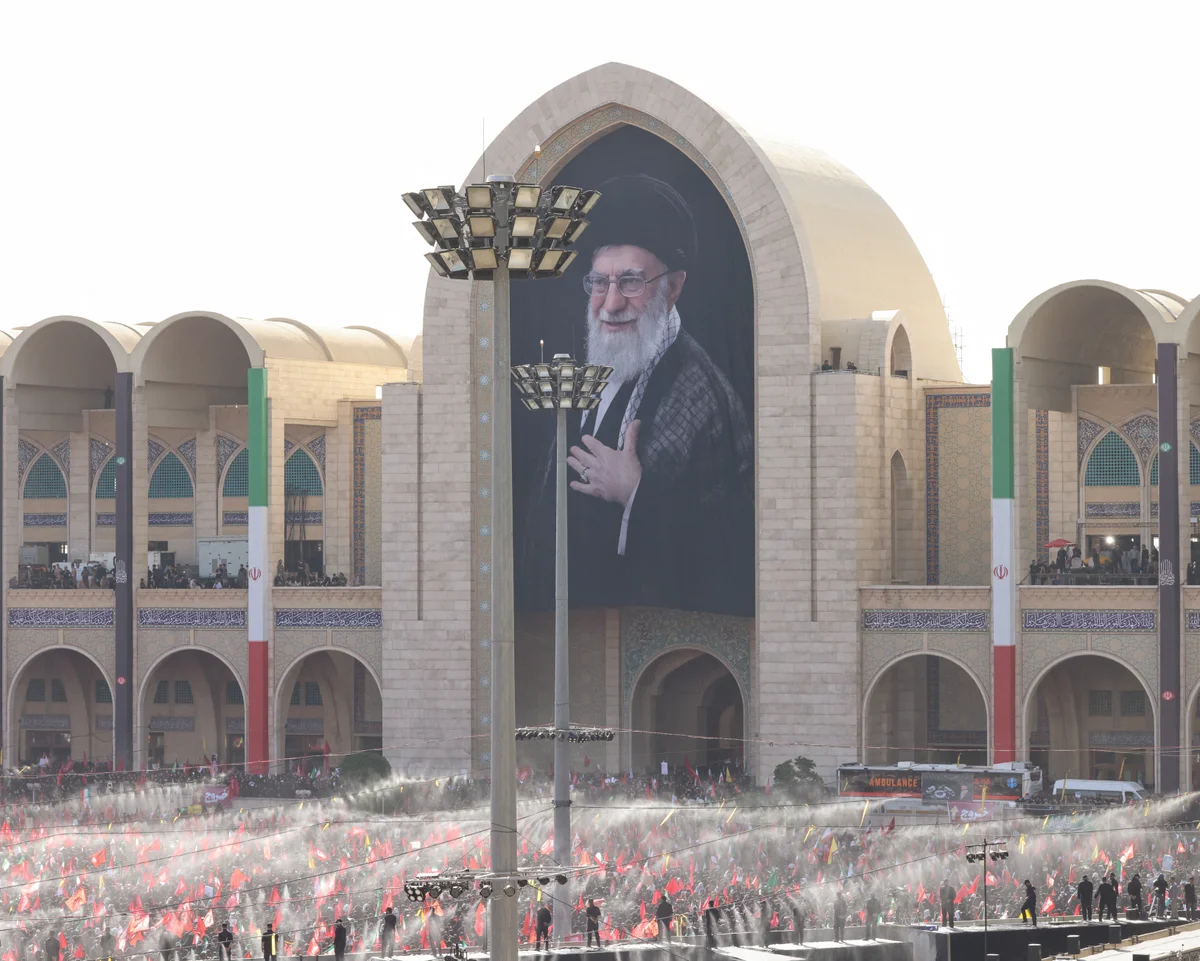


Tehran: Iran on Tuesday drew a symbolic comparison between its late Supreme Leader Ayatollah Ali Khamenei and Imam Hussain, as hundreds of thousands of mourners gathered across the country for his funeral and demanded justice following the February 28 strikes that Tehran blames on the United States and Israel.
Addressing a group of foreign journalists during the funeral ceremonies, Iranian Foreign Ministry spokesperson Esmail Baghaei said Ayatollah Khamenei’s assassination would be remembered as a defining moment in the history of Islam, Shi’ism and Iran.
“Ayatollah Khamenei will be regarded as the second Imam Hussain in 100 years from now,” Baghaei said.
He added that many Iranians had already begun drawing parallels between Khamenei’s killing and the martyrdom of Imam Hussain, describing the assassination as “a turning point in Islam, Shi’ism and Iran.”
Comparison With Imam Hussain
Imam Hussain, the grandson of Prophet Muhammad, was martyred in the Battle of Karbala in 680 CE. His sacrifice is regarded as one of the defining events in Islamic history, particularly among Shia Muslims, where he is revered as a symbol of resistance against oppression and injustice.
Iranian leaders and mourners have repeatedly invoked the Battle of Karbala during the funeral ceremonies, portraying Khamenei’s death within the broader narrative of sacrifice and resistance.
‘Demand for Revenge Is a Demand for Justice’
Responding to a question from NDTV, Baghaei defended calls for revenge against the United States and Israel, saying they reflected a demand for justice.
“What’s wrong in demanding justice?” he asked as chants against the US and Israel grew louder during the funeral proceedings.
Iran has accused Washington and Tel Aviv of carrying out the February 28 strikes that killed Khamenei, several senior Iranian officials and members of his family. The United States and Israel have not accepted responsibility in the context presented by Iranian officials.
Massive Funeral Across Iran
Funeral ceremonies for Ayatollah Khamenei have drawn enormous crowds across Iran, with mourners gathering in cities to pay their final respects amid an atmosphere of grief and anger.
According to Iranian authorities, the February 28 strikes killed Khamenei along with four members of his family, including his 14-month-old granddaughter, Zahra.
Images of the child’s small coffin have become one of the defining symbols of the funeral processions, with many mourners carrying red flags traditionally associated with martyrdom and the pursuit of justice.
Many participants were also seen holding banners bearing the slogan “Ya Latharat al-Khamenei” (“Oh Avengers of Khamenei”), a phrase that echoes slogans commonly heard during Muharram processions commemorating Imam Hussain’s martyrdom.
Karbala Narrative Shapes Iran’s Response
Throughout the funeral ceremonies, Iranian officials and mourners have framed the recent conflict as a moral struggle between justice and oppression by drawing repeated parallels with the Battle of Karbala.
By invoking Imam Hussain’s sacrifice, Iran has sought to present Khamenei’s death as part of a broader narrative of resistance, reinforcing calls for accountability and justice in the aftermath of the strikes.