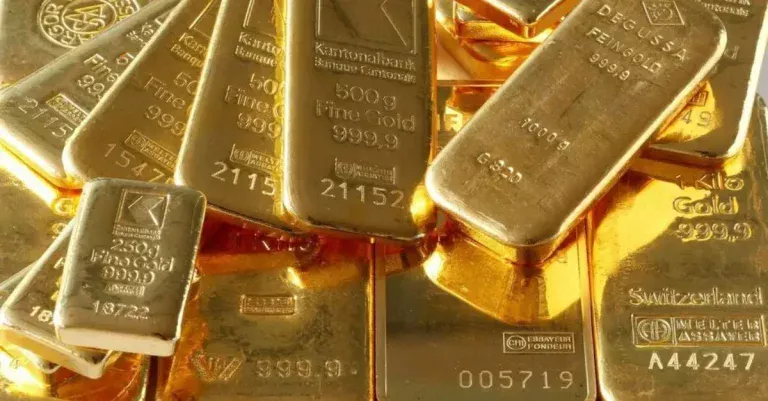
Days after Prime Minister Narendra Modi appealed to citizens to avoid buying gold for a year, the Centre has announced a major increase in import duty on gold and silver.
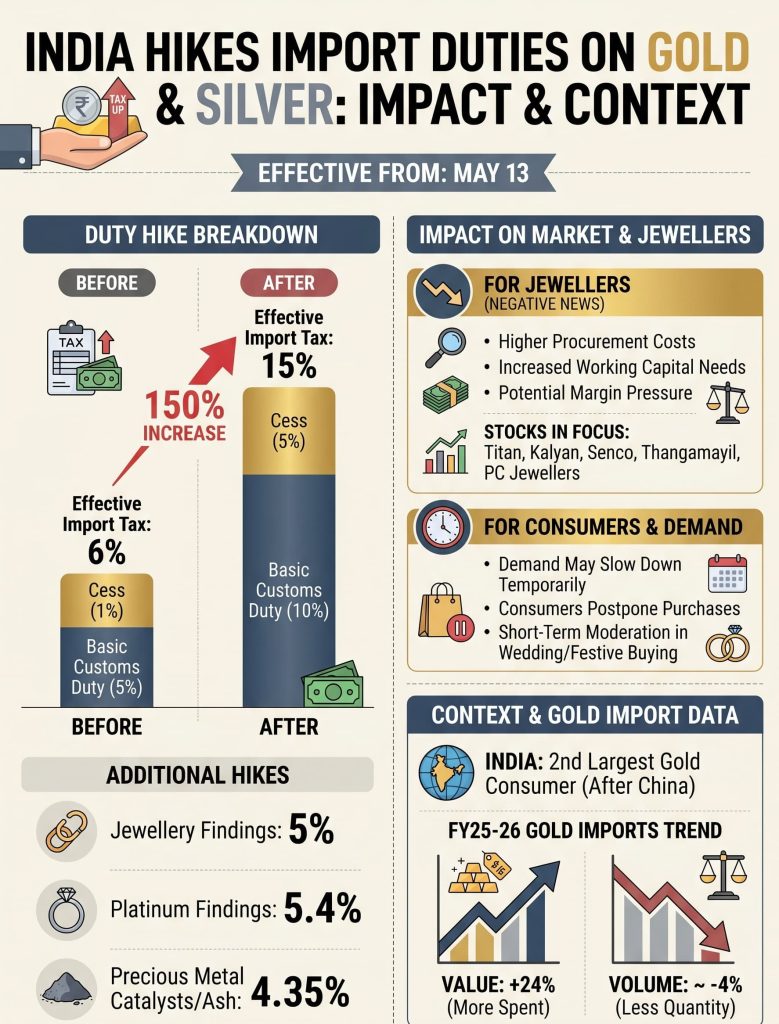
Under a new notification issued by the Ministry of Finance, the effective import duty on gold and silver has been raised from 6 per cent to 15 per cent with immediate effect from May 13.
The move is being seen as a strong macroeconomic measure aimed at reducing gold imports, saving foreign exchange reserves and controlling the widening current account deficit amid global economic uncertainty and rising crude oil prices linked to the Iran conflict.
What Has Changed In Gold Import Duty?
According to Customs Notification No. 16/2026, the revised structure includes a sharp increase in both Basic Customs Duty (BCD) and Agriculture Infrastructure and Development Cess (AIDC).
| Component | Earlier | Now |
|---|---|---|
| Basic Customs Duty | 5% | 10% |
| AIDC | 1% | 5% |
| Effective Import Duty | 6% | 15% |
The government has also revised duties on jewellery findings and industrial precious metal inputs. At the same time, concessional duty rates of 4.35–5 per cent have been introduced for recycling and recovery categories such as spent catalysts and precious-metal-containing ash, signalling a push toward domestic recycling instead of fresh imports.
Why Did The Government Increase Gold Duty?
India imports almost all of the gold consumed domestically, and these imports are paid for in US dollars.
In the financial year 2025-26, India’s gold imports reportedly touched a record $71.98 billion, accounting for nearly 9–10 per cent of the country’s total import bill.
With foreign exchange reserves facing pressure due to elevated crude oil prices and geopolitical tensions in the Middle East, policymakers are attempting to reduce non-essential imports.
The concern has intensified after the International Monetary Fund warned that India’s current account deficit could widen further if the ongoing Iran conflict drags on.
Officials believe that even a 30–40 per cent reduction in gold imports could potentially save the country $20–25 billion annually in foreign exchange outflow.
Gold Prices Rise Sharply After Duty Hike
The duty increase has already made gold and silver significantly more expensive in the domestic market.
On the Multi Commodity Exchange (MCX), gold and silver prices jumped over 6 per cent after the announcement.
At the time of reporting:
- Gold was trading around Rs 1,63,000 on MCX
- Silver was trading near Rs 2,96,600
Retail gold prices in India were hovering around Rs 15,475 per gram for 24K gold, while silver prices ranged between Rs 2.78 lakh and Rs 2.90 lakh per kilogram.
Impact Of Duty Hike On Gold Prices
| Scenario | Duty Rate | Duty Amount On Rs 1,54,750 | Landed Value After Duty |
|---|---|---|---|
| Earlier Structure | 6% | Rs 9,285 | Rs 1,64,035 |
| New Structure | 15% | Rs 23,212 | Rs 1,77,962 |
The calculation does not include additional costs such as 3 per cent GST, making charges and jeweller margins, which means consumers could end up paying substantially more.
How The Government Hopes To Reduce Gold Buying
The government’s strategy appears to target both investment-driven and ceremonial gold purchases.
Traditionally, gold buying in India increases during weddings, festivals and periods of economic uncertainty. However, rising prices are expected to discourage fresh buying and push consumers toward alternative investment products.
Experts believe the following trends could emerge:
- Higher preference for Gold ETFs and digital gold
- Delay in jewellery purchases
- Increased exchange of old jewellery for new ornaments
- Greater participation in gold monetisation schemes
The recent growth in gold ETFs, as highlighted by the World Gold Council, already indicated that investors were gradually shifting toward paper gold instead of physical purchases.
Why The Move Matters For The Indian Economy
Economists say the duty hike is aimed at protecting India’s external finances during a period of global uncertainty.
The measure could help:
- Save foreign exchange reserves for essential imports like crude oil
- Reduce pressure on the rupee
- Narrow the current account deficit
- Discourage speculative hoarding of gold
- Boost domestic recycling and recovery industries
India currently imports nearly 88 per cent of its crude oil requirements, making forex conservation a key policy priority.
Bullion Traders Warn Of Smuggling Risk
While the government hopes the move will reduce imports, industry leaders have warned that a sharp increase in duties could revive gold smuggling networks.
Higher import duties often create profitable arbitrage opportunities through illegal channels operating via neighbouring countries.
Bullion dealers fear:
- Growth in grey market trading
- Rise in cash transactions
- Increased smuggling activities
- Challenges for enforcement agencies such as the Directorate of Revenue Intelligence (DRI)
All India Gems and Jewellery Council chairman Rajesh Rokde warned that the industry fears a return of parallel markets after duties were sharply increased.
Mixed Reaction From Jewellery Industry
The decision has directly impacted jewellers and bullion traders, many of whom are now preparing for weaker demand and rising inventory costs.
Industry concerns include:
- Reduced customer footfall
- Higher working capital requirements
- Increased taxation on jewellery components
At the same time, some organised players have backed the government’s broader economic objectives.
Malabar Gold & Diamonds has reportedly submitted recommendations to the government to strengthen the Gold Monetisation Scheme and improve domestic gold recycling participation.
Government’s Message Is Clear
Analysts describe the move as a combination of moral persuasion and fiscal intervention.
First came Prime Minister Modi’s public appeal asking citizens to reduce gold purchases. That has now been followed by a steep increase in import duty.
The broader message from the government appears clear: excessive gold imports are putting pressure on India’s dollar reserves at a time when the economy is navigating global uncertainty, rising oil prices and geopolitical risks.