
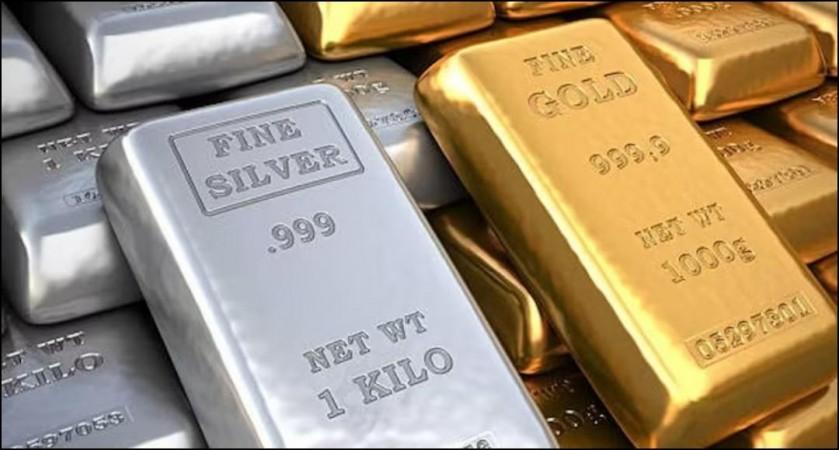


The central government has increased the base import prices of gold and silver, reversing a sharp reduction announced just days earlier, according to a notification issued by the Central Board of Indirect Taxes and Customs (CBIC) on Monday.
The move comes amid concerns over pressure on India’s foreign exchange reserves and follows a series of measures aimed at reducing imports of precious metals.
Gold And Silver Import Prices Increased
As per the latest notification, the base import price of gold has been raised by $5 per 10 grams, taking it to $1,348 per 10 grams from $1,343.
Silver witnessed a much steeper increase. The base import price of the metal was raised by $83 per kilogram, or nearly 4%, to $2,175 per kg from $2,092 per kg.
The revision comes only three days after the government had significantly reduced import prices. At that time, the base import price of gold had been lowered by $80 per 10 grams, while silver prices were cut by $276 per kg.
Move Linked To Forex Reserve Pressures
The latest increase is being viewed as part of the government’s broader strategy to manage India’s external sector and reduce pressure on foreign exchange reserves, which have faced challenges amid ongoing geopolitical tensions in West Asia.
The decision marks the second tightening of import-related measures on precious metals within two months.
Last month, the government increased import duties on gold and silver to 15%, seeking to discourage non-essential imports and contain the country’s import bill.
RBI Data Shows Mixed Trend In Forex Reserves
Recent data from the Reserve Bank of India (RBI) showed that the value of India’s gold reserves increased substantially during the latest reporting week.
Gold reserves rose by $1.98 billion to reach $114.58 billion as of June 5.
However, overall foreign exchange reserves declined by $711 million to $681.61 billion during the same period.
The fall was largely driven by a decline in foreign currency assets (FCA), which form the largest component of India’s forex reserves. FCA dropped by $2.70 billion to $543.44 billion.
The contrasting trend highlights how gains in gold holdings were offset by weakness in foreign currency assets.
Government Tightens Silver Import Rules
The increase in import prices follows additional restrictions introduced on silver imports in recent weeks.
The Directorate General of Foreign Trade (DGFT) recently amended the import policy for specified silver bars, changing their status from “free” to “restricted” with immediate effect.
Under the revised framework, importers are now required to obtain government approval before bringing specified silver products into the country.
Licence Requirement Introduced For Silver Imports
Earlier this month, the Centre further tightened regulations by mandating that silver imports routed through banks, RBI-nominated agencies, or authorised entities require approval from the DGFT.
The licensing requirement also applies to imports conducted through DGFT-authorised entities using the India International Bullion Exchange (IIBX).
The latest policy changes indicate the government’s intent to maintain tighter oversight over precious metal imports while attempting to reduce pressure on India’s external accounts and foreign exchange reserves.
Why The Move Matters
- Gold import price raised to $1,348 per 10 grams.
- Silver import price increased to $2,175 per kg.
- Comes days after a sharp reduction in import prices.
- Follows a recent increase in import duty on gold and silver to 15%.
- Silver imports now require regulatory approval under stricter import norms.
- Aimed at reducing non-essential imports and supporting forex reserves amid global uncertainties.