
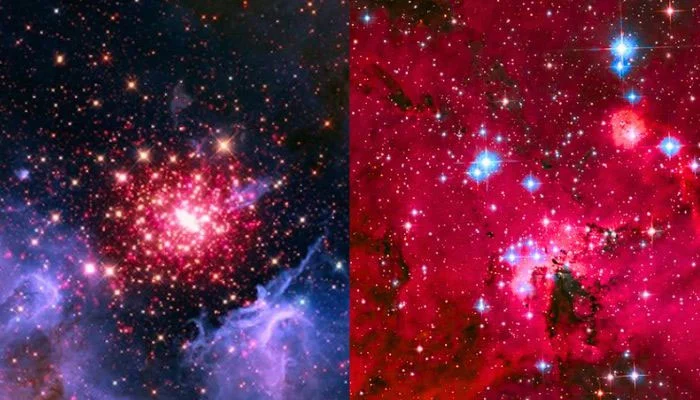


NASA’s Hubble Space Telescope has captured a breathtaking new image of LH 95, a vibrant stellar nursery where thousands of young stars shine brightly against glowing clouds of red hydrogen gas.
The spectacular image, released by NASA, resembles fireworks lighting up a smoky night sky, with brilliant blue and white stars scattered across crimson clouds of gas. The observation provides astronomers with valuable insights into how stars form and evolve over millions of years.
A Stellar Nursery in a Neighbouring Galaxy
LH 95 is located in the Large Magellanic Cloud, a dwarf galaxy that orbits the Milky Way. The region is classified as a stellar association, where thousands of stars of different sizes and ages are born together from massive clouds of gas and dust.
The stellar nursery contains both low-mass infant stars and enormous blue giant stars, making it an ideal laboratory for scientists studying the early stages of stellar evolution.
Massive Stars Shape Their Surroundings
Among the brightest objects in the image are several massive blue stars, each at least three times the mass of the Sun. These giant stars emit powerful ultraviolet radiation and stellar winds that sculpt the surrounding clouds of hydrogen gas.
The intense radiation heats the gas, causing it to glow, while dense filaments of dust remain visible as dark streaks because they resist erosion from the energetic stellar winds.
Why the Nebula Appears Red
The vibrant colours seen in the Hubble image are created using standard scientific image-processing techniques.
Blue represents shorter wavelengths of visible light, while red combines longer visible wavelengths with some near-infrared light. The striking crimson glow comes primarily from hydrogen-alpha emissions, a specific wavelength of light emitted by excited hydrogen atoms.
Hydrogen-alpha observations are particularly important because they help astronomers identify regions where new stars are actively forming.
Thousands of Young Stars Still Growing
Researchers studying LH 95 discovered that many of its young stars are still gathering material from surrounding disks of gas and dust.
The region contains around 2,500 pre-main-sequence stars—young stars that have accumulated most of their mass but have not yet begun nuclear fusion in their cores. These stars continue to contract under gravity and will eventually ignite hydrogen fusion to become fully developed stars.
Scientists found that the accretion rate—the speed at which these stars accumulate material—gradually decreases as they age. However, the process can continue for several million years, longer than previously believed.
The findings provide new insights into how stars continue growing and how the disks surrounding them evolve before eventually giving rise to planetary systems.
Multiple Generations of Stars
One of the most intriguing discoveries is that LH 95 contains several generations of stars rather than stars formed during a single event.
This suggests that star formation in the region has occurred repeatedly over an extended period instead of happening all at once.
The most massive star in LH 95, located slightly above and to the left of the image’s centre, is estimated to be 60 to 70 times more massive than the Sun. Interestingly, astronomers believe it is about one million years younger than most of the surrounding stars, which are estimated to be around four million years old.
Because of their enormous mass, stars like these burn through their fuel rapidly and eventually end their lives in spectacular supernova explosions.
Why LH 95 Matters to Astronomers
LH 95 is considered one of the most valuable nearby star-forming regions for astronomical research. Located relatively close to the Milky Way and containing less dust than many similar stellar nurseries within our own galaxy, it provides Hubble with an exceptionally clear view of star formation.
By studying regions like LH 95, astronomers can better understand how stars are born, how they evolve over time, and how the environments around young stars may eventually lead to the formation of planets.