
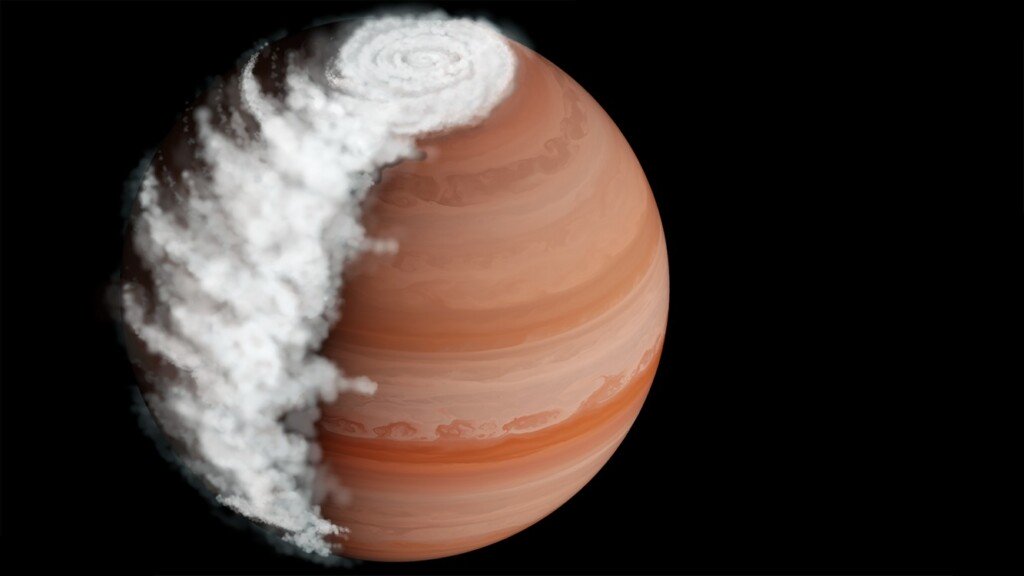


Astronomers using the powerful James Webb Space Telescope have uncovered remarkable weather patterns on WASP-94A b, a distant gas giant located about 700 light-years from Earth.
The planet orbits its host star at an extremely close distance, creating temperatures so intense that clouds made from rock-forming minerals melt and disappear every morning.
The discovery offers one of the clearest views yet of an exoplanet’s atmosphere and could help scientists better understand how giant planets form and evolve throughout the galaxy.
A Hot Jupiter With Extreme Conditions
WASP-94A b belongs to a class of planets known as “Hot Jupiters.” These are massive gas giants that orbit very close to their stars, exposing them to extreme temperatures.
Located in the constellation Microscopium, the planet circles its star much closer than Mercury orbits the Sun.
As a result, conditions on the planet are far more extreme than anything found in our solar system.
Researchers from Johns Hopkins University used Webb’s advanced instruments to study the planet during several transits, when it passed in front of its host star.
Rock Clouds Form at Night and Disappear During the Day
The team, led by David Sing, discovered dramatic differences between the planet’s morning and evening atmospheres.
Observations revealed that the morning side of WASP-94A b is covered with clouds made of magnesium silicate, a mineral commonly found in rocks on Earth.
However, these clouds do not survive long.
As the clouds drift toward the intensely hot daytime side of the planet, temperatures exceeding 1,000 degrees Celsius cause them to evaporate completely.
Consequently, the evening side of the planet becomes largely cloud-free.
Researchers compared the process to morning fog disappearing under sunlight on Earth, although the phenomenon occurs on a much more extreme scale.
Webb Provides a Clearer View Than Ever Before
For years, atmospheric clouds have made it difficult for scientists to study exoplanets accurately.
According to David Sing, cloud cover has often acted like a foggy window, preventing researchers from obtaining clear measurements of planetary atmospheres.
By separating observations of the planet’s cloudy and cloud-free regions, the team was finally able to analyze its atmosphere with unprecedented precision.
Furthermore, the cloud-free evening side allowed scientists to observe chemical signatures that had previously been hidden.
Planet Looks More Like Jupiter Than Expected
One of the most surprising findings involved the planet’s chemical composition.
Earlier observations suggested that WASP-94A b contained hundreds of times more oxygen and carbon than Jupiter.
That conclusion puzzled astronomers because existing planet-formation theories could not easily explain such high concentrations.
However, once the researchers removed the influence of the clouds from their analysis, a different picture emerged.
The new data showed that WASP-94A b has a composition much closer to Jupiter than previously believed.
As a result, the findings align more closely with current theories of planetary formation.
Similar Weather Patterns Found on Other Exoplanets
The research team expanded its investigation by examining eight additional Hot Jupiter planets.
Interestingly, they discovered the same cloud cycle on two other worlds:
- WASP-39 b
- WASP-17 b
This suggests that rock-cloud formation and evaporation may be relatively common among giant planets exposed to extreme temperatures.
Therefore, the phenomenon may represent a widespread atmospheric process rather than an isolated curiosity.
Exoplanet Research Continues to Expand
Since the discovery of the first confirmed exoplanet in the early 1990s, scientists have identified thousands of worlds beyond our solar system.
These discoveries have revealed astonishing diversity across the galaxy.
Astronomers have found planets orbiting two stars, worlds with permanent day and night sides, planets with extremely low densities and even exotic environments where diamonds may form in the atmosphere.
Consequently, each new observation helps researchers better understand the enormous variety of planetary systems that exist throughout the universe.
What Comes Next?
The findings from WASP-94A b have helped establish two important ideas.
First, Jupiter-like chemical compositions may be more common among Hot Jupiters than previously thought.
Second, the newly observed cloud cycling process could be a widespread feature on giant exoplanets.
Moving forward, David Sing and his team plan to compare these hot gas giants with planets that orbit within the habitable zones of their stars.
Such studies could reveal how atmospheric processes differ across a wide range of planetary environments.
With the James Webb Space Telescope continuing to deliver groundbreaking data, astronomers are gaining an increasingly detailed understanding of worlds far beyond our solar system.