
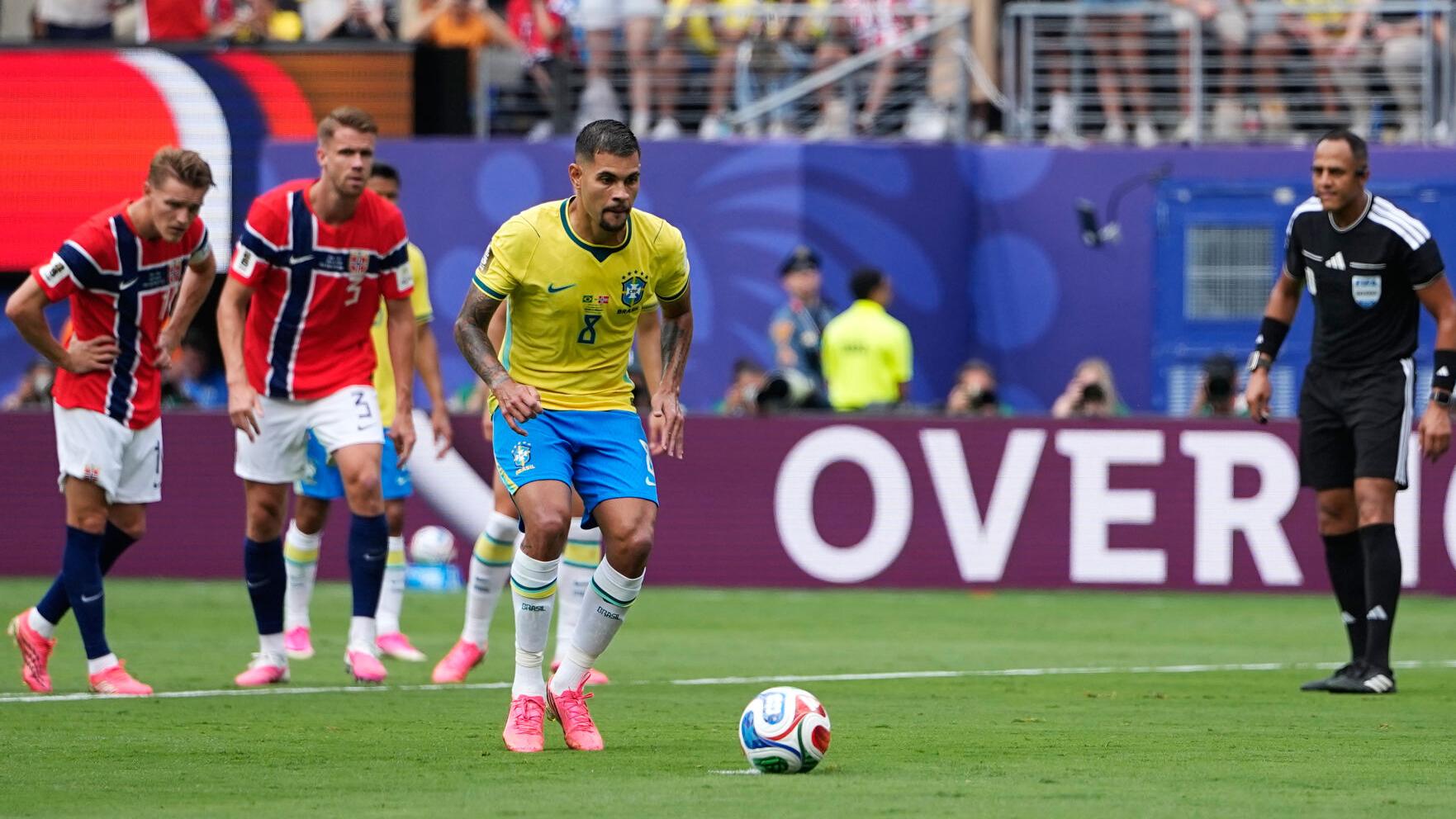


The stutter-step penalty has emerged as one of the defining talking points of the FIFA World Cup 2026, with some of football’s biggest names embracing the high-risk, high-reward technique. While stars such as Lionel Messi, Kylian Mbappé, Cristiano Ronaldo, Harry Kane, and Neymar have all relied on the method, its effectiveness has varied dramatically throughout the tournament.
The approach has helped France book a place in the quarterfinals and produced memorable moments for Portugal, but it has also been associated with costly misses, including Brazil’s exit from the competition. Messi, meanwhile, endured mixed fortunes from the penalty spot, first missing the target during the group stage before seeing another effort saved in the Round of 16.
What Is a Stutter-Step Penalty?
Known in Brazil as the “paradinha,” meaning “little stop,” the stutter-step penalty involves a player slowing down, pausing or feinting multiple times during the run-up while closely watching the goalkeeper’s movement before striking the ball.
The objective is simple: force the goalkeeper to commit early, leaving an open side of the goal for an easy finish.
The technique is believed to have originated in Brazil during the late 1950s and early 1960s. It was popularised by football legend Pelé and later perfected by Neymar, who became one of its most recognisable practitioners.
Neymar’s Famous ‘Paradinha’ Changed the Rules
One of the most iconic examples came in 2010, when an 18-year-old Neymar, then playing for Santos, almost stopped completely beside the ball before calmly placing his penalty into the net after the goalkeeper had already dived.
The move sparked widespread debate and prompted football’s lawmakers to amend the rules ahead of the 2010 FIFA World Cup in South Africa.
Under the revised laws, players are allowed to feint during the run-up but are not permitted to stop or feint after completing the run-up immediately before striking the ball. Violations can result in a yellow card and the goal being disallowed.
Why Elite Players Continue to Use It
Despite the risks, the technique remains popular because it can significantly increase a penalty taker’s chances when executed correctly.
According to Geir Jordet, professor at the Norwegian School of Sport Sciences and author of Pressure: Lessons from the Psychology of the Penalty Shootout, the stutter-step is a sophisticated strategy that removes much of the goalkeeper’s advantage.
“It is very sophisticated and hard to perform when the pressure is truly on,” explains Geir Jordet, professor at the Norwegian School of Sport Sciences and author of the book “Pressure: Lessons from the Psychology of the Penalty Shootout.” “If you’re competent at executing this technique, this will effectively delete the risk factor of the goalkeeper going in the right direction and your odds suddenly going down.”
He added:
“You need to have a very high clarity in your head to be able to do that.”
Mixed Results at FIFA World Cup 2026
The tournament has showcased both the brilliance and the dangers of the stutter-step penalty.
Lionel Messi attempted the technique during Argentina’s group-stage match against Austria but dragged his effort wide. In the Round of 16 clash against Egypt, he abandoned the stutter-step for a conventional run-up, only to see goalkeeper Mostafa Shobeir save his penalty.
England captain Harry Kane also experienced mixed fortunes. His initial penalty against Croatia, taken with a stutter-step, was saved before being ordered to retake it because the goalkeeper had moved off his line early. Kane converted the second attempt using a straightforward run-up.
Meanwhile:
- Kylian Mbappé successfully used the technique to score France’s winner against Paraguay.
- Cristiano Ronaldo converted a stutter-step penalty during Portugal’s victory over Croatia.
- Neymar signed off his international career by calmly converting a stutter-step penalty against Norway before announcing his retirement from international football.
Goalkeepers Are Catching Up
While the technique remains effective, goalkeepers are increasingly adapting.
According to Jordet, modern goalkeepers are becoming more patient, delaying their movement and adopting more unpredictable methods to unsettle penalty takers.
Those adjustments have contributed to several high-profile failures during the World Cup.
Brazil midfielder Bruno Guimarães saw his penalty saved before Norway completed a famous victory over Brazil in the Round of 16. Netherlands forward Justin Kluivert, brought on specifically for the penalty shootout against Morocco, struck the post despite being regarded as a penalty specialist.
A High-Risk, High-Reward Strategy
The stutter-step penalty continues to divide opinion among football fans and experts. Traditionalists still prefer a direct, powerful strike, while many elite players see the “paradinha” as a psychological weapon capable of outsmarting even the world’s best goalkeepers.
At the FIFA World Cup 2026, the technique has once again demonstrated its unpredictable nature—producing match-winning moments for some of football’s biggest stars while proving costly for others under the sport’s greatest pressure.