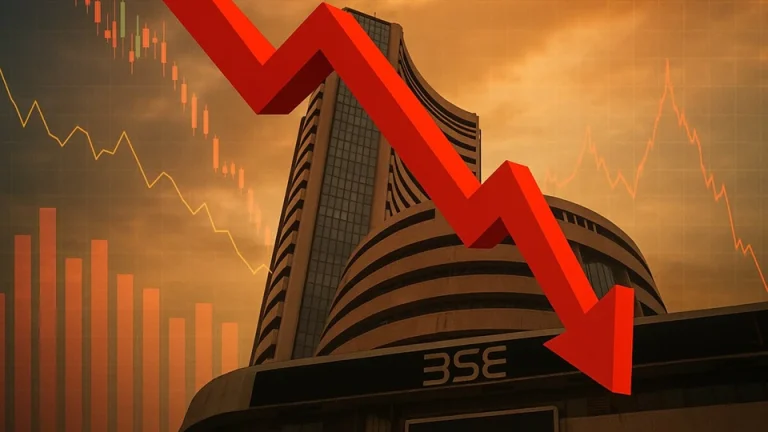
The domestic equity share market opened under immense pressure on Wednesday morning, as a cocktail of unfavorable global cues triggered a sharp, broad-based sell-off across Indian bourses.
The benchmark BSE Sensex plunged 595.82 points to hover near the 74,600 baseline at 74,605.24 within the opening hour of trades, while the tech-and-heavyweight tracking NSE Nifty shed 183 points or 0.84%, sliding rapidly to trade at around 23,420. The decline wasn’t isolated to frontline stocks either; a risk-off sentiment thoroughly gripped the broader market, dragging the Nifty Smallcap 100 down by over 1% and the Nifty Midcap 150 lower by 0.9%. Market volatility indicators surged simultaneously, reflecting a cautious and jittery mindset among institutional and retail investors alike.
A primary catalyst for the morning’s downward spiral is the ongoing macroeconomic friction caused by global energy and bond metrics. International crude prices have refused to relent, with global benchmark Brent crude remaining stubbornly elevated around $110 a barrel and US West Texas Intermediate futures holding firmly at $103.88. Simultaneously, the Indian Rupee hit a fresh historic low in early trade, depreciating by 33 paise to touch an unprecedented 96.89 against the US Dollar. This currency depreciation has compounded foreign institutional investor (FII) outflows, further undercutting domestic market liquidity.
Macroeconomic Friction: The Global Ticking Clocks
The international financial architecture is bracing for key operational shifts this week, driving severe anxiety across emerging markets:
Key Market-Moving Factors on May 20, 2026:
• 1. The Strait of Hormuz Standoff: Global trade remains highly restricted due to
prolonged regional conflict, keeping global shipping and oil transit vulnerable.
• 2. US 30-Year Bond Yield Spike: Yields shot up by 7 basis points to reach 5.20%—
marking their absolute highest level since 2007 on persistent inflation fears.
• 3. The Fed Leadership Transition: Incoming Federal Reserve Chair Kevin Warsh—historically
viewed as an inflation hawk—is set to officially take control of the central bank
this Friday, fueling speculation of extended high interest rates.
Geopolitical Brinkmanship and the Diplomatic Option B
The extreme caution on Dalal Street heavily mirrors the volatile status of international diplomacy. On Tuesday, US Vice President JD Vance addressed reporters at a White House press briefing, expressing measured optimism that ongoing Pakistan-mediated peace negotiations with Tehran were making structural headway.
However, Vance explicitly paired his diplomatic hope with a stern warning, stating that the administration remains “locked and loaded” to immediately reactivate intensive military campaigns if a comprehensive settlement is not reached. “We think the Iranians want to make a deal… but there’s an option B, and the option B is that we can restart the military campaign,” Vance stated, leaving international oil desks and equity traders deeply unsettled over the long-term status of global energy supply chains.
| Benchmark Index / Asset | Current Trading Level (May 20) | Net Intraday Change | Immediate Support / Target Thresholds |
| BSE Sensex | 74,605.24 | Down 595.82 Points (-0.79%) | Critical psychological support at 74,200 |
| NSE Nifty 50 | 23,420.00 | Down 183.00 Points (-0.84%) | Tactical defensive pivot at 23,300 |
| Indian Rupee (INR) | 96.89 vs USD | Depreciation of 33 Paise | Psychological resistance monitored at 97.20 |
| Brent Crude Oil | $110.00 / Barrel | Steady at Elevated Highs | Upside resistance capped at $115 level |
Technical analysts suggest that the local sell-off highlights underlying exhaustion within short-term moving averages. Anand James, Chief Market Strategist at Geojit Investments, noted that a sharp late-hour reversal from the 10-day Simple Moving Average (SMA) in previous sessions signaled that bulls are running out of steam.
“This implies that we remain locked within a sideways range, meaning the corrective dips could stretch as far down as the 23,300 zone for the Nifty. For a positive bias to re-emerge today, we would need to see consistent, sustained trading volumes holding above the 23,600 mark,” James explained. Until concrete resolutions emerge from the Middle Eastern diplomatic channels and Kevin Warsh delivers his inaugural policy address, Indian equity indices are highly likely to face sustained consolidation and erratic intraday swings.