The recent rebellion led by Raghav Chadha has shaken the Aam Aadmi Party and handed a major boost to the Bharatiya Janata Party. But beyond the immediate political impact, the episode has once again revived a long-standing debate in India—the issue of elected representatives switching parties, a practice that once plunged the country into a prolonged phase of instability.
This trend of frequent defections became so widespread in the late 1960s that it forced lawmakers to introduce the Anti-Defection Law, now a key safeguard in India’s parliamentary system.
The ‘Era of Instability’ That Changed Indian Politics
Between 1967 and 1971, Indian politics witnessed a period now known as the “Era of Instability.” During these four years:
- 45 state governments were formed and collapsed
- More than 1,800 legislators switched parties
- Around 115 defecting lawmakers were rewarded with ministerial posts
- President’s Rule was imposed 16 times under Article 356 of the Constitution of India
This turbulent phase marked the decline of the dominance of the Indian National Congress following Independence and signalled the rise of coalition governments.
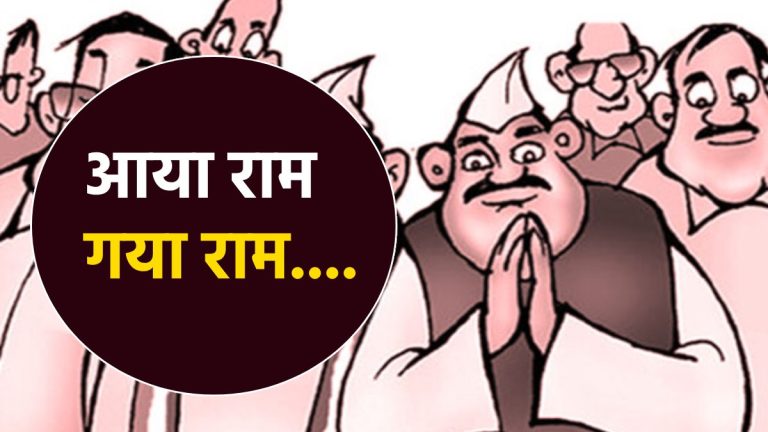
It was also during this time that the famous political phrase “Aaya Ram, Gaya Ram” entered public discourse—symbolising leaders who frequently switched loyalties.
1967 Elections: A Turning Point in Indian Democracy
The 1967 general elections, the last time simultaneous polls were held for both the Lok Sabha and state assemblies, proved to be a watershed moment.
For the first time, the Congress failed to secure majorities in several major states, including:
- Uttar Pradesh
- Bihar
- West Bengal
- Odisha
- Tamil Nadu
- Kerala
- Rajasthan
- Punjab
While the Dravida Munnetra Kazhagam secured power in Madras (now Tamil Nadu), coalition governments known as Samyukta Vidhayak Dal (SVD) were formed in several other states.
However, these coalitions often united parties with vastly different ideologies, creating unstable alliances that became vulnerable to defections.
Mass Defections Across Key States
Political defections rapidly spread across northern India, particularly in:
- Haryana
- Uttar Pradesh
- Madhya Pradesh
- Bihar
- Punjab
In Haryana, the crisis reached dramatic levels when MLA Rao Birender Singh split from Congress and formed the Vishal Haryana Party, eventually becoming Chief Minister.
Around the same time, another legislator, Gaya Lal, switched parties three times within two weeks, giving rise to the now-famous phrase “Aaya Ram, Gaya Ram.”
Similarly, in Uttar Pradesh, Chaudhary Charan Singh rebelled against Congress leadership and formed the Bharatiya Kranti Dal, leading to the collapse of the government.
Horse-Trading and Government Collapses
Political instability during this period was extensively documented in the book The Politics of Defection: A Study of State Politics in India by constitutional expert Subhash C Kashyap.
The book detailed how governments frequently collapsed due to “horse-trading”—a term used to describe negotiations involving promises of ministerial positions or political benefits in exchange for support.
In Bihar, instability reached extreme levels, with nine chief ministers serving between 1967 and 1971. Governments often lasted only weeks, highlighting the fragility of coalition politics during the era.
Ministerial Positions Became Incentives for Defection
One of the key reasons behind the political chaos was the lure of ministerial positions.
Data from the period revealed:
- One in every eight defecting legislators was rewarded with a ministerial role
- The attraction of power and status began to outweigh party loyalty
- Governors were sometimes accused of playing roles in destabilising opposition governments
The lack of a common ideology among coalition partners further worsened instability.
The Chavan Committee and the Road to Reform
Recognising the severity of the crisis, the government formed a committee in 1968 under then Home Minister Yashwantrao Balwantrao Chavan to study the issue of political defections.
The committee recommended several reforms, including:
- Limiting the size of the Council of Ministers
- Preventing defectors from holding ministerial posts for at least one year
- Discouraging political parties from fielding defectors as candidates
Later, the size of the Council of Ministers was capped at 15% of legislative strength through the 91st Constitutional Amendment (2003).
Birth of the Anti-Defection Law
Based on the committee’s findings, the Anti-Defection Law was introduced in 1985 during the tenure of Rajiv Gandhi.
The law was added to the Constitution as the Tenth Schedule of the Constitution of India through the 52nd Constitutional Amendment.
Further strengthening measures were introduced in 2003 during the government led by Atal Bihari Vajpayee.
Why the AAP Exodus Does Not Trigger Anti-Defection Law
Despite the large-scale shift led by Raghav Chadha, the Anti-Defection Law is unlikely to apply in this case.
This is because:
- Seven out of 10 Rajya Sabha MPs from AAP supported the move
- The two-thirds threshold, required for a legal merger under the Tenth Schedule, has been met
Under the law, legislators are allowed to merge with another party if at least two-thirds of members support the move, preventing automatic disqualification.
A Historical Reminder for Modern Politics
The current political developments echo lessons from India’s past, reminding observers how unchecked defections once destabilised governments and weakened public trust.
While the Anti-Defection Law was designed to curb such instability, modern political shifts continue to test its limits—making each major defection episode a moment of renewed debate about the future of democratic accountability in India.